
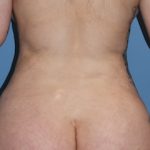
Rib removal surgery typically refers to partial resection of the floating ribs (11th and/or 12th ribs) and sometimes the 10th rib to reduce lower waist width or to improve contour. In aesthetic surgery patient selection it is highly selective.
Common Indications
Aesthetic
- Lower waist narrowing when skeletal width is dominant
- Adjunct to abdominoplasty, liposuction, or circumferential body contouring
- Patients with prominent floating ribs palpable or visible in thin individuals
Relevant Anatomy
- 11th and 12th ribs are floating ribs (no anterior costal attachment)
- 10th rib has an anterior costal attachment albeit not a rigid one.
- Close relationships:
- Intercostal nerve and vessels
- Pleura (especially 10th rib)
- Quadratus lumborum & diaphragm attachments
Surgical Technique
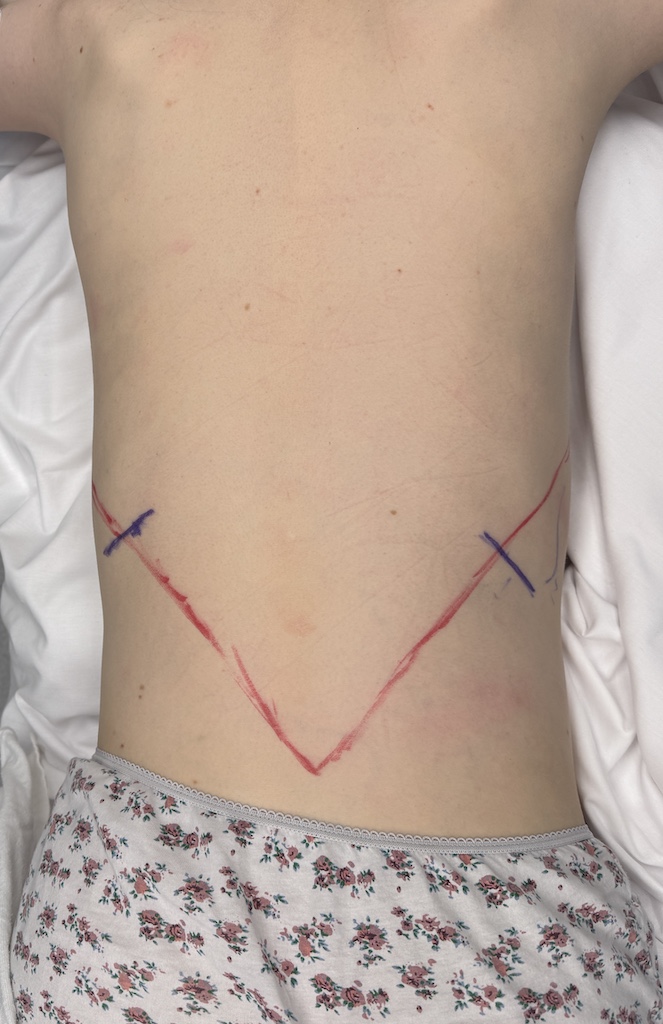
 Preoperative Markings
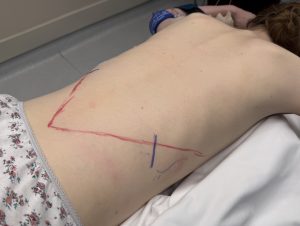 Preoperative Markings
- Incisional markings over rib 11 placed in posterior flank crease
- V-shaped back mark delineating symmetric medial extent of rib resection
2) Posterior / Flank Approach
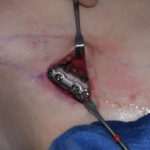
- Small incisional access
- Muscle-splitting approach (latissimus, obliques)
3) Extent of Resection
- Partial rib removal only (extent depends on rib level)
- 12 – 3 to 4cms
- 11 – 10 to 12 cms
- 10 – > 10cms
- Preservation of:
- Periosteum (when possible)
- Neurovascular bundle
- Lateral border Latissimus Dorsi muscle resection/plication
4) Closure
- Placement of drain
- Subcuticular skin closure

 Placement of drain
Key Operative Principles
- Precise identification of rib level (avoid wrong-level resection)
- Protection of:
- Pleura (pneumothorax risk)
- Subcostal nerve (chronic pain risk)
- Hemostasis (intercostal vessels)
- Tunnel delivery technique with circumferential lateral rib dissection
- Lateral extent of rib taken is their bone-cartilage junction where they are most easily separated in the depth of the tunnel
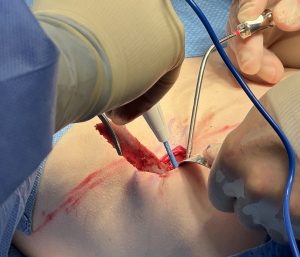 Tunnel delivery technique with circumferential lateral rib dissection
Postoperative Considerations
- Pain control, aided by intraoperative use of Exparel
- Monitoring for fluid collection after drain removal
- Compression garments
- Delayed onset of final result (2 to 3 months)
Risks & Complications
- Pneumothorax (never yet seen)
- Chronic intercostal neuralgia (never yet seen)
- Asymmetry
- Scarring
- Patient dissatisfaction if expectations are unrealistic
Patient Selection Pearls
- Best suited for thin patients with skeletal prominence
- Poor candidate if waist width is primarily soft-tissue–driven
- Requires preoperative counseling about expectations
Conclusions
In aesthetic practice, rib removal should be considered a last-tier waist-reshaping strategy. Liposculpture, muscle plication, and posture/core dynamics usually provide adequate benefit for many patients. For select patients who are not candidates for the traditional procedures or have exhausted those options, however, it can be their only surgical strategy for waist reshaping improvement that is best appreciated as a silhouette-modifying adjunct technique
Dr. Barry Eppley
World-Renowned Plastic Surgeon