
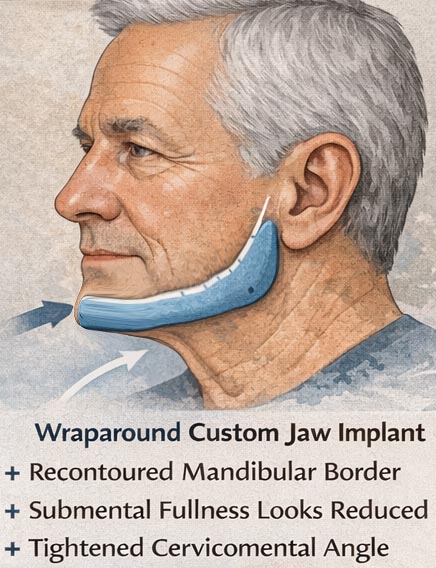
Custom jawline implants can play a meaningful role in improving the appearance of the aging neck in older men, but their effect is structural — not a replacement but as an enhancement for soft-tissue rejuvenation. The improvement comes from restoring bony projection and tension to the lower face–neck junction.
Here is how they have their structural influence:
1) Restoring Skeletal Support at the Cervicomental Angle
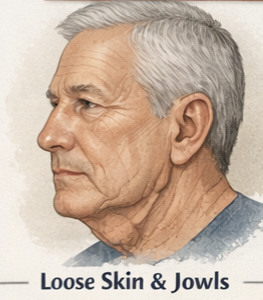 With aging, men often develop:
- Loss of jawline definition
- Blunting of the cervicomental angle (neck–chin angle)
- Jowling that spills over the mandibular border
A custom jawline implant — due to its wraparound design — increases:
- Chin projection
- Mandibular border width
- Jaw angle definition
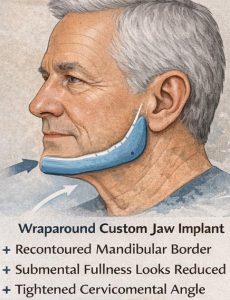 This stronger skeletal framework:
- Pushes the soft tissue envelope outward and upward
- Improves the visual separation between face and neck
- Sharpens the cervicomental angle
The neck is lifted by the pull of the jawline implant above it.
2) Creating a Stronger “Ceiling” for the Neck
Think of the jawline as the structural ceiling of the neck.
In older men:
- Soft tissue descends
- Platysma laxity increases
- Submental fullness becomes more noticeable
By enlarging and defining the mandibular border:
- The overhanging appearance of jowls is reduced
- Submental fullness looks proportionally smaller
- The neck appears less heavy from profile view
This is also a proportional improvement as well as a true lifting/tightening effect.
3) Improving Neck Profile Without Touching the Neck
In patients with:
- Mild to moderate neck laxity
- Adequate skin tone
- No severe platysmal banding
A custom implant can significantly enhance profile aesthetics without a neck lift.
Projection changes alter the visual balance between:
- Chin
- Neck
- Lower lip
A recessed chin exaggerates neck fullness. Advancing the chin reduces that imbalance.
4) Enhancing Masculinity in the Aging Lower Face
Older male necks often look aged because:
- The jawline narrows
- The chin becomes less projected relative to soft tissue bulk
A wider, stronger mandibular border:
- Counteracts soft tissue descent
- Restores masculine geometry
- Improves side and three-quarter views
Sharpening the neck-face transition by outward expansion has a masculinizing effect in men.
5) When It Works Best
Custom jawline implants improve the aging neck most when:
- The primary issue is skeletal deficiency
- There is moderate soft tissue laxity
- The patient wants structural enhancement
They are less effective alone when:
- There is significant skin redundancy
- Prominent platysmal banding exists
- There is heavy submental fat
In those cases, combination procedures are common:
- Jawline implant + submental liposuction
- Jawline implant + neck lift
- Jawline implant + lower facelift
6) Why Custom Design Matters in Older Men
Older men often have:
- Thicker soft tissue envelopes
- More variable asymmetry
- Heavier jowling
A custom implant allows:
- Increased vertical height along the mandibular border
- Strategic jaw angle widening
- Chin projection matched to neck contour
Standard implants usually do not address these nuances.
Summary
Custom jawline implants improve the aging neck in older men by:
- Restoring mandibular definition
- Enhancing chin projection
- Improving cervicomental angle appearance
- Providing structural support to sagging tissues
- Increasing masculine lower face geometry
They are a skeletal solution that visually upgrades the neck–jaw relationship.
Case Study
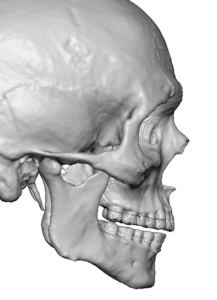
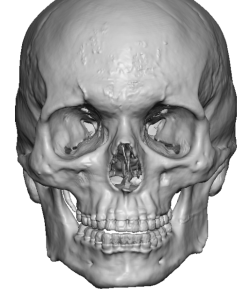 This middle-aged male had always had a smaller jaw and finally decided to have a jaw augmentation. His lower facial was small which meant his mandible was not only horizontally short but vertically short as well. His 3D CT scan showed the vertical jaw proportional deficiency.
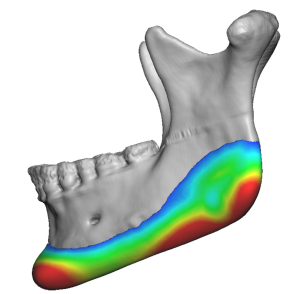
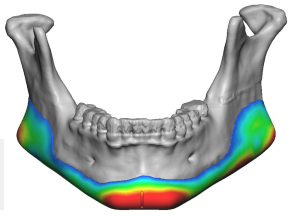 A custom jawline implant was designed that added up to 8mms of vertical length at the jaw angles, 6mms at the chin and 6mms horizontal chin projection. Total implant volume was 15ccs.
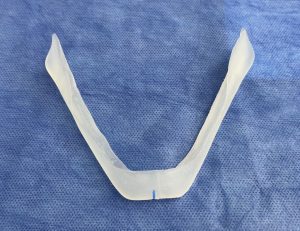
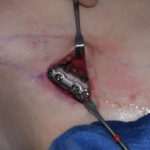
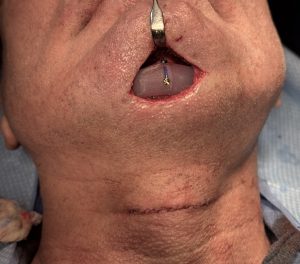 Under general anesthesia the implant was placed through a submental and bilateral intraoral vestibular incisions.
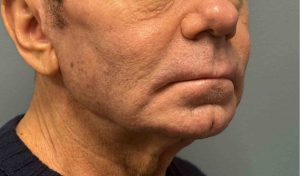
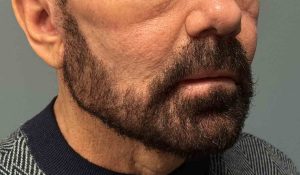
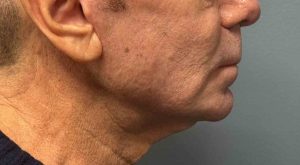
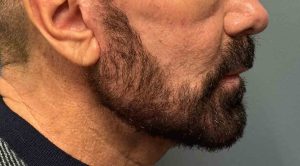
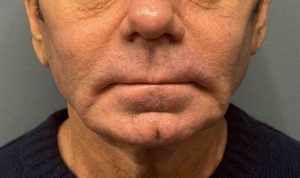
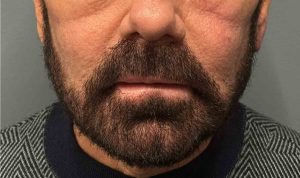 His four month results showed a good jaw augmentation effectwith an improved neck contour.
Discussion
Older male patients are not simply “aged younger men.”
They present with distinct structural and soft-tissue characteristics that directly influences implant design.
Older male jawline implant designs often differs from younger male design.In older men:
- The mandible itself typically does not shrink significantly unless there is major tooth loss.
- However, the jawline appears weaker because soft tissue bulk increases and descends.
Planning Implication:
Avoid undercorrecting implant projections. Skeletal support must be strong enough to overcome loose stretched soft tissues.
Increased Vertical Mandibular Border Height
Adding vertical height along the inferior mandibular border:
- Helps sharpen cervicomental angle
- Creates stronger jaw–neck separation
- Counters jowling visually
Stronger Chin Projection
Advancement of 6–10mm is often needed to:
- Rebalance submental fullness
- Improve neck projection relationship
- Strengthen profile dominance
Older men frequently require more projection than younger patients because of thicker soft tissues.
Controlled Jaw Angle Widening
Moderate widening:
- Restores masculine width lost with aging
- Provides posterior support to descending tissues
- Improves 3/4 view significantly
Avoid excessive lateral flare, which can look unnatural in mature faces.
Overcorrection vs Undercorrection
Younger patients:
- Risk of overprojection
Older male patients:
- Risk of underprojection (most common mistake)
Because:
- Thick soft tissues mask subtle augmentation
- Small changes are often visually insignificant
Custom design allows more precise volumetric correction than stock implants.
Combination Procedure Planning
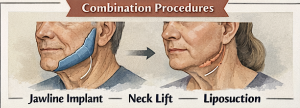 Common combinations in older men:
- Custom jawline implant + submental liposuction
- Custom jawline implant + anterior platysmaplasty
- Custom jawline implant + limited neck lift
- Custom jawline implant + lower facelift
Sequence matters:
- Structural implant first
- Then adjust soft tissue to new framework
Surgical Decision Tree:
|
Soft Tissue Status |
Implant Alone |
Combine Procedure |
|
Mild laxity |
Often sufficient |
Optional liposuction |
|
Moderate laxity |
Helps profile |
Consider submental lipo |
|
Severe laxity |
Insufficient alone |
Add neck lift/lower facelift |
Long-Term Aging Considerations
The implant:
- Remains stable
- Does not age
- Does not cause resorption of the jawbone
Soft tissues:
- While they will continue to age they age better due to the added structural support beneath them (age resistance)
- Will lessen the magnitude or need for secondary soft tissue procedures.
Summary
In older male anatomy, custom jawline implant planning requires:
- Stronger skeletal augmentation than younger men
- Strategic vertical height addition is some cases
- Controlled width enhancement
- Often combined with certain neck procedures or more aggressive soft tissue management done secondarily.
The key principle:
Improve the structure first and see how the soft tissues respond. Then secondarily refine the soft tissues if further improvement is needed.
Dr. Barry Eppley
Plastic Surgeon