
Brow bone reduction reversal means trying to restore projection to the brow after it has been surgically reduced.
Most patients seeking reversal want:
- More brow prominence
- A stronger / more masculine contour
- Restoration of pre-transition facial structure (common in detransition cases)
- Correction of over-reduction
Regardless of the type of brow bone reduction done, burring or bone flap setback, the conceptual approach is the same …bony augmentation.
Options to Restore Brow Projection
? Custom Brow Bone Implant (Most Predictable)
- Designed from CT scan
- Restores precise projection
- Most controlled aesthetic outcome
? Bone Cement (PMMA)
- Sculpted during surgery
- Good for small amounts of augmentation
- Less precise than custom implant
These material options are also influenced by:
- The type of previous bone bone reduction performed (burring vs bone flap setback)
- Location of brow bone restoration
- The extent of added brow bone projection needed.
Case Study
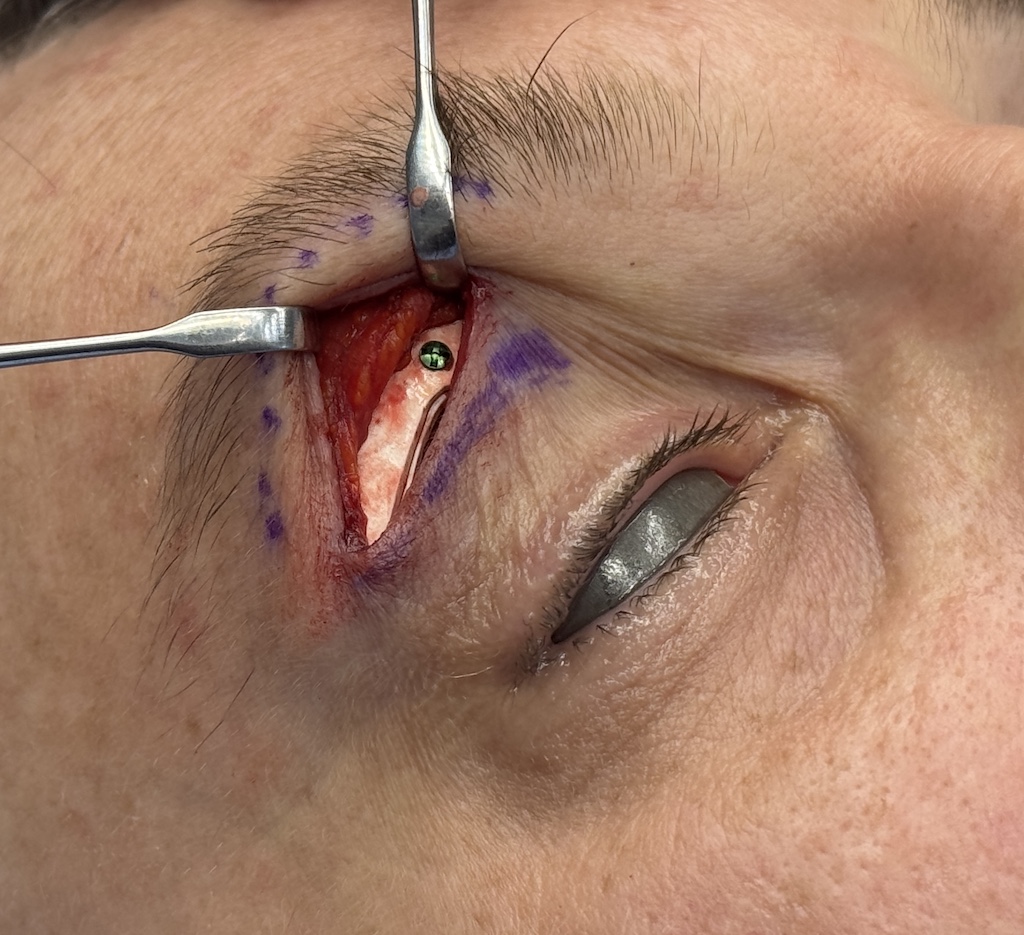
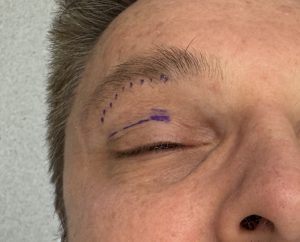
This middle-aged male had a burring brow bone reduction decades previously with a resultant brow asymmetry. He felt he lacked upper eyelid or supratarasl fullness over the lateral brow bone area.The right outer half of the brow bone had less horizontal projection and an indentation between the supraorbital nerve and the fronto-zygomatic suture line could be felt (flatter).
Surgical Procedure:
 Upper eyelid incision made in crease
- Dissection up to the brow bone
- Subperiosteal pocket created
- 2mm ePTFE implant hand shaped
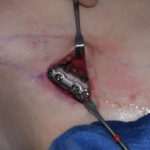
- Placement with micro screw fixation
- Closure like a standard upper blepharoplasty incision
 Upper eyelid incision made in crease
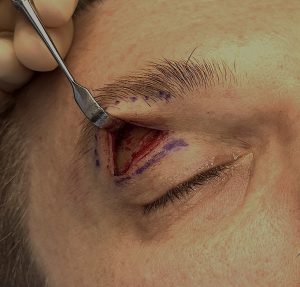 Subperiosteal pocket created
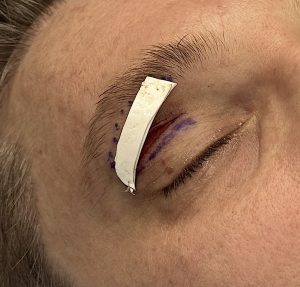 2mm ePTFE implant hand shaped
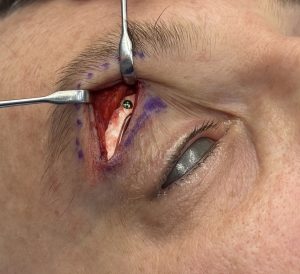 Placement with micro screw fixation
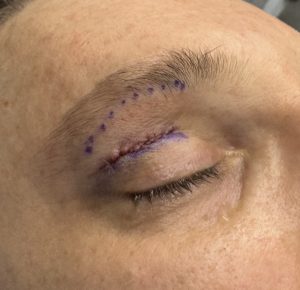 Closure like a standard upper blepharoplasty incision
Procedure time: ~1 hours
Discussion
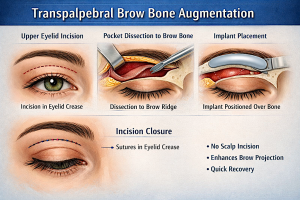 Transpalpebral brow bone augmentation is a technique to increase brow ridge projection through an upper eyelid (blepharoplasty-type) incision, rather than a scalp incision. It’s a more limited-access approach compared to traditional brow augmentation.
What “Transpalpebral” Means
- Trans = through
- Palpebral = eyelid
The implant or augmentation material is inserted through an incision in the natural crease of the upper eyelid.
No scalp incision.
Who It’s Best For
This approach works best when:
- Augmentation is limited to the outer or tail of the brow bone (outer half of the brow bone)
- Only a limited amount of brow bone projection is needed
It is not ideal for side to side or total brow bone augmentation
What Can Be Used for Augmentation
? Small Implant
- Pre-shaped custom or hand fashioned implant
- Material options (silicone, ePTGE)
- Placed over the supraorbital rim
- Small screw fixation
? PMMA Bone Cement
- Sculpted during surgery
- Allows contour blending
- Good for moderate enhancement
? Fat Grafting (Injection)
- Very mild augmentation only
- Less structural definition
- Unpredictable long-term retention
Advantages
? No scalp incision
? Less invasive
? Faster recovery
? Scar hidden in eyelid crease
? Can combine with upper blepharoplasty
Limitations
? Limited exposure
? Not ideal for large or complete brow augmentation
Recovery
- Significant swelling: 2–3 weeks
- Bruising: often does not occur
- Eyelid tightness initially
- Return to work: 5 to 7 days
Complete resolution of swelling in the brow region can take 4 to 6 weeks.
Aesthetic Effect
Transpalpebral augmentation typically:
- Increases upper orbital rim projection
- Deepens eye set appearance
- Creates stronger brow shadowing
- Can make eyes look more “deep set”
- Does not change overall forehead shape
The transpalpebral approach to the tail of the brow bone can be used for direct reduction and augmentation when onlu modest changes are needed.It is essentially a scarless approach given how most eyelid incisions heal using a crease incision.
Dr. Barry Eppley
Plastic Surgeon