
Rib removal surgery typically refers to partial resection of the floating ribs (11 and 12th ribs) known as Eppley Type 1 rib removal. As part of that surgery a small wedge of latissimus dorsi muscle is also taken underlying the oblique lateral flank incision.
In an evolution of that original structural waist narrowing procedure the 10th rib can also be addressed in an Eppley Type 2 version through the use of a more vertical incision to optimize lower waist width narrowing. Through the same incision a more effective reduction of the latissimus dorsi is done by internal resection and plication.
A Type 2 approach has been shown to be more effective in some patients due to:
- Rib 10 is recognized as being more important in waist narrowing than rib 12 through anatomic studies
- Through t
In either type of rib removal surgery patient selection is critical for optimal results.
Common Indications
Aesthetic
- Lower waist narrowing when skeletal width is dominant
- Adjunct to abdominoplasty, liposuction, or circumferential body contouring
- Patients with prominent floating ribs palpable or visible in thin individuals
Relevant Anatomy
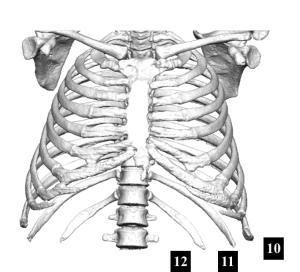
- 11th and 12th ribs are floating ribs (no anterior costal attachment)
- 10th rib has an anterior costal attachment albeit not a rigid one.
- Close relationships:
- Intercostal nerve and vessels
- Pleura (especially 10th rib)
- Quadratus lumborum & diaphragm attachments
Case Example
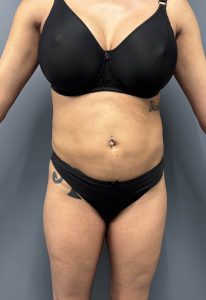
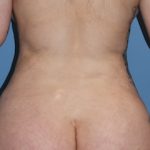
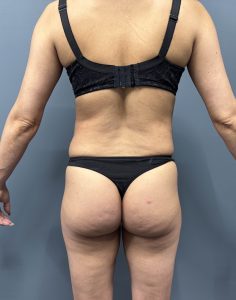 A normal weight female with a straight torso profile presented for rib removal surgery. She did have some limited flask and abdominal fat collections which were felt could be reduced along with the rib modifications. These underwent liposuction before the rib resections
Surgical Technique
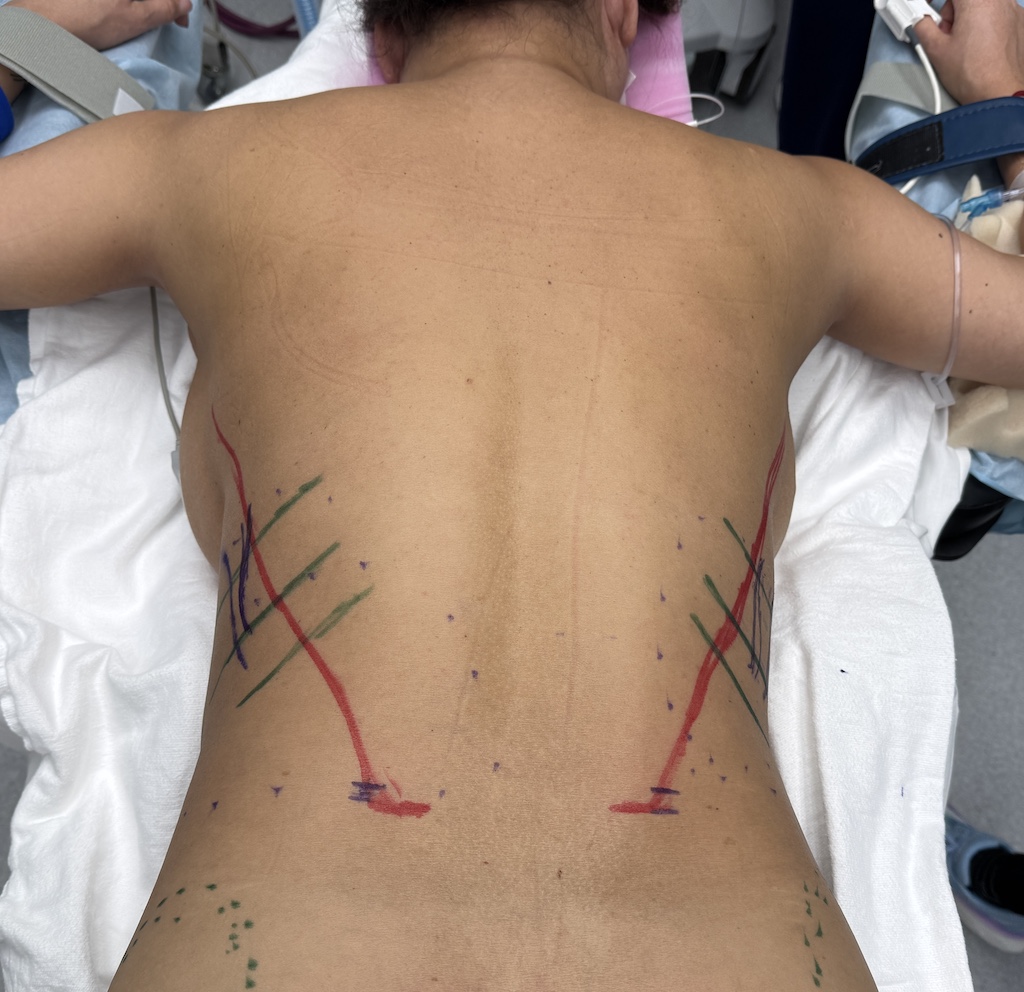
- Preoperative Markings
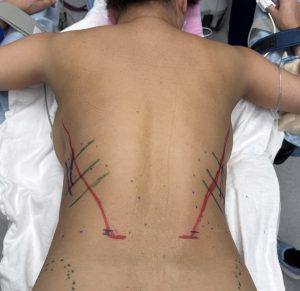
- Vertical incisional markings between 10 and 11th lateral rib in a wavy pattern (Type 2 approach)
- V-shaped back mark delineating symmetric proximal extent of rib resections
- Muscle-splitting approach (latissimus, obliques)
2) Extent of Resection
- Muscle-splitting approach (latissimus, serrates)
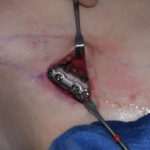
- Partial rib removal using a Piezotome
- 12 – 3 to 4cms
- 11 – 10 to 12 cms
- 10 – > 10cms
- Preservation of:
- Neurovascular bundle
- Lateral border Latissimus Dorsi muscle resection/plication
3) Closure
- Placement of drain
- Subcuticular skin closure

 Her three month result showed a very visible change in her lower torso/waitline shape.
Discussion
There are several surgical and postoperative considerations needed for a successful outcome.
Key Operative Principles
- Precise identification of rib level (avoid wrong-level resection)
- Protection of:
- Pleura (pneumothorax risk)
- Subcostal nerve (chronic pain risk)
- Hemostasis (intercostal vessels)
- Tunnel delivery technique with circumferential lateral rib dissection
- Proximal extent of rib taken is at the lateral line preoperatively marked on the back from the axilla superiorly to the lateral Dimples of Venus inferiorly
Postoperative Considerations
- Pain control, aided by intraoperative use of Exparel
- Monitoring for fluid collection after drain removal
- Compression garments
- Delayed onset of final result (2 to 3 months)
Patient Selection Pearls
- Best suited for patients with skeletal prominence and limited subcutaneous fat layer
- If significant fat layer exists should be addressed by circumferential liposuction first
- Poor candidate if waist width is primarily soft-tissue–driven
- Requires preoperative counseling about expectations
Bottom Line
In aesthetic practice, rib removal should be considered a last-tier waist-reshaping strategy when more traditional body contouring options have been tried or do not apply. It is also useful in those patient who have been through prior imited rib modifications procedures (e.g., Rib Xcar) that have not been successful. It can be an effective silhouette-modifying technique in those patients that have realistic expectations.
Dr. Barry Eppley
World-Renowned Plastic Surgeon