Archive for the 'abdominoplasty' Category
Understanding the Differences Between a Cosmetic Abdominoplasty and a Medically Necessary Abdominal Panniculectomy
Author: barryeppleyAbdominoplasty, or a “tummy tuck,” is a well known procedure in plastic surgery that tightens loose rectus muscles and removes excess abdominal skin and fat. This recontouring of the abdominal wall area is exclusively done for cosmetic purposes to create a more flat and firm abdomen.
A panniculectomy, a cousin to the abdominoplasty, is different in that it involves exclusively the removal of a large and/or long overhanging apron of skin and fat in the lower abdominal area. While the pannus produces a stretching of the tissues from the anterior abdominal wall, such effects are not treated by any form of muscle plication as in a tummy tuck. The abdominal pannus occurs exclusively in morbidly obese individuals or following substantial weight loss, most commonly bariatric surgery. For the sake of classification, although this doesn’t change how it is treated, abdominal pannuses are graded by the American Society of Plastic Surgeons as follows:
Grade 1: pannus covers hairline and mons pubis but not the genitals
Grade 2: pannus covers genitals and upper thigh crease
Grade 3: pannus covers upper thigh
Grade 4: pannus covers mid-thigh
Grade 5: pannus covers knees and below
Unlike an abdominoplasty, a panniculectomy is performed for functional or medical reasons. As a result, it is often covered by insurance. There is little question that Grade 3 through 5 pannuses are almost always covered. Debate frequently ensues from the insurance company in the medical merits of removing Grade 1 and 2 types. This is where documentation of its medical problems is really important. Without adequate written evidence of symptoms, these lower grade abdominal panniculectomies will be viewed as a cosmetic procedure.There is little question that a massive overhanging apron of fat and skin creates chronic and unremitting skin problems underneath it. In addition to the need for enhanced personal hygiene (which is very difficult), treatment of these skin conditions may require antifungal creams and powders and occasionally antibiotics.
Not infrequently, there may be a need for a panniculectomy to be done with other abdominal and pelvic procedures such as hernia repair, hysterectomy, and even gastric bypass surgery. While it may seem obvious that getting rid of an obstructive pannus could only benefit the results of these surgeries, the insurance companies rarely see it this way. Citing that there is ‘insufficient scientific literature’ to support any benefit, these combined procedures are usually denied. How they can not easily see that such benefits as improved surgical access and less risks for wound healing problems after surgery is a mystery to me. Such concomitant coverage can be obtained if the documentation of skin problems is first obtained however.
Interestingly, an abdominal panniculectomy is not considered medically necessary when the main reason it is being performed is to relieve back, hip and knee pain. Even though the sheer weight of grade 4 and 5 pannuses clearly strain these areas, this consideration alone is insufficient for medical coverage. I have performed over the years numerous panniculectomies that were requested by an orthopedic surgeon to first be done before they would consider knee replacement surgery. Apparently, the musculoskeletal problems that it causes by orthopedic specialists is not sufficient evidence for medical coverage.
One procedure that is never needed and certainly not medically covered as part of a panniculectomy is liposuction. In fact, thinning out of an abdominal skin flap with liposuction can impact its blood supply and create wound healing problems. The wound edges in closing a panniculectomy are already compromised from chronic swelling and lymphedema in many cases. Adding liposuction to it may be ill-advised.
Dr. Barry Eppley
http://www.eppleyplasticsugery.com
Indianapolis, Indiana
Case Study: Tummy Tuck Surgery and the Potential Need for Revision
Author: barryeppleyBackground: A tummy tuck, or abdominoplasty, is one of the best and most reliable body contouring procedures. For many women after childbirth or for men and women after extreme weight loss, a classic tummy tuck procedure can make a world of difference. But unlike the many marketing ads and images, the sheer size of the procedure and the tissues removed does not give everyone a perfect waistline or result. For some patients after surgery, and for all patients considering it, the reality is that revisional surgery or touch-ups may be desired or needed.
This 48 year-old female was tired of her full and hanging belly. While she was not a diet or exercising fiend, she felt that she was never going to get rid of this problem. As a result, she inquired about a tummy tuck or abdominoplasty. With the amount of skin and fat that she had, and that it hung down over her pubic region, a full or complete tummy tuck was the best option. She was ore than willing to accept a long horizontal scar as a trade-off. (as well as a scar around her new belly button)
She underwent the full abdominoplasty procedure with successful results, giving her a tighter and more narrow waistline. Over two years after the procedure, she inquired about making some minor improvements to the result. Specifically, she wanted the fullness of the pubic region reduced. A protruding pubic area after a tummy tuck is quite common. This is because the tightness of the scar around the waistline above the pubis makes its fullness stand out. While it was always that full, it only became apparent when it was lifted and juxtaposed against a tighter waistline scar. Also, the central tummy tuck scar remained wider and more red than the rest of the scar. This is commonly seen as the middle of the scar was originally exposed to more tension during the tummy tuck closure than the sides of the wound.
One other common tummy tuck sequelae is that the pubic hairline will be right up against the tummy tuck scar. This is unavoidable and will exist in all tummy tuck procedures. The only way to make a hair-free zone between the scar and the pubic hairline is to undergo laser hair treatments.
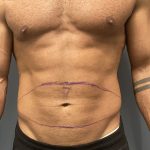
She underwent a simple revisional procedure consisting of pubic liposuction and central scar excision to optimize her result. The marks in the presurgical photo for her revision show the area of horizontal scar excision and the oblique markings for the area of pubic liposuction.
Case Highlights:
- Tummy tuck surgery can make a dramatic difference in one’s waistline shape and frontal trunk contour. But it can not solve every minor detail of the abdominal problem and there are almost always residual minor issues of scar and tissue redundancies.
- Revision of tummy tucks are not rare and can be done as early as three to six months after the original surgery depending upon the type of concern.
- Scar revision (scar narrowing), excision of dog ears at the sides of the tummy tuck scar, belly button adjustment, and pubic and abdominal liposuction are secondary tummy tuck options for obtaining an optimal result.
Dr. Barry Eppley
http://www.eppleyplasticsurgery.com
http://www.ologyspa.com
Indianapolis, Indiana
Background: A tummy tuck, or abdominoplasty, is one of the great plastic surgery body contouring procedures. It can do for many patients what no diet and exercise program can…get rid of loose skin and fat along the waistline. While there is always the trade-off of a scar (and a significant recovery), the results usually justify those significant trade-offs.
Like most every other plastic surgery procedure, a tummy tuck can be done multiple ways. The amount of loose skin and fat removed can be adjusted through either a more limited resection of tissues (limited or mini-tummy tuck) and a more complete or full tummy tuck. What differentiates these two variations is the amount or length of horizontal scar that is needed to complete the tissue resection. Mini-tummy tucks remove tissues below the belly button and result in a shorter horizontal scar and no scar around the belly button. A full tummy tuck includes a resection of abdominal tissues that extends to just above the belly button, ultimately resulting in a longer low horizontal scar and a scar around the new belly button.
This 32 year-old female, who is serving in the military, wanted improvement in her abdominal region. After the delivery of her twins a year ago, she has been unable to get her tummy back in any reasonable shape. She had a very large amount of abdominal muscle looseness (laxity) which accounted for a significant amount of her tummy protrusion. She also had loose skin with an extreme number of stretch marks around her belly button and throughout her entire lower abdomen.
In discussing her tummy tuck options, she was what I call in my Indianapolis plastic surgery practice a ‘tweaner’. This means she could have either a smaller or a larger procedure, in this case being either a mini- vs. a full tummy tuck. She had enough loose skin and stretch marks to justify a full tummy tuck to get all of them out. But by doing so, she would have a scar that went past her hips. With a mini-tummy tuck, her scar would be less but a significant portion of her stretch marks would remain. With her tummy tuck option, her abdominal muscles would be sutured back together. Which one is best for her? As you can see, her approach will make a big improvement but each one has trade-offs.
Because she did not want a longer scar, she was willing to accept much of stretch marks to remain. She opted for the mini-tummy tuck which included liposuction through the entire abdomen and into the flank (back) areas. She had a drain for a week and wore a binder for two weeks. She returned to her service duties in three weeks and exercise four weeks after surgery.
1) The decision between the two tummy tuck options in the ‘tweaner patient’ is a
balance between much scar one can tolerate vs the amount of improvement that
one expects.
2) Scars are always a consideration in a tummy tuck procedure. Once they are
placed, there is no way to remove them. A long tummy tuck scar is not a
choice if it would bother someone as much as the original abdominal problem.
3) While the scar may be different between a mini- vs. a full tummy tuck, the
recovery is not much different. The concern about recovery should be the least
consideration when making a decision between the tummy tuck options.
Dr. Barry Eppley
http://www.eppleyplasticsurgery.com
Indianapolis, Indiana
The Fleur-de-lis Abdominoplasty in the Bariatric Patient after Massive Weight Loss
Author: barryeppleyWithout question, the number one concern of bariatric surgery patients after their weight loss is abdominal reshaping. When the weight loss is in the neighborhood of 75 to 100 lbs., the abdominal skin does not redrape or shrink back down. Rather, a large amount of redundant skin results which both hangs and has multiple rolls.
The traditional tummy tuck or abdominoplasty is almost always inadequate to create the best abdominal result in the massive weight loss patient. This is because the excess skin exists in a true three-dimensional fashion, being excessive in both horizontal and vertical dimensions. As a result, I almost always use the combined vertical and horizontal tummy tuck procedure known as the fleur-de-lis abdominoplasty in my Indianapolis plastic surgery practice for bariatric patients. This results in abdominal scars that have a midline vertical and a low horizontal line, known as the anchor scar pattern. Adding the vertical part to the traditional tummy tuck does require more surgery time for dissection and closure, but most relevantly increases the amount of deep space underneath the skin after closure.
In theory, the fleur-de-lis abdominoplasty should be associated with more complications than a traditional abdominoplasty. It takes longer to do and has incisions that meet at an inverted-T area. It also removes a very large segment of skin which leaves more dead space uinderneath. To investigate if this seemingly truth is reality, the May 2010 issue of Plastic and Reconstructive Surgery published a study conducted by the University of Pittsburgh Division of Plastic Surgery on this very question. Over 400 abdominoplasty patient were evaluated of whom 154 (31%) had a fleur-de-lis abdominoplasty operation. The overall abdominal complication rate was 26%. This included all types of complications of which 5% would be considered major. (requiring further surgery) Traditional horizontal excision abdominoplasties and fleur-de-lis abdominoplasties were very similar in complication rates with the exception of a higher rate of wound infections in the more extensive abdominoplasty.
My Indianapolis plastic surgery experience is slightly different than that reported in this very extensive and thorough study. I have seen no greater incidence of wound infection between the two types but have certainly seen more wound openings/separations at the inverted-T area. A traditional abdominoplasty does not have this zone and, as a result, significant wound openings are very uncommon. The dead space in the fleur-de-lis abdominoplasty is managed with an extra drain and I am more conservative about their removal, keeping at least one in place for two weeks after surgery.
The fleur-de-lis creates a better abdominal result in the bariatric patient if they feel that the trade-off of a vertical scar is worth an improved upper abdominal area. In days gone by with open gastric bypass surgery, a vertical scar already was present so the decision for the fleur-de-lis was easy. With laparoscopic gastric bypass today, the patient must consider a new obvious vertical scar.
Another consideration for bariatric patients considering the fleur-de-lis abdominoplasty is insurance coverage. If one’s health insurance will provide an abdominoplasty coverage, that does not include the vertical component of the fleur-de-lis. The insurance company covers the horizontal abdominal excision only. There will be an extra out-of-pocket charge for adding the vertical component to the procedure.
Dr. Barry Eppley
http://www.eppleyplasticsurgery.com
Indianapolis, Indiana
Abdominoplasty or tummy tuck is one of the top five cosmetic procedures for women but is performed much less frequently in men. Because men do not get pregnant, their abdominal skin does not suffer as much loss of elasticity and can ‘snap’ back better after weight loss. Men are also less tolerant of a low abdominal scar than women who may already have had a c-section.
Even though it is far less than women, more men are considering or undergoing tummy tuck surgery than ever before. Some of this is fueled by the large increase in bariatric surgeries which has equal distributions between men and women. Another mitigating factor is that men are increasingly concerned about their appearance and are willing to go to greater lengths to get the best body shape as possible.
There are some significant differences between a male and a female tummy tuck that affects recovery from the procedure. Most importantly, muscle plication is rarely done or needed. In my Indianapolis plastic surgery practice, I have never done muscle tightening in a man. Men do not suffer from rectus diastasis, again due to never being pregnant. As a result, there is no cosmetic or functional advantage to sewing the rectus muscles tighter.
Because the rectus muscles don’t need tightening, undermining of an abdominal skin flap to do so is not needed. This enables just the overhanging loose skin and fat to be removed in a direct cut out fashion. The need for prolonged use of drains is reduced because there is less undermined skin space.
The avoidance of muscle manipulation also impacts one very important aspect of recovery…a significant reduction in pain after surgery. Sewing muscle is the single main contributor to postoperative tummy tuck pain and the restriction in standing up straight right afterwards. The removal of skin and fat causes surprisingly little pain for most people. At best it gives some incisional discomfort but not severe or restrictive pain.
The length of the incision line in men is determined by how much loose skin exists and how far back it goes from the hips…if it does at all. Unlike women, most male tummy tucks require skin and fat removal at least between the front edge of the hips. (anterior superior iliac crests) Most men wouldn’t undergo a tummy tuck if the amount of skin removal would be less than that amount. In some cases, the skin removed may go into the back area of significant weight loss has occurred.
Men should not fear a tummy tuck because of how they perceive it to be done in women. The male tummy tuck is simpler to do and less involved. The lack of a need to tighten the abdominal muscles makes for less pain after surgery and a reduced need for prolonged drain use.
Dr. Barry Eppley
http://www.eppleyplasticsurgery.com
Clarian North Medical Center, Carmel, Indiana
Clarian West Medical Center, Avon, Indiana
Indianapolis
Combining Liposuction in a Tummy Tuck for Improved Safety and a Faster Recovery
Author: barryeppley
Liposuction and abdominoplasty are two of the most popular plastic surgery procedures. While commonly used to treat different body areas, they can be combined to improve one’s abdominal contour and shape. When done together and weaved into a single procedure, it is known as lipoabdominoplasty or liposuction abdominoplasty.
A traditional abdominoplasty or tummy tuck involves removing lower abdominal skin and fat and undermining the skin up to the lower margins of the ribs. After sewing the rectus muscles together, the remaining upper abdominal skin flap is brought down and closed under tension. By undermining this skin and placing it under such tension, a flatter abdomen is obtained but this skin flap has less blood circulating through it. This accounts for why some small percentage of tummy tucks suffer skin death (necrosis) at the center part of the incision line underneath the new belly button. It is also why drains are almost always used afterwards, to remove fluid that accumulates in this wide open space.
In contrast, liposuction abdominoplasty does not undermine this upper skin flap to any degree and relies on the use of the liposuction cannula as the dissection tool. This saves more blood vessels to the skin than undermining with cautery while disrupting ligaments that helps the skin move downward. The skin ligaments are released by a combination of initial liposuction followed by blunt dissection with scissors and/or fingers. Because large undermined skin flaps are not created, the use of drains after surgery is often not needed.
The question is…is lipoabdominoplasty a replacement over a traditional tummy tuck or is it more of an option for properly selected patients. Some tout it as a better tummy tuck although it is yet not widely adopted by the majority of plastic surgeons. Currently, I am using it in my Indianapolis plastic surgery practice as the latter. In some patients with tight and thin supraumbilical tissues, liposuction and blunt dissection alone is not enough to get the skin flap to adequately move downward. It does require some loose skin above the umbilicus to execute a lipoabdominoplasty.
This lipoabdominoplasty operation, however, is ideal for smokers. Smoking is well known to cause blood supply problems to stretched skin under tension. This concern is significant enough that some plastic surgeons will not do a tummy tuck in someone who smokes or has smoked recently. Because it preserves more blood supply to the skin, this operation makes the tummy tuck less risky for healing problems.
In the right patient, liposuction abdominoplasty produces similar results to conventional techniques with improved safety and a faster recovery. It is not a passing fad or a procedure of theoretical benefit but an improvement proffered by an amalgamation of two well-established plastic surgery treatment methods.
Dr. Barry Eppley
http://www.eppleyplasticsurgery.com
Clarian North Medical Center, Carmel, Indiana
Clarian West Medical Center, Avon, Indiana
Indianapolis
Men have just as many concerns about their waistline and abdominal shape as women. But the anatomic basis for the male abdominal problem is usually different. Exclusive of the morbidly obese or the extreme weight loss patient, men have different skin, fat and muscle compositions of their abdominal shape. Men do not get pregnant so the amount of stretched and/or stretchy skin is less. Fat distribution in men has a more significant intraperitoneal component and usually less between the skin and the underlying muscle. Lastly, men rarely have significant muscle laxity or midline separation.
For these reasons, tummy tuck surgery is performed less on men than women because the excess skin and loose muscle issues are less. For every male that undergoes some form of an excisional abdominoplasty, ten women probably do. This is different in the extreme weight loss patient where the ratios are much more comparable.
Much abdominal reshaping in men can be done with liposuction. Aggressive liposuction of the entire abdomen extending into the flanks is necessary before any consideration of skin excision can be done. For most men with any amount of abdominal protuberance, it is not possible to get a near flat abdomen with liposuction alone. There is too much intraperitoneal fat for that to occur except in the already relatively fit male.
Most of the time whether simultaneous skin resection should be done with liposuction can be determined before surgery but not always. Some men are understandably reluctant to acquire a low horizontal scar which is relatively unnatural in a male. Women accept these scars much better as they have a long history of c-section and tummy tuck scars. When in doubt, it is most logical to use the ‘wait and see’ approach for the amount of skin retraction. But, psychologically, most men are not as tolerant of multiple procedures and are impatient to get to the final result.
Tummy tucks in men are usually more limited in scope of skin resection and length of the horizontal scar. In addition, muscle plication is rarely necessary or that beneficial unless there is an associated umbilical hernia. Infraumbilical skin and fat resections are all that is needed in most cases and the lateral resection should go as far as needed to work out any pleats or dog ears.
In removing the lower abdominal skin and fat, I avoid exposing the abdominal wall fascia and leave a layer of tissue just below Scarpa’s fascia. The upper abdominal skin is then advanced over top. By so doing, this reduces the amount of time a drain will be needed and decreases the risk of seroma later after the drain is removed. Men are not particularly tolerant of tubes exiting their body.
The concept of lipoabdominoplasty in men leans heavily toward the liposuction component in the non-bariatric or large weight loss patients. The tuck and tightening of lower abdominal skin is often quite helpful from a contouring standpoint and probably should be considered in more older male patients who seek a better waistline. In my Indianapolis plastic surgery practice, I find an increasing number of men who benefit by some version of a lower skin resection and do not have objection to the final scar that results.
Barry L. Eppley, M.D., D.M.D.
http://www.eppleyplasticsurgery.com
Clarian North Medical Center, Carmel, Indiana
Clarian West Medical Center, Avon, Indiana
Indianapolis
Tummy tucks (abdominoplasty) traditionally are a horizontally-oriented operation. This means that excess skin and fat is removed with an elliptical incision that is oriented from one side of the waistline to the other. This results in a fairly low horizontal scar that is some distance below a newly created belly button. (if it is a full tummy tuck)
This conventional tummy tuck is effective for the vast majority of people as their abdominal skin excess is largely located in that direction. However, some patients have abdominal skin issues that have greater dimensional excesses than just in one direction. In my Indianapolis plastic surgery practice, I can determine this before surgery by looking at the sides of the waistline and seeing how much tissue bulges to the side. One can also see how much skin can be pinched in a vertical direction above the belly button.
When there appears to be considerable vertical excess as well, consideration can be given to an extended or combined vertical-horizontal tummy tuck. This is also known as a fleur-de-lis type tummy tuck. By removing both horizontal and vertical tissue, the sides of the waistline are brought in as well as the frontal overhang removed. This creates a better abdominal result but there is a trade-off…a vertical closure as well as the horizontal one creating an anchor or inverted T scar.
In the past, there were many more patients who presented with a history of prior abdominal surgery in which a midline scar was present. But the use of laparoscopic techniques is making such patients fewer and fewer. Therefore, the consideration of adding a vertical abdominal scar when one isn’t already present can be a difficult decision. If a vertical scar is present, however, the choice of an extended tummy tuck is straightforward.
While this type of tummy tuck always produces a better abdominal result, it does bring some increased risks of wound complications. The intersection of the vertical and horizontal closures at the inverted T creates a zone of tension. Combined with upper skin flaps that may have a blood supply to the skin edges which is compromised, it is not uncommon that these incisions can develop an opening at this intersection several weeks after surgery. This wound problem can be magnified based on where the new belly button is brought through on the vertical closure. Most of the time, this is only a few inches above the horizontal closure. These wound problems are self-limiting although it can take four to six weeks to close if the opening is significant.
Dr. Barry Eppley
http://www.eppleyplasticsurgery.com
http://www.ologyspa.com
Clarian North Medical Center, Carmel, Indiana
Clarian West Medical Center, Avon, Indiana
Indianapolis
The traditional tummy tuck (abdominoplasty) is primarily what I call a frontal approach where skin and fat is removed from the lower abdomen. The skin cutout is done horizontally in the shape of a football. Often times, liposuction is also performed on the sides around the waistline to get more of a 270 degree result. When the skin excess is not large, this is a perfectly fine approach and will immensely satisfy the vast majority of people who seek abdominal contouring.
When the amount of abdominal skin increases, however, the dimensions of the skin problem change. Redundant skin and fat is present not only in the horizontal direction but in the vertical dimension as well. Such abdominal problems exist in the larger abdominal pannus patient (skin overhang onto the thighs) and in the extreme weight loss patient. (greater than 100 lbs.)
If this additional dimension is not taken into consideration during the planning, patients may be disappointed with the result at the sides of the waistline. They may wonder why the side of the waistline does look as flat or as contoured as the front. Herein enters the concept of the extended tummy tuck, also known as the anchor tummy tuck or the fleur-de-lis tummy tuck.
The extended tummy tuck adds a upper vertical cutout of skin along with the lower horizontally oriented skin removal. By so doing, the skin closure pulls in on the sides of the waistline as well as pulling down in the front. This effectively helps narrow the waistline as well and helps reduce the amount of redundant skin in that area. By adding this ‘third’ dimension to the tummy tuck, the length of the operation is increased but it does not result in any significant increase in the risk of postoperative problems.
The extended tummy tuck does result in an additional scar that runs vertically from below the sternum down to the pubis. This creates the anchor scar result. Whether this extra scar is worth the trade-off for the improvement in the waistline is a personal choice. That choice is an easy one if an existing midline abdominal scar is already present. If no such midline scar exists, then one has to decide which ‘negative’ they can live with the best….loose skin on the sides or a vertical scar.
In my Indianapolis plastic surgery practice, I have noted that most patients with a lot of excess abdominal skin opt for the most skin removal and the best abdominal contour result. My general approach to the consideration of incisional scarring in non-hidden areas is…if you have to think about whether the scar is worth it…don’t do it. If the answer is an immediate yes and one could care less about the scar (compared to the existing problem), then the scar is not very likely to be a regrettable concern after surgery.
Dr. Barry Eppley
Http://www.eppleyplasticsurgery.com
Clarian North Medical Center, Carmel, Indiana
Clarian West Medical Center, Avon, Indiana
Indianapolis
Tummy tuck surgery remains as one of the most sought after elective plastic surgery procedures. To the person struggling with a loose or unsightly stomach area that has not changed with diet and exercise (and it almost never does), tummy tuck surgery offers a result that is otherwise unobtainable. But tummy tuck surgery has evolved over the years into an increasingly more sophisticated operation. No longer is it just the simple removal of some loose skin and fat. Recognizing that this area is aesthetically more complex than just be a flatter surface, newer techniques are being incorporated into the old traditional tummy tuck.
Lipoabdominoplasty is an advanced technique bringing significant change to the old-style tummy tuck. This procedure, which incorporates liposuction into the skin and fat cut out, has allowed plastic surgeons to transform patients’ tummies after child birth and/ or significant weight loss into improved shapes. Liposuction has historically been shunned at the same time as a tummy tuck due to blood supply concerns and the risk of creating wound healing problems and skin loss.
In my Indianapolis plastic surgery practice, I now use liposuction to help shape the upper portion of the abdomen. This is an area that often remains full after a standard tummy tuck because the fat in this area is not thinned out. With the skin pull down at the time fo skin closure, this area does get a little thinner I(as the fat is stretched out like an accordion) but often the upper abdomen pouches out more than the lower part after surgery in some patients. Liposuction, particularly laser-assisted liposuction, selectively melts fatty tissue and helps remove some of this fat without a lot of additional trauma. This enables better sculpting and definition to be achieved in the upper portion of the abdomen.
To shape the waistline better, liposuction is also carried out around the sides into the back area. If this area is not addressed as well, many patients will develop what I call the ‘muffin-top’ deformity, where the stomach area is flat but the tissue over the hips now sticks out. Performing liposuction beyond the ends of the tummy tuck incision into the back helps create a better waistline appearance, creating a near 270 degree waistline improvement.
The use of a newly developed suture known as the Quill suture for repair of the separated abdominal muscles and tying down the underside of the skin is now also used. The Quill suture is a sophisticated, bi-directional barbed suture, which adjusts its tension with each stitch. This locks tissue in place for a snug and secure closure. This type of suture material is a marked improvement over traditional sutures in terms of holding strength. This suture technique also makes it possible to not have to use drains in some tummy tucks, which is a huge relief for these patients.
Many tummy tuck patients are sometimes surprised to learn that removing the excess skin and fat on the lower abdomen is just one step or level of the procedure. In this more contemporary lipoabdominoplasty procedure, an improved abdominal appearance can be obtained due to the concomitant use of liposuction and muscle tightening.
Dr. Barry Eppley
Clarian North Medical Center,Carmel, Indiana
Clarian West Medical Center, Avon, Indiana
Indianapolis