Archive for the 'breast implants' Category
Breast implants remain a very popular plastic surgery option. Despite the recent economic downturn, however, the number of women requesting the procedure has not substantially decreased. The reason undoubtably is that it is a very successful procedure that produces instantaneous results. In my Indianapolis plastic surgery practice, I know of few operations that can make such a dramatic difference in a very short period of time.
Despite the dramatic improvements that implants can make in breast size, there are several things that they can not do. These are important for prospective patients to understand so their expectations after surgery are realistic.
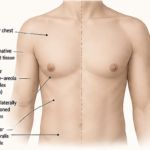
Breast implants will not lift a saggy breast or move the nipple higher up on the chest wall. In essence, breast implants do not replace a breast lift. This is certainly one of the biggest misconceptions that I come across. To properly understand that statement, we must first define what saggy (or ptosis as we plastic surgeons call it) is. If the nipple is at the level of the lower breast or above it with some loose skin, this is not what I define as saggy. Breast implants will fill out the loose skin and the nipple position will point forward. However, if the nipple sits anywhere below the lower breast crease, this is significant ptosis and some form of breast lift with the implant must be considered. If not, an implant will make the breast bigger but the nipple will end up on the bottom pole of the bra…pointing downward.
Breast implants will not necessarily being the breasts closer together. Certain women have very widely spaced breasts. Many women have seen pictures of breast augmentation results in which they comment about how ‘widely spaced the breast implants are’ and they don’t want a large valley between their breasts. Whether you will or won’t have that aesthetic problem after surgery can be determined beforehand. If your breasts are positioned way to the side of your chest wall, you will have widely spaced breasts afterwards. Implants will not move the breast mound inward. It does fill out the breast mound and will move the inside of the breast mound closer to the sternum. But if the implants are placed too close together, the nipples will point outward or sit on the outside of the breast. For many breast augmentation patients, bras make cleavage not the implants.
Implants won’t get rid of stretch marks or any skin irregularities on the breast. Women are usually concerned about these issues if they exist on the upper pole of the breast where they can be seen in certain types of clothing. In expanding the skin surrounding the breast, stretch marks will actually get bigger…but they often become less noticeable because they become flatter. At the very least, plan on those skin imperfections staying the same. Consider it a bonus if they actually look better.
Dr. Barry Eppley
http://www.eppleyplasticsurgery.com
http://www.ologyspa.com
Clarian North Medical Center, Carmel, Indiana
Clarian West Medical Center, Avon, Indiana
Indianapolis
The issue of the potential impact of breast implants on causing systemic disease, specifically autoimmune problems, has been put to rest after many years of research and clinical studies. More recently, anectodal reports have arisen from the observation of a few women who have been diagnosed with lymphomas in or near the breast who also have had breast implants. This raises the theoretical question of whether there is any causal relationship between breast implants and lymphoma malignancies.
In a most recent paper in the March 2009 issue of Plastic and Reconstructive Surgery, Drs. Lipworth et al from Maryland and Tennessee investigated this very question. The authors reviewed the evidence from five long-term studies evaluating over 43,000 women with breast implants, some of whom had follow-up for up to 37 years for the incidence of lymphoma and other cancers. Their results found 48 cases of non-Hodgkin’s lymphoma compared with 54 expected cases based on sample size and incidence of malignancy. None of the studies reported a primary lymphoma of the breast. They concluded that there is no increased non-Hodgkin’s lymphoma occurrence in women with breast implants.
This study was a necessary response to the question posed by these anectodal reports of lymphoma in breast implanted women. We are all too well aware, based on the purported association of autoimmune diseases and breast implants which is well chronicled in the past, of the potential hysteria caused by such reports. This report is a pre-emptive strike on this issue from gaining any momentum and women needlessly suffering worry and emotional distress. I applaud the authors for their work and forward thinking. It is a service to many millions of women around the world.
Dr. Barry Eppley
http://www.eppleyoplasticsurgery.com
Clarian North Medical Center, Carmel, Indiana
Clarian West Medcal Center, Avon, Indiana
Indianapolis
In most cases of breast augmentation, women usually desire predictable and reasonable increases in their breast size. (implant sizes of 300cc to 500ccs) Occasionally, maybe once or twice a year in my practice, someone will want really large breasts. A size that is disproportionate to their body frame but still able to be achieved with standard off-the-shelf implants sizes. (standard implant sizes go to 850cc)
But the recent world record for breast implant size reached an astronomical increase of KKK. As reported at www.worldrecordsacademy.org, a Houston Texas woman had her tenth breast augmentation surgery (performed in Brazil) to reach the gigantic size of 3,500cc per breast! Besides questioning the sanity of any patient who would even want to go half that size, it is not a very proud moment for plastic surgeons. While I am all for helping patients achieve what they want, not everything that some patients want is actually good for them…….and we as plastic surgeons should not be afraid to say so. Yes it is true that patients will go ‘down the street’ and find someone else to do it….there is a time to let them do so.
While such an extreme breast implant patient makes worldside news, the occasional patient who wants to be really big, by more normal standards, is more commonplace. When women make a choice for a large breast implant, they need to understand the long-term consequences. And there will be some. Most pertinently, there will be a day when the patient will not want to be so big. Downsizing breast implants will always make the breast sag…and many women will want a lift which results in breast scars. It is easy to go big, the skin will stretch and be nice and tight, but going down is another matter. The breasts will be deformed and will require some degree of skin tightening. Large breast implants over time will weaken the soft tissue support of the skin and many such patients will develop bottoming out of the implant over time as this support is lost.
In short, large breast implants are unnatural and the breast tissues are not designed to support such weight and size over time. When downsizing of a large breast implant is wanted, the loose size and large underlying breast implant pocket must be managed in a more reconstructive breast approach. This results in scars and may require multiple surgeries to get an acceptable shape and result. For these reasons, I advise patients to think very carefully about making breast implant size choices that exceed what their breast tissues are designed to handle. What size that is will vary greatly based on the patient’s breast and chest wall anatomy. There is no absolute upper implant size that applies to everyone.
Dr. Barry Eppley
http://www.eppleyplasticsurgery.com
Clarian North Medical Center, Carmel, Indiana
Clarian West Medical Center, Avon, Indiana
Indianapolis
A very common question that most breast augmentation patients ask during a consultation is…how much do breast implants weigh….and which weighs more, silicone or saline breast implants? This question is one of more interest than importance as there are many more relevant issues in deciding between these two implant filler materials than their weight.
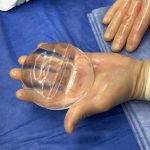
By weight measurements, silicone gel implants weigh more than saline. This is somewhat obvious by having one in each hand and feeling the weight difference. Although it is a common misconception than saline implants weigh more. The fact that weight differences exist can be gleaned from a simplistic look at the periodic table of elements. Silicon occupies the 14th position
and is of the metalloid category of elements. Hydrogen is the first element and oxygen is number 8. Silicone gel is a combination of silicone (14) and oxygen (8), silicone dioxide, for a total atomic weight of 30 compared to saline (water) which is a combination of hydrogen (1) and two oxygens (8 x 2 = 16) for an atomic weight of 17. Although saline also includes the elements of sodium (Na) and chloride (Cl), which would add more weight than just hydrogen and two oxygen alone, its concentration is only 0.9%. For the sake of simplicity, we will discard this minute amount elements and treat the weight as pure water. (at higher concentrations such 3% as in the Dead Sea, this would be a different matter)
But how significant are the weight differences? One cc of silicone gel weighs 0.0375 ounces. For example, a 400cc silicone gel implant would then weigh 15 ozs. (0.94 lbs) and a pair would weigh 30 ozs. or 1.875 pounds. Conversely, a cc of saline weighs 0.0325 ozs. A 400cc saline implant would then weigh 13 ounces (0.81 lbs.) and a pair would weigh 26 ounces or 1.62 lbs. The difference at 400cc would be around 0.2 pounds or about 3 ozs.
As one get smaller or bigger in implant size the differences in weight between saline and silicone breast implants becomes smaller or greater. At 200cc size implants it is a mere 1.5 ozs, but at 600cc implants this difference becomes closer to a 1/4 of a lb.
Dr. Barry Eppley
http://www.eppleyplasticsurgery.com
Clarian North Medical Center, Carmel, Indiana
Clarian West Medical Center, Avon, Indiana
Indianapolis
Breast augmentation surgery through the use of implants naturally increases one’s breast size. And while all breast augmentation patients have great concerns about the final size they want to be, they also are often concerned about the final shape as well. While breast implants, whether they are saline or silicone, come in a wide variety of sizes they also come with different projections or profiles. The concept of breast implant profiling is relatively new and is an additional consideration that prospective patients needs to consider.
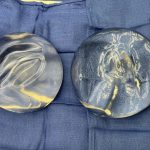
Profiling of a breast implant is a method of altering the shape of the implant, changing the height and width ratio. That may sound like geometry but what it does is allow more of the implant volume to create a ‘higher mountain’. This is real apparent when looking at to two different profiles of the same size implant when sitting on a table. The higher profile one will be slightly narrower (decreased diameter) but will sit up higher. When sitting on a woman’s chest that means the top side of the implant will be more full, creating a rounder breast shape. Lower profile implants will create more of a natural or teardrop shape. Every breast implant size comes in different profiles as well.
What I have found about breast implant shape is that women prefer one of two types. The teardrop or natural shape or the more full and rounder (some call this unnatural) breast shape. The profile of the breast implant will make a contribution to this final shape, a high profile implant for a round shape and a low or moderate profile for more of a teardrop shape.
I caution all patients, however, that the profile of a breast implant is but one contributing factor to the final breast shape. In reality, it may not even be the most important. The tightness or looseness of the existing breast size and the size of the implant may be more important. For example, small tight A or B cup breasts with a large implant will end up looking round no matter what the profile is used. Conversely, loose saggy breast skin that is implanted will almost always have a final teardrop shape unless a very large implant is used.
When considering breast augmentation, breast implant options include filler material (saline vs silicone), size in ccs, and height of profile. The concept of breast implant profile is relatively new and what its impact may be on the final shape of the breast should be gone over carefully with your plastic surgeon.
Dr. Barry Eppley
http://www.eppleyplasticsurgery.com
Clarian North Medical Center, Carmel, Indiana
Clarian West Medical Center, Avon, Indiana
Indianapolis
Breast augmentation is one of the most common plastic surgery procedures performed in the United States and also one of the most euphoric cosmetic procedures due to the instantaneous results. In one hour of surgery, an immediate increase in breast size is achieved. Despite the successful nature of breast augmentation surgery and the immediate results, there are an expected number of temporary events after surgery that patients have to tolerate before truly having the final result.
Swelling of the breasts after surgery always occurs. What can be confusing for patients is that the swelling does not occur immediately. The first day after surgery some swelling is present but it takes two to three days to see the maximal swelling of the breasts. They will continue to get larger and tighter for the first few days before they start to go down.
Because of the combination of swelling and the immediate and dramatic expansion of the skin, the breasts will feel abnormally stiff and tight. They will feel like ‘two’ rocks’ sitting on your chest. They will have that feeling for several weeks until the swelling goes down and the skin starts to relax and get used to the implants underneath. It usually takes about 4 to 6 weeks until the breasts relax enough to feel more normal.
It is also common for some patients to hear fluids or something swishing around inside during the first week after surgery. In the case of saline breast implants, in particular, this is not the implant deflating or water running out of it. It exists for both saline and silicone gel implants. Rather it is the irrigation or fluid that your surgeon used to wash out the breast pocket prior to inserting the implants. This fluid will be absorbed naturally in a week or so and that feeling or sound will go away.
Numbness of the skin, particularly on the lower half of the breast, will occur and may be present for a long time. This is because this skin is lifted up the most of any part of the breast during the surgery and the tiny skin nerves get disrupted. Most patients will get back the feeling back on this part of the breast but not all patients will get all of the feeling completely back.
While the risk of losing feeling in the nipple permanently is one of the risks of breast augmentation surgery, it is not common. However, temporary changes in nipple sensation right after surgery is. Usually it is too much feeling or hypersensitivity that occurs. This will settle down and return to normal in a few weeks. Less commonly, the nipple may actually be numb for awhile but returns to normal in a month or so after surgery.
Finally, the final size and shape of the breast can not be fully realized until about 6 weeks after surgery. The breast implants may initially seem too high but will usually settle as the skin relaxes. Don’t be too critical of the breast shape and symmetry between the breasts for some time after surgery. While the change in breast size is immediate, the final shape and contour of the breasts take some time to be realized.
Dr. Barry Eppley
http://www.eppleyplasticsurgery.com
Clarian North Medical Center, Carmel,l Indian
Clarian West Medical Center, Avon, Indiana
Indianapolis
Breast augmentation is an operation that works exclusively because of the implant. Like joint replacement surgery, the operation is completely dependent on a medical device for its result. Like all medical devices, breast implants will eventually fail for some patients at some point in their lives. Because of this concern, I not infrequently hear questions from breast augmentation patients asking….is it time for me to replace my breast implants?
As a general statement, you do not need to replace breast implants until they develop a problem, known as failure. They is no known benefit to replacing them just because they are ‘old after ten years, for example, or some other length of time. You replace them when the device fails.
The presentation of failure will differ depending upon what type of breast implant is used. Saline implant failure is usually quite obvious as it develops a leak and the breast size begins to change. In other words, you develop a ‘flat tire’. Whether the leak is slow or fast, your breast gradually gets smaller. This is tantamount to a cosmetic emergency and there will be no question as to whether it needs to be done. Silicone gel implants, however, fail differently. Because the gel is not a liquid, it will not come running out and cause a dramatic change in breast size. Rather silicone gel implant failure may not be obvious at all as the breast will not change size. Its failure is ’silent’ and often will only be picked up by mammogram or MRI. If the breast looks good and is pain-free, one can have the debate if it should be replaced at all since it will cause no harm to your body (because of the tear) and the breast size has not changed. Certainly there is no urgency to replace it like in saline implants. One has a lot of time to decide if replacing it needs to be done now or later.
Dr. Barry Eppley
http://www.eplpeyplasticsurgery.com
Clarian North Medical Center, Carmel, Indiana
Clarian West Medical Center, Avon, Indiana
Indianapolis
Understanding the Combined Breast Lift and Implant Procedure in Breast Reshaping after Extreme Weight Loss
Author: barryeppley
Breast reshaping in the extreme weight loss patient almost always require the combination of an extended breast lift and a breast implant. The loss of breast tissue from the weight loss and the now overstretched skin results in a deflated breast with a significant sag. The nipple lies below the lower breast crease and in many patients it points directly to the floor. Such a misshapen breast requires both volume (breast implant) and a radical skin reshaping. (lift)
While this combination breast reshaping procedure is commonly done, it is not easy to get a good symmetrical breast result. The need for secondary revisions with this approach is not rare. Revision rates may be as high as 25% to 35%. The reason this procedure is difficult from a cosmetic standpoint is that the breast lift and the implant work against each other in achieving their goals. A breast lift is a skin reduction procedure that lifts and tightens, a breast implant is an expansion procedure that stretchs and lifts. There is no exact science that can tell a plastic surgeon exactly what size implant is needed for how much skin is removed in a lift. It is as much an art as anything else.
One valid approach is to do the breast lift first and defer the placement of the breast implant as a second stage months later. While this staged approach has its advocates, it condemns the patient to two operations 100% of the time. While the combination of a lift and implant may require a significant percent of patients to need two operations due to a revision, the majority of patients (> 50%) will be able to get a satisfactory result in one combined operation.
The primary objective of this form of breast reshaping is to get the nipple lifted and centered on the breast mound. This results in the classic anchor breast scars to achieve it and the blood supply to the nipple is always in jeopardy with the low but real risk of nipple loss. The implant is placed through the same approach as that of the breast lift.
The combination of breast scars, an uplifted nipple position, breast implants, and having two breasts makes achieving perfect symmetry and shape between the two breasts a difficult proposition in the combined lift/augmentation procedure. Fortunately, most extreme weight loss patients are quite satisfied with significant improvement in their breasts even when revisional procedures may be needed.
Dr. Barry Eppley
http://www.eppleyplasticsurgery.com
Clarian North Medical Center, Carmel, Indiana
Clarian West Medical Center, Avon, Indiana
Indianapolis
Saline and Silicone Breast Implant Failures - Understanding The Differences
Author: barryeppley
Breast augmentation remains as one of the most popular and successful of all cosmetic plastic surgery procedures. The biggest decision any woman makes (beyond deciding to undergo the operation) in considering breast augmentation is the choice between saline and silicone breast implants. One consideration in making this choice is to consider the risk of device (breast implant) failure over their lifetime.
All breast implants may eventually develop a hole or tear in the ‘bag’, known as fatigue failure of the containment shell. This is a risk for every patient and eventually most breast augmentation patients will experience this risk. It is a natural phenomenon that develops over time through the motion of the implant’s wall as it is displaced by external pressures on the breast. Even though the containment sac or shell that contains either silicone or saline is soft and flexible, at the microscopic level it is a more rigid plastic. Eventually a crack (fatigue failure) will develop in it and this crack will propagate and become a more visible hole or tear. Once this becomes a full-thickness failure, the material inside has an opportunity to escape outward.
Saline breast implant failure is known as deflation. This is because when a hole develops in the implant shell, the saline will flow easily through it. This results in a relatively rapid deflation, over hours, days or weeks. Sometimes the deflation is immediate and complete (spontaneous deflation), other times it takes longer to see the breast implant go down. (slow leak) Either way, it is always obvious on the outside as the breast loses shape and size. When a saline breast implant fails, it will always be eventually obvious.
Silicone breast implant failure is different because the silicone gel inside the bag does not act like water. Rather it is a thick viscous gel that behaves more like jello. It is sticky or cohesive and does not flow due to bonding of the silicone molecules to each other. The gel material is somewhere between a liquid and a solid. Because it does not flow, it can not come out of the hole or tear unless it is quite large. Even then it will only bulge out when the implant is squeezed but will go back in as soon as the pressure is off of the implant. This failure process, rather than be called deflation, is known as silent rupture because it is not possible to tell on the outside that the implant has failed. The only way to know for sure is to get a mammogram as this test squeezes the breast implant and can make the bulge evident. Even an MRI may not be able to detect a silicone gel implant rupture as this test does not put any pressure on the implant.
Based on the different ways that saline and silicone breast implants fail, it is fair to say that the need to replace saline breast implants over a patient’s lifetime is higher than silicone. Simply because all saline implant failures can be seen and cause an immediate adverse change in the breast. Most silicone breast implant failures will not be seen and cause no external change in the appearance of the breast.
Dr. Barry Eppley
http://www.eppleyplasticsurgery.com
Clarian North Medical Center, Carmel, Indiana
Clarian West Medical Center, Avon, Indiana
Indianapolis
Breast Lifting (Mastopexy) and Implants for Breast Reshaping after Extreme Weight Loss
Author: barryeppley
The severely sagging breast usually requires a combined breast lift with an implant, known as a mastopexy with augmentation in plastic surgery terms. This combined procedure lifts and repositions the nipple to a more central mound position, tightens and reshapes the breast mound into more of a conical form, and adds volume to create a fuller mound. In many ways, the different goals of this procedure work against each other….tightening the breast but making it bigger at the same time. This may seem like a trivial consideration, but it is these opposing forces which make a breast lift with an implant a difficult operation. It is difficult to do well and even more difficult to get both breasts as symmetrical as possible.
An extended or full breast lift is needed in the extreme weight loss patient. A large amount of skin must be removed in a ‘keyhole’ or wedge-like pattern. While this skin excision is marked before surgery with a tape measure and the planned incisions made visually symmetric, few breasts are exactly the same to start with. This inherently makes even the most well marked and planned breast lift exposed to risks of asymmetry. In a breast lift, skin is removed but breast tissue (and the nipple) are not. The cutting and redraping of the breast skin provides a more uplifted and better shaped containment sac for the breast tissue. This results in a classic anchor or inverted-T scar pattern on the lower pole of the breast.
During the breast lift, there is ample opportunity and access to introduce and place a breast implant. Because of the blood supply that goes to the nipple through the breast tissue, it is prudent to place an implant under the pectoralis muscle rather than above it. Placing a breast implant above the muscle into the breast tissue may injure or disrupt the nipple’s blood supply, increasing the risk of losing the nipple after surgery due to necrosis. (turns black and dies) What size implant to use will vary greatly. You want to fill out the overlying breast tissue and make a nice round mound but you still want to be able to close the breast lift skin over it. Therein lies the art and skill of the procedure. It is a delicate balance between choosing the right breast size (expansion) that still allows closing and tightening the breast skin (contraction)without too much tension. Too much tension of the breast lift skin closure will result in wide scars at the least and the possibility of suture line opening or breakdown after surgery.
Because of the complexities of making an improved breast shape through lifting and an implant, every patient undergoing this procedure should be aware of and accept that the need for revisional surgery is likely. Whether it be asymmetry of the nipples, positioning of the implants, and poor scarring from the lift, revisional surgery for this operation is not rare.
Dr. Barry Eppley
http://www.eppleyplasticsurgery.com
Clarian North Medical Center, Carmel, Indiana
Clarian West Medical Center, Avon, Indiana
Indianapolis