Plastic surgery is one of the marvels of modern medicine, with a wide range of options for face and body improvements. And today’s media outlets make it easier than ever before to gather information on the latest plastic surgery procedures. But how does this information apply to you and your concerns?


Every person is unique and has his or her own desires. What procedure or combination of treatments is right for you? And what can you really expect? EXPLORE PLASTIC SURGERY with Dr. Barry Eppley, Indianapolis plastic surgeon, who can provide you with a wealth of practical and up-to-date insights into the world of plastic surgery through his regular blog posts. In his writings, Dr. Eppley covers diverse topics on facial and body contouring procedures. You will be sure to find useful information that will help broaden and enrich your plastic surgery education.


Archive for the 'chin implants' Category


Almost anyone in the world is aware of the recent tragedy in Norway with the mass killings of an incomprehensible number of Norwegian teens and young adults. The murderer Anders Breivik appears to have acted alone, driven by his white supremacist and anti-Muslin views. What has caught my attention as a plastic surgeon, however, is comments that have been written about his facial appearance.


According to the head of Norway’s intelligence agency, it is believed that he had undergone plastic surgery in the past to look more “Aryan.” The agency’s head has stated that “You do not have that Aryan look naturally in Norway”…”Hitler would have had him on posters. He has the perfect, classic Aryan face. He must have had a facelift.”


While I am not an expert on Norwegian facial structure, I do know that he would not have had a facelift to change his facial appearance. That is not what a facelift does. A facelift is what I call ‘anti-aging facial surgery’, where one is trying to return to one’s prior appearance. This does not change your face but rather makes it look rejuvenated and less tired like it did 10 or 15 years ago. But you still look like you, just a better you.


Rather he would have undergone ‘structural facial surgery’, where the foundational components of the face are altered. That can and often does change one’s appearance. Foundational facial procedures are done at the bone or cartilage level, not just the skin and soft tissues. This includes plastic surgery procedures such as rhinoplasty and facial bone augmentations. (forehead, brow, cheek, chins and jaw angles) According to reports, he supposedly underwent nose and chin surgery at age 21. This would make more sense as these can change the structure of the face and definitely can make one more Aryan in facial appearance, particularly if certain elements of the face are already there.


This raises the question of what is an Aryan facial appearance and why does it look so? The word Aryan, at least as it was perceived and used in Nazi Germany, specifically refers to being white, blond-haired and blue-eyed. But there is not necessarily a specific set or arrangement of facial features that are ascribed to an Aryan face. People talk about it and one would know if they saw it but may not be able to describe the details of it.  But what it undoubtably refers to is a strong and well-chiseled face. For a male this would be highlighted by well-defined facial bony prominences of the brows, cheeks, chin and jaw angles. The nose would have a strong and high dorsal line with a balanced ratio between the three nasal thirds.


The concept of an Aryan face continues to exist today but it is better known as the ‘Male Model Face’. Most young male models in any advertisement today almost all have this type of facial appearance. Whether they have it by genetics, plastic surgery or the use of good lighting and/or Photoshop, the strong and desireable male face has these consistent features.


Plastic surgery techniques today can help many men undergo these type of structural facial changes. Rhinoplasty, anatomical cheek implants, square chin implants, vertical lengthening jaw angle implants and occasionally select fat removal below the cheeks and in the neck can create a face that has more well-defined angles and is more masculine in appearance. For some men, this ‘Male Model Surgery’ can be very effective provided they don’t have a lot of facial fat and not an overly round face.  


Dr. Barry Eppley

http://www.eppleyplasticsurgery.com

Indianapolis, Indiana


May 15, 2011

The Removal Of Medpor Chin Implants

Author: barryeppley

The most common method of chin augmentation is to use a synthetic implant. While there are a large number of chin implant sizes and styles, the compositions of them are more limited. The two most commonly used materials for chin implants are silicone elastomer and porous polyethylene. (Medpor) Each has their own merits and surgeon advocates but both can work well with good placement technique.

One of the highly touted advantages of Medpor implants is that they develop some degree of tissue ingrowth due to its semi-porous material property . This is opposed to the completely smooth surface of silicone implants which develop a surrounding scar capsule instead. While this tissue ingrowth is advantageous for long-term implant stability, it also makes the removal of Medpor facial implants difficult.

The difficulty with removing Medpor facial implants is well chronicled, particularly across the internet. Despite this purported difficulty, I have not had the same experience. Over the years, I have had the opportunity to remove or remove and replace numerous Medpor implants, most commonly those of the chin. While they are more difficult to remove than silicone implants, which literally slide right out, that difference in difficulty is only a comparative one. They are not impossible to remove nor are they ‘extensively destructive’ to the surrounding tissues to do so.

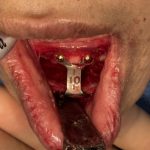
Many times in their removal it is easier to remove them in pieces as they fragment fairly easily. Here is a recent case I did where another surgeon secured a chin implant in with 8 screws! While I am a fan of screw fixation  for facial implants, the reason for 8 screws in a single chin implant is  unclear. With so many screws, the Medpor chin implant needed to be removed in pieces to access all of the screws.

A new Medpor chin implant, of a different size and style, was inserted and secured with two new screws. The underlying bone showed no resorption and the overlying soft tissues had but a thin capsule. There was nothing abnormal about the revised chin implant site.

Medpor facial implants should not be viewed as overly difficult or destructive to remove should they need be. The material easily fragments helping preserve the tissue quality of the recipient site.  

Dr. Barry Eppley

www.eppleyplasticsurgery.com

Indianapolis, Indiana


Background:  Chin augmentation is the original and the most common area of facial skeletal enhancement. As a projecting edge of bone that is fairly easy to access, placing a chin implant is understandably perceived as a very simple and near error-free facial implant procedure. Despite this commonly-held belief, however, chin implants do have problems and need to be revised, replaced, or even removed.  

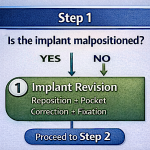
There are two common chin implant problems, malpositioning and implant selection. Malpositioning of a chin implant can occur in two different ways. Superior or upward migration of the implant usually occurs if it is placed from inside the mouth. While the intraoral approach avoids an external incision, its path of dissection provides an avenue for the implant to slide up along the bone afterwards. Lateral or wing malpositioning is actually the most common problem and is a result of the newer styles having thin and more floppy wing extensions which can easily fold onto themselves. Chin implants can also have size (undersized, oversized) and style (too wide, too narrow) problems which is a preoperative diagnosis and selection issue.

Case Study: This 40 year-old male was unhappy with the result of his chin augmentation. He had two prior chin implant procedures. They were done from an intraoral incisional approach. He felt that his chin was still not defined and prominent enough. He wanted a more masculine chin appearance. He had a record of his indwelling chin implant which was silicone in composition,7mms in projection, with limited lateral wings.

To improve his chin result, two different approaches were discussed for a revisional surgery. First, use a submental skin incision to remove the existing implant and replace a new one at the lowest position on the bone. Secondly, a different implant style would be used that had greater lateral extensions to add more lateral chin fullness and width.

During surgery, the submental incision was done but no implant was found at the inferior border of the chin. Located 14mms above the chin border, an implant was found and removed. There was 2 to 3mms of bone resorption underneath the implant when it was removed. Pockets  were dissected out along the  lower border of the jaw from the midline about 4.5 cms per side. A new chin implant style, a chin-prejowl design, was then inserted. Pulled down to the lower edge of the bone, the implant was secured with a single 12mm long titanium screw.

The immediate results of this chin implant exchange and repositioning can be seen just one hour after surgery. The chin had more lateral fullness and better horizontal projection, particularly at the low edge of the chin bone which is the most important point of increasing its projection.  

Case Highlights:

1)      Chin augmentation requires proper placement of the implant on the bone. Intraoral chin augmentation is prone to superior implant migration and malpositioning.


2)      Replacement of a highly positioned chin implant is best done from a submental approach with screw fixation.


3)      In the male chin augmentation, consideration needs to be given to an implant design that provides more lateral fullness and extends back further towards the body of the mandible.


Dr. Barry Eppley

http://www.eppleyplasticsurgery.com

Indianapolis


April 26, 2009

Chin Augmentation - Implant Styles and Sizes

Author: barryeppley

Chin augmentation using an implant is a very common  and satisfying plastic surgery procedure of the face. Its success is primarily based on the implant itself, both in size and style type. Surgical placement, whether done through the skin under the chin or through an incision inside the mouth, is straightforward and is not a significant contributor to a good outcome in experienced hands.

In days of old, chin implants were of one main style…a central button type implant which provided forward projection which was  limited to the central chin. While this type of implant may be appropriate for a few patients, chin deficiencies are three-dimensional and this style of implant is not appropriate for many of them. Today, numerous styles and sizes of chin implants are available that help better treat a larger number of chin shape problems.

In assessing one’s chin deficiency, it is important to look at the overall face to see how changes in the chin would be most aesthetically beneficial. From this assessment, one can look at the four main chin implant styles. They include anatomic, extended anatomic, pre-jowl, and square types.

 Anatomic chin implants are the short in width and are really the original or first generation type implant. It increases the forward projection of the central chin only. This is good for chins, particularly female, in which increasing chin projection will make the chin look narrow as well from a frontal view. This is never good for use in men in my experience.

The extended anatomic chin implant is, by far, the most common one used. With the implant wings which extend out laterally, the increase in forward projection is also accompanied by the side of the chin coming forward (not as much as the central part) as well. These wings taper and blend into the side of the jaw bone so a step-off or sharp transition into the side of the jaw is not seen or felt.

The pre-jowl chin implant is uniquely used for the older patient to help with aging marionette lines. Similar to the extended anatomic implant, its lateral wings are thicker  so that fullness can be beneath the vertical skin folds (marionette lines) to help plump them out.

The square chin implant is obviously designed to help male patients achieve a bigger chin that has a more masculine and stronger appearance. Its lateral wings are as thick as the central part which then taper back onto the bone. I have yet to use this implant in a woman.

All chin implant styles come in three or four sizes which differ in projection n thickness and length around the curvature of the chin. In my Indianapolis plastic surgery practice, I like to look at photographs and use computer prediction imaging to help make a style and size selection. While imaging is never completely accurate, it does help communication and understanding…even if nothing is achieved other than the patient pointing out what she  is not interesting in looking like.

Dr. Barry Eppley

http://www.eppleyplasticsurgery.com

http://www.ologyspa.com

Clarian North Medical Center, Carmel, Indiana

Clasrian West Medical Center, Avon, Indiana

Indianapolis


April 11, 2009

Double Chin Correction

Author: barryeppley

The double chin is not truly two chins in the classic sense. Rather it is one upper chin (true chin) that is bony in nature and a lower chin that is really an accumulation of fat. (false chin) The development of fat accumulation can occur quite easily beneath the jawline in some people. For those predisposed, the double chin can develop even when one is not particularly overweight. Short necks, low hyoid bones, and underdeveloped jaws are all anatomic factors that can lead to the appearance of a double chin.

Some try exercise and diet to lose the double chin but with little success.  Double chin exercises, chin exercisers, and devices such as ‘chin gyms’ can improve platysmal (neck) muscle tone and make it more firm.  But the collection of fat on the upper neck or under the chin will remain, no matter what exercises are done.  You simple cannot exercise neck fat away. 

Liposuction double chin surgery is very effective for eliminating and getting rid of excess fat and or loose or sagging skin of the upper neck area.  With the newest small cannula and Smartlipo (laser lipolysis) liposuction techniques, neck fat can be very effectively removed. With fat removal, chin and neck skin tightens as part of the healing process, getting rid of the false chin and improving the neck angle in profile.  

Liposuction of the neck is part of all double chin corrections and most low-hanging neck issues. (e.g., facelifts) Through a tiny skin incision under the chin under local anesthesia, a fiberoptic cable for Smartlipo or small liposuction cannulas are used, both of which are usually less than 2mm in diameter and are not much larger than the lead from a #2 pencil. I really like to use the laser energy from Smartlipo as the heat generated melts fat as well as has a positive effect on neck skin tightening. 

How large the double chin is and how tight or loose the neck skin is determines whether liposuction alone will be sufficient. Skin that is not too excessive or is thick will likely tighten fairly well. A lot of neck skin or skin that is thin and wrinkly will not likely do well with liposuction only. Other accompanying procedures such as a face or necklift may be needed in these cases. 

In double chins, it is also important to look at the true chin and see if it is far enough forward in the facial profile. Some double chin corrections can really benefit by chin augmentation as well. In a deficient bony chin (too short), the combination of a chin implant (bigger true chin) and the reduction of the false chin by liposuction can make a really dramatic change.  

In my Indianapolis plastic surgery practice, most patients take 2 to 3 days from work after chin liposuction surgery.  But they are easily able to undergo light to moderate activity during that time.  There is minimal to moderate swelling and bruising which rapidly subsides. After liposuction for double chin, a special garment is worn for a few days.  It is an elastic strap, kind of like an enlarged chin strap.  The purpose of the garment is to provide a little gentle pressure for a few days.  After that, no special care is needed.

 Dr. Barry Eppley

http://www.eppleyplasticsurgery.com

http://www.ologyspa.com

Clarian North Medical Center, Carmel, Indiana

Clarian West Medical Center, Avon, Indiana

Indianapolis


April 16, 2008

Jaw Angle Implants for Men and Women

Author: barryeppley

A more defined jaw angle is a not uncommon request of men, particularly younger men. I am seeing more of these patients recently than ever before. This is presumably driven by the desire for increased facial angularity and jaw line definition as seen in many male models. Surprisingly, I have also seen a few women with the same request although the female models that I have seen with this look (surgically created or natural?) look a little cartoonish to me.

 
Either male or female, the procedure is the same. An intraoral incision is used along the back part of the jaw. The large masseter muscle is lifted up along the entire angle of the jaw. The only ‘difficult’ part of a jaw implant angle procedure, in my opinion, is in the selection of the type of implant material (silicone rubber vs. polyethylene (Porex) and the exact style and size of the implant. There are theoretical differences between silicone vs polyethylene but, in the big picture, I am not sure any real differences exist in terms of postoperative outcome. I think the plastic surgeon should use whichever implant material thay are most comfortable. Whether to drop the existing jawline by an extended implant or simple along the current jawline to be widened is another decision. I found that most of the time an extended implant that lowers the jawline is most useful in those patients who have an ill-defined jawline that is both narrow and obtuse in angularity. Many men will get an extended style of implant, the few women I have done get a little increased width only. Whatever jaw implant is chosen and placed, it is very important to secure it in place with a screw or two. The only complications I have ever seen with jaw angle implants has been implant migration toward the incision. This risk is completely eliminated by secure screw fixation.

 
After surgery, there is a fair amount of discomfort due to muscle trismus and swelling. Unlike any other facial implant, jaw angle implants produce the greatest amount of discomfort and dysfunction. (difficulty with opening your mouth for a few weeks) However, jaw angle implants produce a nice lower profile change that is second only to what a chin implant can do. Sometimes, for maximum effect, jaw angle implants and chin implants may be done together to accentuate the entire jawline.

 
Dr Barry Eppley
http://www.eppleyplasticsurgery.com
http://www.ologyspa.com
Clarian North Medical Center, Carmel, Indiana
Clarian North Medical Center, Avon, Indiana
Indianapolis


April 2, 2008

Chin and Jawline Augmentation in Male Plastic Surgery

Author: barryeppley

The facial features most associated with masculinity is the chin and jawline. A stronger chin and jawline conveys increased masculinity, smaller chins and ill-defined jawlines convey timidity and weakness. While this perceptions may not always be true (and often aren’t), they certainly help create a first impression by their appearance. In today’s plastic surgery, newer generation implants and fillers make this look possible more than ever before.

 
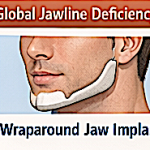
Chin implants have really evolved over the past decade with many new styles and sizes. The most important change has been that they have been extended in their shape rather than small ‘buttons’. The idea is to have an enhanced chin that flows better into the surrounding jaw. This requires an implant that ‘extends’ back from the chin to create a smooth transition from the augmented chin to the back of the jaw. These newer implants are longer and more tapered at the ends, although they can still be placed through a small incision right under the chin. Because they extend back further they give an enhanced but natural appearance to the chin. This is achieved by filling in the jawline between the chin and the back of the jaw, slightly widening the anterior jawline making the overall look more balanced. In addition to jawline width, chin and jawline height can also be lengthened by having a ‘wrap-around’ implant that extends lower than the existing edge of the bone. Prior to these type of implants, only cutting the bone or bone grafting could have achieved this look. This increases the height of the lower third of the face, a very male-enhancing effect.

 
New implant options also exist for bolder cheekbones and more square jaw angles. Small cheekbones generally are not as obvious as a smaller chin but the effect on the appearance of the face is just as real. Small cheek bones create a flatter facial appearance or even a longer thin face look. Several styles of cheek implants exist to fill out different areas of the midface, from creating higher cheekbones to improving that sunken cheek look. Cheek implants are placed through an incision in the mouth so there is no scarring. A more square and well-defined jaw angle is a very masculinizing look and can only be created with implants. Jaw angle implants can eitehr widen the back of the jaw, make it more longer and more square, or both. Like cheek implants they are placed inside the mouth so scarring is never any issue.

 
It would not be uncommon to perform several areas of facial enhancement in the male to get the overall look that they want. Since an appreciation of facial shape and how the different areas can be changed and how they would look from implants mandates that computer-imaging be used. I find it usually takes at least two consultations to thoroughly cover all the options and make sure the patient has complete understanding of the facial look that they desire.

 
Dr Barry Eppley
http://www.eppleyplasticsurgery.com
http://www.ologyspa.com
Clarian North Medical Center, Carmel, Indiana
Clarian West Medical Center, Avon, Indiana
Indianapolis


December 30, 2007

Chin Implants in Indianapolis by Dr. Barry Eppley

Author: barryeppley

Chin Implants for Facial Enhancement in Indianapolis


In the pursuit of improved facial balance and shape, the chin is one of the most prominent facial features. When combined with the nose, these two protruding structures have great influence on the overall appearance of the face. We usually don’t give the chin much thought, until it is either too weak or too prominent, and then it becomes the defining part of one’s face (in a negative way). When the chin is deficient (weak), the facial profile has a very convex appearance with the appearance of a short neck as well. As long as the chin deficiency is not too great and the overall jaw is not short with a malocclusion (bad bite), when jaw lengthening surgery may be more appropriate, the use of a chin implant is a simple and proven method. In my practice here in Indianapolis, I always discuss with the patient the two methods of chin enhancement; implants vs osteotomy (moving the bone forward). Over 90% of the time, a chin implant is chosen.


While chin implants are available in different materials, I prefer the use of solid silicone (rubber) chin implants, which are still by far the most commonly used. They are soft, flexible, and slide easily into place along the chin bone. The chin implant is inserted through a small incision hidden underneath the chin below the jaw line. This leaves no visible scar. Usually the chin implant is sutured into place, however, I sometimes use a metal screw to secure the implant to the bone. This screw fixation method can eliminate one of the very few complications of chin implants, that of shifting or changing position after surgery causing chin asymmetry. I rarely insert a chin implant through the mouth as it is more painful, has more swelling, and is more easily displaced upward off the chin prominence.While any implant (foreign-body) has some risk of infection, chin implant infections are quite uncommon.


Enhancing the chin with an implant is the most commonly performed facial implant procedure. The goal of a chin implant is to bring the chin forward enough so that it is in balance to the nose and lips. Unlike the old style ‘button’ chin implant, there are many different styles of chin implants today. From curved anatomical styles, to a more box shape, to chin implants with a central dimple, there are many options to custom tailor a chin implant to fit most patient’s faces. The different sizes of chin implants makes it possible to make a subtle or a dramatic facial change, dependent upon the patient’s cosmetic needs.


Chin implants are commonly in conjunction with other facial procedures including rhinoplasty, neck liposuction, and facelifts. In some cases, the use of different implants in the same patient, such as a chin and jaw angle implants in a male, can provide dramatic changes in one’s facial appearance. Chin implants are a powerful procedure, that is simple and usually uncomplicated, to achieve better facial balance.


Dr Barry Eppley
http://www.eppleyplasticsurgery.com
http://www.ologyspa.com
Clarian North Medical Center, Carmel, Indiana
Clarian West Medical Center, Avon, IndianaIndianap