EXPLORE
Plastic Surgery
Dr. Barry Eppley

Explore the worlds of cosmetic
and plastic surgery with Indianapolis
Double Board-Certified Plastic
Surgeon Dr. Barry Eppley

Archive for the ‘custom facial implants’ Category

Custom Facial Implants From PreFormed 3-D Model Modifications

Sunday, December 11th, 2011

The use of implants makes it possible for many cosmetic facial procedures to be done. The mere existence of some of these implants has created new possibilities for facial augmentation. A wide variety of preformed implants of differing materials are available which allows the plastic surgeon to enhance structures as diverse as the temporal regions to the jaw angles. But despite the dozens of implants available, there still remains certain aesthetic facial problems which are not adequately treated by their existing dimensions and sizes.

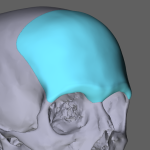
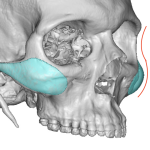
The use of custom facial implants is ideal for the truly unique aesthetic case, whether it be because of altered anatomy or that existing preformed implants are not adequately sized or shaped. The traditional use of custom facial implants begins with obtaining a 3-D model of the patient from a high resolution CT scan. From that model, either the plastic surgeon or a manufacturer creates the desired implant design. In my practice, I hand carve all implant designs myself out of clay based on this model. The final facial implant is then manufactured out of silicone material and sterilized by one of several major implant manufacturers.

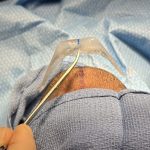
While this custom approach to unique facial implants is ideal, it adds considerable expense and time to the final cost of the surgery. There are cases where the custom facial implant process can be streamlined and expenses reduced. In this custom approach, a 3-D CT model is still needed and used as a template for implant fabrication. But instead of making a new implant design from scratch, existing preformed implants are used as the ‘templates.’ They are placed on the patient’s 3-D model and carved down to the desired shape before surgery. This then becomes the final implant which is then sterilized for the patient’s surgery.

This modified custom approach obviates the need to have a new implant fabricated, saving presurgical time and cost. In an elective aesthetic facial case, however, time is not as important as cost. This concept only works when the size of the preformed implant is adequate but its shape or adaptation to the desired bone site is insufficient. If the preformed implant is too small, then the custom implant will have to be made in the traditional manner from a clay prototype.

I have found that this modification of preformed implant approach is effective for a variety of aesthetic facial situations. For the patient who is just not comfortable with the  traditional but ‘blinded’ approach to facial implant augmentation, the 3-D model can help create confidence in the implant selection process. It also allows any minor modifications to the implants selected. Where it can be tremendously helpful is in revisional facial implant surgery where the positions of the existing implants are ill-placed, asymmetric or otherwise of inadequate shape.  

Dr. Barry Eppley

www.eppleyplasticsurgery.com

Indianapolis, Indiana

The Process of Custom Jawline Implant Design and Fabrication

Thursday, September 1st, 2011

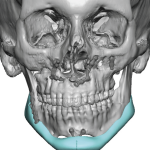
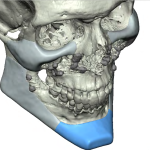
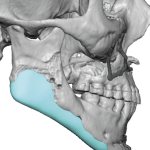
A well-defined jawline has become a recognized aesthetic facial skeletal feature, particularly amongst men. An appealing male jawline has a strong chin, jaw angles that are more square with a slight outward flare and a continuity between the front and back of the jaw, creating a wrap-around effect that flows smoothly around the arc of the jaw. While such a male jawline has probably always been desireable through the ages, it has acquired a lot more attention recently due to new techniques and implants that make it surgically possible to alter or create one.

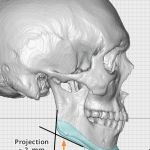
While most male jawline augmentations can be done with conventional off-the-shelf implants, certain jawline deficiencies and aesthetic desires can not be ideally treated this way. Vertical lengthening of the jawline is a good example where standards implant can not create this dimensional change. Certain styles of jaw angle implants do provide some vertical lengthening but no chin implant does so. Traditional chin and jaw angle implants, which come in many different styles, do not connect across the body of the mandible which disrupts a smooth jawline look.

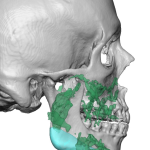
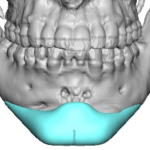
Custom jawline implants are designed off of a patient’s jaw or mandibular model. This is obtained by first getting a 3-D CT scan of their lower jaw. This can be done at almost any facility, hospital or free standing, that offers CT services. The CT scan is done with 1mm cuts which is standard for 3-D reconstructions. The scan data is then sent to a model manufacturer. I currently use Medical Modeling (Golden, Colorado) who makes great models with a rapid turnaround time. Such models can be made either opaque (osteoview) or with clear acrylic where the intrabony structures can be seen. (clearview) For implant designing, the opaque osteoview model is just fine and comes at a lower cost.

The jaw model is then used to make the chin and jaw angle implants. While it is often thought that such implants are made using a computer or CAD-CAM technology, such is not the case. No computer or technician can know what is the best design for the patient’s need or, more importantly, whether any implant design can actually be made to fit into the patient. Computer design works well in reconstruction when there is a facial deficiency on one side and it is normal on the other. Then the computer has a well-defined implant design goal to match. But in aesthetic implant designing, the end target is not as clear and requires the aesthetic judgment of the surgeon. This is why I custom design and fabricate them myself out of modeling clay. These shapes can be shared with the patient for their input as well. Once the final clay implant models are completed, they are allowed to cure and covered with a varnish finish.

The custom-designed jaw implants and the model are then sent to an implant manufacturer. The only material that can be used to make custom implants is silicone. This is because it is a liquid composite that can be poured into a mold and allowed to set. The clay implants are used to make a mold into which the silicone is poured. Other implant materials, such as medpor, would have to be machined which would not only would be a lot more expensive but its manufacturer does not currently offer that service. The final implants are sent back to me for surgical insertion.

Custom jawline implants can be designed and available for surgery in as little as three weeks after a patient acquires their 3-D CT scan. The cost of this custom facial implant process is $7500. Surgical costs are in addition to the implant fabrication process. While only a minority of male jawline enhancement need custom implants, the final aesthetic results are far superior to trying to use or modify existing off-the-shelf facial implants.

Dr. Barry Eppley

www.eppleyplasticsurgery.com

Indianapolis, Indiana


Dr. Barry EppleyDr. Barry Eppley

Dr. Barry Eppley is an extensively trained plastic and cosmetic surgeon with more than 20 years of surgical experience. He is both a licensed physician and dentist as well as double board-certified in both Plastic and Reconstructive Surgery and Oral and Maxillofacial Surgery. This training allows him to perform the most complex surgical procedures from cosmetic changes to the face and body to craniofacial surgery. Dr. Eppley has made extensive contributions to plastic surgery starting with the development of several advanced surgical techniques. He is a revered author, lecturer and educator in the field of plastic and cosmetic surgery.

Read More


Free Plastic Surgery Consultation

*required fields


Pricing

The cost of any type of elective plastic surgery plays a major role in the decision to undergo the procedure(s).

More Info


Military Discount

We offer discounts on plastic surgery to our United States Armed Forces.

More Info


Categories