EXPLORE
Plastic Surgery
Dr. Barry Eppley

Explore the worlds of cosmetic
and plastic surgery with Indianapolis
Double Board-Certified Plastic
Surgeon Dr. Barry Eppley

Archive for the ‘forehead recontouring’ Category

Gender Differences in Forehead Recontouring Surgery

Tuesday, February 8th, 2011

The forehead occupies a major part of the face, up to one-third of its total length. It is a major contributor to facial aesthetics even though it appears largely as a blank slate. Because it has few identifiable features (only the eyebrows) other than wrinkles, it is often overlooked as a facial feature which can be modified. Botox and browlifts affect change in the overlying soft tissue, but the bony shape of the forehead  

The forehead is outlined by three features which create the visual impression of its overall size. The top of the forehead is marked by the variable position of the frontal hairline which differs greatly by female vs. male gender. The bottom of the forehead is evidenced by the eyebrows and the supraorbital rims, which is the ridge of skull bone just above the eyes. The sides of the forehead are defined by the temporal ridges, the edges of the bony forehead where it meets with the large temporalis muscle.

It is the shape of the bony forehead (amount of convexity) and the prominence of the brow ridges that help define a more masculine or feminine appearance. In times past, its shape was also thought to impart the degree of intellect of an individual. This is most commonly portrayed in movies where the villians, monsters and other evil-doers will usually have big and bulging foreheads, often being grotesquely distorted.

As a gender marker, the forehead has some well-defined features. The forehead differs in the areas of the brows and the mid forehead and the skull’s shape affects the drape and contour of the skin. A long forehead is generally more acceptable in a male, largely because the variability of a receding hairline (particularly in an M-shaped pattern) is well known and expected. The bone ridge running across the forehead above the eyes, known as brow bossing (supraorbital rims), is more pronounced in males. The degree of acceptable brow protrusion is not well-defined and it can certainly become excessive causing an over-masculinized or Neanderthal appearance. Male brow protrusion should be enough to create a noticeable break between the brow ridge and the forehead bone above it. It may also extend off to the side tapering down onto the lateral orbital rim.

While a long forehead is generally acceptable for the male, it is not in a female. Females have almost no discernable brow bossing because their foreheads are more rounded with a fairly flat front. In profile, female foreheads are more vertical instead of backward sloping. This means that some brow bossing may be aesthetically acceptable but there is no break between the brow ridge and vertical forehead bone above it, it should flow very confluently without a noticeable transition. The amount of convexity in profile view, however, is important and it should not stick out further than the lowest edge of the brow ridge. The sides of the brow ridges are also more tapered towards the temples unlike the male which can be more boxy or square-shaped.

These aesthetics considerations are critical when it comes to performing recontouring of the forehead in men and women. While forehead reshaping is often thought of as exclusively being done in facial feminization surgery, it is not in my experience. I have done as many if not more forehead surgeries in gender-stable patients. It is the nuances of the brow shape and how it flows into the upper forehead in both frontal and profile views that can make the difference between a good vs. an unhappy surgical outcome.

Dr. Barry Eppley

www.eppleyplasticsurgery.com

Indianapolis, Indiana

Common Questions on Forehead Reshaping and Contouring

Monday, February 8th, 2010
  1. What influence does the forehead have on one’s appearance?

The forehead is a very prominent and visible facial area. While it is not the most dominant facial feature, it does have an influence on one’s appearance in numerous ways.

The forehead does have an influence on gender appearance. In men, the brow ridge (bossing or prominence above the eyes) is stronger and the forehead angles more steeply away from the eyes. In women, the forehead does not have a prominent brow ridge, tends to be more round, and angles more vertical above the brow rather than more backward sloping as in men.

A forehead can often be seen as too ‘big’ because of the distance between the eyebrows and the frontal hairline. When more than 6.5 cms exists between the two, the forehead will look elongated or large. This may be the result of frontal hairline recession in men or the natural position of the hairline in women.


  1. How is forehead reshaping done?

Changing the shape of the forehead can be done in three ways. Brow ridge (bossing) reduction, brow ridge augmentation, or altering the slope or shape of the forehead between the brow bone and the top of the skull under the hairline are the common changes requested.

They all share one common theme, the need to use a coronal or scalp incision for access to do the procedure. This is a more significant aesthetic consideration in men. Surgically changing the brow bone uses different techniques depending upon whether one is reducing or building it up. While some minor bone alterations may be able to be done endoscopically (from above) or through the upper eyelids (from below), major changes require the liberty of unfettered access by the turn down of a scalp flap.

  1. How is brow bone reduction done?

In brow bone reduction, the anatomy of the prominent brow must be appreciated. The cause of a prominent brow is that the underlying frontal sinus cavity is expanded. (pneumatized) Because the frontal sinus is air-filled, the prominent brow ridge only has  thin bone covering it. It can not just be burred or shaved down in most cases. Only the tail of the brow ridge, where the frontal sinus does not exist, can be simply reduced by shaving.

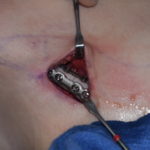
In the setback of frontal bossing, the thin plate of overlying must be removed, reshaped, and put back in place with small titanium plates and screws (1mm profile) to hold the bone in place while it heals.

A plain lateral skull film or cephalometric x-ray will show how much frontal bossing is caused by air vs. actual bone.


  1. How is brow bone augmentation done?

Building up a deficient or over-reduced brow ridge requires the use of synthetic materials which are added on top of the bone. The two most commonly used cranioplasty materials are acrylic (PMMA) and hydroxyapatite. (HA) Each material has its own advantages and disadvantages and either one can work in experienced hands.

PMMA incurs less cost to use and has a very high impact resistance. HA is more expensive with a lower impact resistance to trauma. Both can be impregnated with antibiotics and shaped during the procedure. How much material to add and where to place it is very much like sculpting and requires a thorough discussion before surgery with the patient.

Solid implants, composed of silastic, Gore-tex, or Medpor, can also be used. They require more effort at shaping and must be held in place with tiny titanium screws. Their cost is intermediate between PMMA and HA.

  1. Can other areas of the forehead be reshaped besides the brow bone?

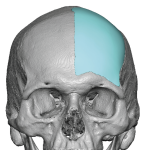
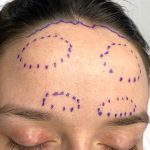
The forehead (frontal bone) between the brow ridge and the front of the hairline can also be reshaped. It can be made flatter, more round, narrower, or wider. Changes can be done in either profile, width, or both. This is done through either burring of the prominent areas, adding material on deficient areas, or a combination of both.

  1. What is the recovery after forehead reshaping? What complications can occur?

Aesthetic forehead surgery is usually done as an outpatient procedure. Depending upon what other procedures may be done with it, it may require an overnight stay in the surgical facility. A wrap-around forehead dressing is put on at the end of surgery and is removed the next day. In some cases, a drain may be removed (not commonly) and it is removed the next day also. Ther6e is some mild pain afterward but much of the forehead skin will be numb for awhile. Pain is easily controlled by pills. There will be some swelling afterwards which is driven downward by the dressing and gravity which affects the eyes and upper cheeks. It is most evident by two days after surgery and is largely gone within seven to ten days after surgery. Most patients return to work in two to three weeks. Dissolveable sutures are used in the scalp so there is no need for suture remocal. One can return to working out in two weeks after surgery.

Complications of significance are very rare with forehead surgery. The forehead skin will be numb but normal feeling will return in most patients within six to eighty weeks after surgery. It is possible to not get back all of your feeling. The biggest concern is aesthetic…did we achieve what our goal was? Is the forehead contour smooth and even? Is it too much or too little?

  1. What can I do if my forehead is too long?

Usually a long forehead is a female concern. It is evident when the distance between the eyebrows and the frontal hairline is aesthetically too long, usually greater than 6.5 or 7cms in length.

The length or size of the forehead skin can be reduced by a scalp advancement (hairline lowering. This is conceptually a ‘reverse browlift’. An incision is made at the frontal hairline and the scalp behind it is loosened and brought forward over the fixed forehead skin. The underlying forehead skin is then removed and the hairline closed in its new lower position. A frontal hairline can be advanced between 1 and 2.5 cms, which often makes for a significant difference.


Dr. Barry Eppley

http://www.eppleyplasticsurgery.com

http://www.ologyspa.com

Clarian North Medical Center, Carmel, Indiana

Clarian West Medical Center, Avon, Indiana

Indianapolis

Brow Bone Forehead Augmentation

Thursday, October 8th, 2009

The forehead has a variety of shapes that do differ based on gender. Men will tend to have flatter fuller foreheads with more prominent brow bones (supraorbital ridges) while women’s foreheads will usually be softer, less full, and with flatter brow bones that tend to angle off into the temporal region. Whether it be by a congenital deformity (such as craniosynostosis), frontal tumor resection (craniotomy flap) or from prior contouring purposes (FFS, facial feminization surgery), there are rare instances when one desires to have a fuller or more prominent brow definition restored.

Brow bone augmentation (BBA) is one form of forehead reshaping that can be done. Using synthetic materials as a building material, the bone can be ‘thickened’ and recontoured to alter how the brow looks. Since the eyebrow and the upper part of the eyelid is affected by its underlying bony support, such changes can produce subtle to dramatic differences.

One of the key issues of brow bone augmentation is which material to use. Currently, hydroxyapatite (HA) and acrylic (PMMA) are the only two moldeable materials of choice. Your own bone is usually not a good option since you have to harvest it and how it survives as an onlay is unpredictable. Both HA and PMMA have their advocates but I have gotten good results with both. Either one can do the job. PMMA is much cheaper from a material cost standpoint and is very hard once it sets, being hard if not harder than natural bone. HA is much more expensive, a little harder to work with, and is more fragile to impact. But it is closer to the mineral of natural bone so it has greater compatibility and less risk of long-term body reaction concerns.

There is also the option of a synthetic implant carved out of silicone or polyethylene. (Medpor) This requires a greater degree of skill and time to get all the edges flat and flush with the surrounding bone. It is easy to see how an edge step-off can be felt through the skin unless it is done perfectly. Feathering edges and blending into the surrounding bone is much more assured with the moldable materials. 

The other important consideration of BBA is access. For the most part, an open scalp approach provides the best vision and control of the shape. But this is understandably problematic for most men unless they have a pre-existing scalp scar to use. For most women, this is not a significant issue as a hairline (pretrichial) approach can be done and that scar can really be quite fine and unnoticeable. I know this from a lot of experience with pretrichial (hairline) browlift procedures done for cosmetic purposes.

A non-open scalp approach (endoscopic) can be used in select cases of forehead augmentation. When it is the central or more upper parts of the forehead that are being augmented, the endoscopic approach using PMMA as an injectable material can be done. PMMA can be injected and pushed around as a congealed putty and shaped by external molding through the forehead skin. HA is a quite different material and its handling properties do not permit anything but an open approach scalp approach. But working down at the brow area, which is a very low point for endoscopic visualization, is even difficult with PMMA. Therefore, I would advocate an open approach for any amount of brow bone build-up.


Dr. Barry Eppley

http://www.eppleyplasticsurgery.com

http://www.ologyspa.com

Clarian North Medical Center, Carmel, Indiana

Clarian West Medical Center, Avon, Indiana

Indianapolis


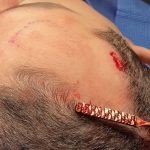
Forehead Contouring and the Coronal Incision

Thursday, August 27th, 2009

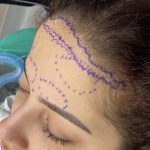
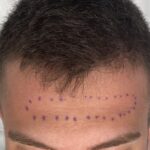
Contouring of the forehead is an uncommon procedure in plastic surgery but the techniques to do it are not. Whether it is to reduce frontal bossing, soften prominent brow bones, or change the slope of the forehead, the forehead can be reshaped in a variety of dimensions. Most reduction changes are more subtle to moderate due to the limitations of the thickness of the skull and the presence of the underlying brain or frontal sinuses. Building up the forehead can produce changes that are more significant as there are no such anatomic restrictions.


Forehead contouring developed from craniofacial plastic surgery techniques. One of the basic craniofacial tenets is that of the approach and using direct vision to see the entire surgical field. Using a coronal or scalp incision, the forehead tissues are degloved or peeled back from the scalp down to the orbital rim. With this amount of access, forehead bone manipulation is fairly straightforward. Whether it is bone reduction by burring, sinus osteotomies for reduction, or adding synthetic materials for augmentation, one is unrestricted in options with this exposure.


More males than females desire forehead and skull reshaping in my Indianapolis plastic surgery practice experience. The limiting factor for males fulfilling that desire is the scalp scar. Males are more limited in having a hidden scar due to the location of their hairline and hair density. Most plastic surgery procedures are about making trade-offs…trading off one problem for another. The trade-off of a scalp scar for a better shaped forehead must be considered carefully in most males. This is rarely such an issue for females.


As craniofacial surgery techniques has evolved, more limited incisional or endoscopic approaches have been tried. In general, these are not particularly effective for most forehead procedures. They can be used to remove small osteomas or soft tissue masses and are very effective for cosmetic browlift and supraorbital nerve decompressions. But the access is too limited and the instrumentation is not sufficiently developed to allow for much bone manipulation. I have done a few synthetic augmentations endoscopically but only partial or subtotal areas can be done satisfactorily this way.


The only other incisional option is an upper eyelid incision but this can only be used for brow bone shaping. The eyelid incision provides good access to the mid- and lateral brow. But the inner brow area is blocked by the important sensory nerves that exit out from the bone there.


The bottom line is…most forehead contouring must be done using the full coronal incision. The magnitude of the deformity will determine whether the scalp scar is a reasonable aesthetic ‘problem’ to replace it. The forehead deformity and one’s concerns about it should be sufficiently significant to make coronal incision worth it.


Dr. Barry Eppley

http://www.eppleyplasticsurgery.com
http://www.ologyspa.com
Clarian North Medical Center, Carmel, Indiana
Clarian West Medical Center, Avon, Indiana
Indianapolis


Forehead Augmentation (Expansion) - PMMA (Acrylic) vs HA (Hydroxyapatite)

Sunday, March 29th, 2009

The desire for forehead reshaping in adults is done for three reasons. Most commonly, it is someone who has a residual forehead deformity due a congenital skull deformity. (e.g., craniosynostosis) As one gets older, or as hair loss occurs in men, the frontal skull deformity becomes more aesthetically obvious. Secondly,  a frontal skull deformity exists due to an injury or after a neurosurgical craniotomy procedure has been done. Lastly, for those individuals going through a gender transition (female to male), the slope of the forehead or the prominence of the brows may be desired to be increased.


For any of these reasons, forehead reshaping involves expansion of the existing bone boundaries. It is not practical to try and do this by manipulating the skull bone in most cases, as there is an easier and more effective solution…..build up the bone with synthetic materials. While I always try to avoid synthetic materials when it is possible, their use in forehead augmentation is the only practical and reasonable option in the vast majority of cases. (onlay cranioplasty) As such, a good working knowledge of the available synthetic materials for the skull is important.


Fortunately, adding to the forehead bone is not a technically difficult procedure. The two questions about it are: what type of material to use…and access to the bone. Forehead augmentation has two very moldable and adaptable materials to build it up with. Traditional PMMA (polymethylmethacrylate) has been around for a long time and has the advantages of a very low cost, high resistance to impact forces, and ease of intraoperative contouring. Its main disadvantage is that some patients over time can develop some low-grade reactions to it and it may get loose, become infected or the overlying forehead skin may thin, although these issues are uncommon. It does generate a lot of heat during its setup (polymerization) but this is managed by cool water irrigation. Newer ‘more natural’ materials such as hydroxyapatite cements (HA) have been available over the past 10 years. HA offers the advantage of being a more natural, less synthetic material as its structure more closely resembles that of bone. Its disadvantages are that it is considerably more expensive, has a low resistance to impact (easily shatters), and is a bit tricker for the plastic surgeon to use. It generates no heat during its setup but is very sensitive to moisture and is easily deformed and pushed around during its set up phase. At this time, there are no long-term clinical studies that give a decided advantage to one material or the other.


Other synthetic options include pre-made or custom-made synthetic implants. They can be made of either silicone rubber (most common), gore-tex, or poplyethylene. In most cases, these would have to be prefabricated based on a skull model of the patient to get the best and most exacting fit. Any irrergularities will be obvious in the contour of the forehead so a precision fit is essential. I don’t find that these onlay custom implants offer any advantages over PMMA or HA in terms of better long-term outcomes or reduced risks of complications.  


Regardless of the material used, synthetic forehead augmentation is all about access. The asiest and most predictable way to place it is through an open scalp incision. While this is the best and easiest way to do, there is always the cosmetic trade-off of this scar. When more limited or endoscopic access methods are used, one has to use PMMA because it is easier to mold through intact skin and will predictably stay where it is placed and molded. Endoscopic forehead augmentation is a more limited procedure due to its more limited visual access.


Dr. Barry Eppley

http://www.eppleyplasticsurgery.com

http://www.ologyspa.com

Clarian North Medical Center, Carmel, Indiana

Clarian West Medical Center, Avon, Indiana

Indianapolis

Forehead Recontouring/Augmentation With Synthetic Materials

Wednesday, December 10th, 2008

Reshaping the forehead is an uncommon patient request. While the plastic surgery techniques to do so are well known and not new, the need to do forehead contouring is not. Most commonly, forehead reshaping is done on patients who had a congenital skull deformity (e.g., craniosynostosis) or a frontal skull deformity secondary to trauma or after a neurosurgery craniotomy procedure. The cosmetic reasons would be to soften prominent brow ridges or to smooth out some forehead irregularities.


The treatment of forehead irregularities can theoretically be done by either burring down bone or adding a synthetic material to it. In reality, burring down bone on the skull is a limited procedure and can never make as big a difference as one would think. The brow ridges can be burred down but the limiting factor is the underlying frontal sinus. If the overlying frontal sinus bone is thin, then very little bone can actually be taken. Above the brow ridges, burring down forehead bone is very effective for small raised areas that are easily identifiable but is less effective at reducing large surface areas of bone.


Filling in or adding to the forehead bone is a much easier and effective procedure. The real question in forehead augmentation is what material to use. Traditional PMMA (polymethylmethacrylate) has been around for a long time and has the advantages of a very low cost, high resistance to impact forces, and ease of intraoperative contouring. Its main disadvantage is that some patients over time can develop some low-grade reactions to it and it may get loose, become infected or the overlying forehead skin may thin, although these issues are fairly low risk. Newer ‘more natural’ materials such as hydroxyapatite cements (HA) have been available over the past 10 years. HA offers the advantage of being a more natural, less synthetic material as its structure more closely resembles that of bone. Its disadvantages are that it is considerably more expensive, has a low resistance to impact (easily shatters), and is a bit tricker for the plastic surgeon to use. The advantages and disadvantages for HA vs. PMMA must be considered and weighed on an individual case basis.


Regardless of the material used, synthetic forehead augmentation usually requires an open scalp incision which, because of its length, is a significant consideration in a cosmetic procedure. (particularly for men) Endoscopic or limited scalp incisions may be able to be used in small areas of augmentation in carefully selected cases.


Dr. Barry Eppley

http://www.eppleyplasticsurgery.com

http://www.ologyspa.com

Clarian North Medical Center, Carmel, Indiana

Clarian West Medical Center, Avon, Indiana

Indianapolis


Dr. Barry EppleyDr. Barry Eppley

Dr. Barry Eppley is an extensively trained plastic and cosmetic surgeon with more than 20 years of surgical experience. He is both a licensed physician and dentist as well as double board-certified in both Plastic and Reconstructive Surgery and Oral and Maxillofacial Surgery. This training allows him to perform the most complex surgical procedures from cosmetic changes to the face and body to craniofacial surgery. Dr. Eppley has made extensive contributions to plastic surgery starting with the development of several advanced surgical techniques. He is a revered author, lecturer and educator in the field of plastic and cosmetic surgery.

Read More


Free Plastic Surgery Consultation

*required fields


Pricing

The cost of any type of elective plastic surgery plays a major role in the decision to undergo the procedure(s).

More Info


Military Discount

We offer discounts on plastic surgery to our United States Armed Forces.

More Info


Categories