EXPLORE
Plastic Surgery
Dr. Barry Eppley

Explore the worlds of cosmetic
and plastic surgery with Indianapolis
Double Board-Certified Plastic
Surgeon Dr. Barry Eppley

Archive for the ‘jaw angle implant’ Category

Case Study: Jaw Angle Implants in Jawline Enhancement

Tuesday, April 17th, 2012

Background:

The aesthetic appearance of the lower third of the face is defined largely by the size and shape of the underlying jaw bone. The support that the bone provides in the transition of the face into the neck creates one of the face’s most distinctive features. There are three aesthetic zones to this jawline including the chin, body and jaw angles. Like the chin in the front, the jaw angles provide the definition to the back of the jaw.

There is usually some correlation between the strength of the chin and the prominence of the jaw angles. As the overall mandible becomes weaker or more underdeveloped, the jaw angle area rotates upward. (becomes shorter) Known as the mandibular plane angle, stronger jaws have less of a plane angle than those that are weaker. This makes them vertically longer and slightly more wide.

Thus when evaluating the jaw angle area, it is important to determine if the deficiency is just one of overall width (desire for more flare or prominence) or whether the problem is more three-dimensional. (combination of vertical shortness and width) The clue to that diagnosis is almost always in the forward position of the chin. The weaker the chin, the shorter the jaw angles and the greater vertical deficiency they have.

In patients seeking jaw angle enhancement, the correct diagnosis of the jaw angle anatomy is critical for this controls the style of jaw angle implant selected. While the size of the implant is also important, no good result can be achieved if the proper style is not selected.

Case Study:

This 35 year-old male presented for multiple facial enhancements from the temples down to the jawline. His jawline concerns were that of it being weak. On examination he had a moderate chin deficiency with a mentalis muscle strain evident. His jaw angles were high (1.5 cms above the horizontal chin position) and narrow.

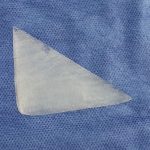
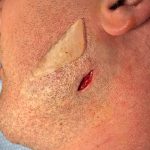
Under general anesthesia, he initally had a large square silicone chin implant placed through a submental incision. The forward projection of the implant was trimmed back to 5mms. This allowed for a more square effect to be seen at the sides of the chin but without too strong of a horizontal change. Through an intraoral approach, jaw angle implants were placed beneath the masseter muscles. Because he needed vertical lengthening, the tendinous attachments of the masseter muscle were released back at the angle area. A vertical lengthening Medpor jaw angle implant was used that was 7mms in width and 10m in vertical length. Once properly positioned, it was secured into place with a single screw on each side.

His postoperative course was typical for every jaw angle implant patient, one of considerable facial swelling and masseter muscle tightness. This took three weeks to look less surgical and six weeks to really look normal and be completely in the ‘benefits’ phase of recovery. While he had good improvement, he felt the jaw angles were too strong and requested some reduction in them. This was done by cutting down the size of the implants in a revisional procedure.

Jaw angle implants can make a dramatic difference in the jawline and be very complementary with chin augmentation. Choosing the right implant style is critical. Size estimation with jaw angle implants, however, remains very subjective and lacks any objective method for selection. Over-correction and asymmetry remains the biggest reasons for revisional surgery with this type of facial implant.

Case Highlights:

• Jaw angle augmentation is a part of overall jawline enhancement and is often done in combination with chin augmentation.

• Jaw angle augmentation can be done either as a two-dimensional change (width and greater angle definition) or three-dimensional. (width, vertical length and angle definition)

Jaw angle implants are placed through an intraoral approach in a submuscular position. The greatest risks with their use are the aesthetics of symmetry and size.

Dr. Barry Eppley

Indianapolis, Indiana

Structural Facial Surgery In Men And The Male Model Look

Wednesday, August 3rd, 2011

Almost anyone in the world is aware of the recent tragedy in Norway with the mass killings of an incomprehensible number of Norwegian teens and young adults. The murderer Anders Breivik appears to have acted alone, driven by his white supremacist and anti-Muslin views. What has caught my attention as a plastic surgeon, however, is comments that have been written about his facial appearance.


According to the head of Norway’s intelligence agency, it is believed that he had undergone plastic surgery in the past to look more “Aryan.” The agency’s head has stated that “You do not have that Aryan look naturally in Norway”…”Hitler would have had him on posters. He has the perfect, classic Aryan face. He must have had a facelift.”


While I am not an expert on Norwegian facial structure, I do know that he would not have had a facelift to change his facial appearance. That is not what a facelift does. A facelift is what I call ‘anti-aging facial surgery’, where one is trying to return to one’s prior appearance. This does not change your face but rather makes it look rejuvenated and less tired like it did 10 or 15 years ago. But you still look like you, just a better you.


Rather he would have undergone ‘structural facial surgery’, where the foundational components of the face are altered. That can and often does change one’s appearance. Foundational facial procedures are done at the bone or cartilage level, not just the skin and soft tissues. This includes plastic surgery procedures such as rhinoplasty and facial bone augmentations. (forehead, brow, cheek, chins and jaw angles) According to reports, he supposedly underwent nose and chin surgery at age 21. This would make more sense as these can change the structure of the face and definitely can make one more Aryan in facial appearance, particularly if certain elements of the face are already there.


This raises the question of what is an Aryan facial appearance and why does it look so? The word Aryan, at least as it was perceived and used in Nazi Germany, specifically refers to being white, blond-haired and blue-eyed. But there is not necessarily a specific set or arrangement of facial features that are ascribed to an Aryan face. People talk about it and one would know if they saw it but may not be able to describe the details of it.  But what it undoubtably refers to is a strong and well-chiseled face. For a male this would be highlighted by well-defined facial bony prominences of the brows, cheeks, chin and jaw angles. The nose would have a strong and high dorsal line with a balanced ratio between the three nasal thirds.


The concept of an Aryan face continues to exist today but it is better known as the ‘Male Model Face’. Most young male models in any advertisement today almost all have this type of facial appearance. Whether they have it by genetics, plastic surgery or the use of good lighting and/or Photoshop, the strong and desireable male face has these consistent features.


Plastic surgery techniques today can help many men undergo these type of structural facial changes. Rhinoplasty, anatomical cheek implants, square chin implants, vertical lengthening jaw angle implants and occasionally select fat removal below the cheeks and in the neck can create a face that has more well-defined angles and is more masculine in appearance. For some men, this ‘Male Model Surgery’ can be very effective provided they don’t have a lot of facial fat and not an overly round face.  


Dr. Barry Eppley

http://www.eppleyplasticsurgery.com

Indianapolis, Indiana

Case Study: Custom Jaw Angle Implants For Extreme Jawline Enhancement

Saturday, June 25th, 2011

Background: The desire for a stronger jaw appearance is sought by many younger men. Part of a strong jawline is the size and angularity of the jaw angle. Located under the masseter chewing muscles, the right or left angle of the back part of the jaw is one of the largest areas of the lower jaw. Unlike the chin, the jaw angle is not a profile structure of the face and is most evident in the frontal and oblique views.

A well defined jaw angle has visible vertical and horizontal edges, some degree of outward flare, and sits above the level of the lower edge of the chin. This allows the profile of the jawline to be seen to angle back and outward from the frontal view, creating a V-shaped configuration. There is no aesthetic consensus on how much flare is best or the vertical relationship of the angle to the chin.

Implants are the only plastic surgery option for creating increasing the prominence of the jaw angle. There are no osteotomy or bone moving procedures that can enhance its shape. Jaw angle implants come in two basic styles, one for lateral augmentation (pushing out the existing bone shape) and inferolateral augmentation. (creating a lower and wider jaw angle partially below its existing shape) Selection of the proper implant style for the patient’s anatomy is critical to get an improved jaw angle definition result

Some men, however, desire a jaw angle change that simply can not be obtained with current implant styles. Or have had prior jaw angle implant surgery, and while finding it provided some improvement, was not satisfied with the result. In these cases, only custom jaw angle implants will suffice.

Case Study: A 35 year-old male had prior chin and jaw angle implant surgery. While there was visible improvement, he wanted a much stronger chin and jaw angle augmentation with an overall more defined jawline. Given the size of his current implants, larger off-the-shelf implants would still fall short of his goals. Therefore, a custom implant approach was used.

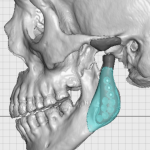
An initial 3-D CT scan of the mandible was obtained and a polymer-based mandibular model created. Jaw angle implants were fashioned out of clay and hand-carved to the desired size. They were also made to connect with the largest off-the-shelf silicone square chin implant available. Once created, the implant mock-ups were sent to a manufacturer where they were made into silicone implants and sterilized.

During surgery, his old chin implant was removed and a new larger square chin implant placed. To get even more horizontal projection of the chin, the back section of the old implant was placed behind the new one using a wafer technique. The two stacked chin implants were then screwed together down to the bone. Then his old jaw angle implants were removed and replaced with the new custom ones. The back end of the chin implant wings was sutured to the front edge of the jaw angle implants as initially envisioned on the model during their creation.

He reported that his postoperative recovery was less much severe than his first chin and jaw angle surgery. This was presumably due to the presence of pre-existing pockets from his prior surgery. Although the jaw angle implant had to be significantly lowered and extended to accommodate the size of the new implants. This custom implant approach satisfactorily achieved his aesthetic jawline appearance goals..

Case Highlights:

1) Prominent jaw angles are a desired feature for many men to create a more angular and visible jaw line. Jaw angle implants are the only surgical method available to augment this part of the lower jaw.

2) Current off-the-shelf styles of jaw angle implants may not create a strong enough change for some men. For these patients, custom jaw angle implants may need to be made.

3) Made off of a jaw model from a 3-D CT scan, custom jaw angles implants are manufactured from a silicone material. They can be made with any desired height and width and can make a dramatic change in the angle of the jaw’s appearance.

Dr. Barry Eppley

http://www.eppleyplasticsurgery.com

Indianapolis, Indiana

Implant Options in Jawline Enhancement

Thursday, February 17th, 2011

The lower third of the face is dominated by the jawline. The jawline extends from one jaw angle around a convex arch to the other. It is actually the largest surface area of any facial bone prominence. Leading the way is the chin but the jaw angles located at the back play an often equally important aesthetic role. A well-defined chin and jaw angles conveys a stronger facial appearance. Weak chins and jaw angles convey timidity and weakness. While this perception may not always be true (and often isn’t), an ill-defined jawline helps create that impression and often makes the neck appear fuller with an obtuse neck angle. In today’s plastic surgery, newer implant designs and styles opens up the possibilities for a variety of jawline enhancements.

The evolution of chin implants has really evolved over the past decade with many different styles and size options. The most important change has been that they have been extended in their shape rather than just being small central buttons. Having an enhanced chin that flows better into the surrounding jawline is a more anatomic approach for most patients. To have a smooth transition from the chin implant to the side of the jaw, the implant must extend back further to blend into the jawline. These newer implants are longer and more tapered at the ends, although they can still be placed through a small incision right under the chin. Because they extend back further they give an enhanced but natural appearance to the chin. Slightly widening the anterior jawline by filling in this area between the chin and the side of the jaw creates a more balanced look. Chin implants can be placed on the lower edge of the bone to add some vertical length to the chin as well. Square and cleft chin implant styles exist for those that want more chin width or a central chin soft tissue highlight.

Jaw angle implants are one of the newest facial implant options that adds to what the historic chin implant can do for the jawline. A more square and well-defined jaw angle creates a more masculinizing look and can only be created with implants. Jaw angle implants can either widen the back of the jaw, make it more longer and more square, or both. These effects are created by different jaw angle implant style options. They are inserted from inside the mouth so scarring is not a concern.

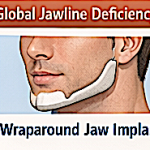
Combinations of chin and jaw angle implants can create a more complete jawline makeover and are often done together. In some cases, no available off-the-shelf chin or jaw angle implant can create the desired effect due to a patient’s unique anatomy or aesthetic needs. In this situation, a customized ‘wrap-around’ jawline implant can be made from a 3-D CT scan of the patient. These can be made as a single implant or in multiple units that can be inserted in pieces and assembled when next to the bone. This approach is particularly useful when the jawline needs to be vertically lengthened. (implant sitting on the bottom edge of the bone)

Dr. Barry Eppley

www.eppleyplasticsurgery.com

Indianapolis, Indiana

Understanding Recovery after Jaw Angle Implant Surgery

Sunday, November 28th, 2010

Synthetic augmentation of various regions of the facial bones has always been a popular cosmetic facial procedure in plastic surgery. While historically recognized as that of just chin and cheek enhancement, implant designs and styles has now been expanded to many other facial regions as well. One of these more new areas is that of the mandibular angle, also known as the jaw angle.

Augmentation of the jaw angle area is largely a male cosmetic facial procedure. Having a prominent jaw angle has long been recognized as an important element of the ‘strong jaw’ or masculine facial appearance. While perhaps not as important as having a well proportioned and horizontally sufficient chin, the jaw angle adds an important accent to the jaw line. Many prominent male celebrities and models can be seen with this look.

Like all facial augmentation, jaw angle implants are placed next to the bone area under the layer of tissue known as the periosteum. This involves splitting and lifting up a layer of muscle that overlies the bone. In the chin, for example, this is the mentalis muscle. But this muscle, like many other facial implant zones, is relatively small and does not affect any significant function. Jaw angle implants, however, are significantly different in this regard and that makes a big difference in the recovery process.

In placing jaw angle implants, the incisional access is done from inside the mouth back behind the molar teeth. The incision is made along the bone and the masseter muscle is lifted off of the front part of the ramus of the mandible all the way back to the angle and posterior ramus border. In lateral augmentation, the masseter muscle is lift just down to the lower edge of the bone. But in inferolateral augmentation, the lower edge of the muscle where it wraps around the bottom of the bone must be lifted off as well. Either way, the entire lower half of the large masseter muscle must be removed from the bone to accommodate the implant.

Lifting up of the masseter muscle for the placement of jaw angle implants causes a different recovery from that of all other facial implants including even the other common jaw area that of the chin implant. As a result, there will be more swelling and discomfort as the size of the muscle that is surgically manipulated is so much bigger. But more importantly, there will be a temporary functional issue caused by a phenomenon known as trismus. Since the masseter muscle is one of the major movers of the lower jaw, any trauma to it will cause it to become stiff and sore. This makes it difficult to open one’s mouth for several weeks after surgery. It is not impossible to open one’s mouth, nor will it hurt it or the implant to do so, but it will definitely be stiff. This means that one may only have 10 or 15 millimeters of opening the first week or so. (normal interincisal opening is 35 to 50 millimeters) And it may take up to a month to return to a more normal jaw range of motion.

Jaw angle implants require about a month to return to normal jaw function and eating. When undergoing the procedure, one should be aware of this recovery issue as it is completely normal. Some may consider it a ‘benefit’ as not eating a normal diet for several weeks will usually result in some weight loss. At the least, it is a temporary inconvenience.

As the largest of the facial implants and given the amount of muscle that needs to be removed to accommodate its size, there will be a lot of lateral facial swelling. And it will take considerable time to go down as well. Therefore, I do not really judge the final results in terms of jaw angle size and symmetry for at least 6 weeks after surgery with three months being a more ideal final assessment time.

Dr. Barry Eppley

www.eppleyplasticsurgery.com

Indianapolis Indiana

Jaw Angle Augmentation for Females

Monday, August 16th, 2010

The jaw is the largest bone of the face and completely accounts for the shape of the lower face.  It provides a sharp line of demarcation from the neck and the rest of the face. It can be weak or strong or well outlined and distinct. No matter how it is shaped, it creates a definite impression of how one’s face looks. From an aesthetic surgery standpoint, the only historic point of interest of the jaw was that of the chin. Recent aesthetic interest has now cast the shape and prominence of the jaw angle of great significance also, particularly in men.

The jaw angle reflects the intersection of the posterior border of the mandibular ramus (vertical part of the jaw) and the horizontal body of the jaw. It can range anywhere from 60 to 90 degrees. The closer one is to 90 degrees the stronger the jaw prominence is perceived. But angulation alone does not solely contribute to the impression of a strong jaw angle. Angle width or flaring is equally important. The jaw angle width is somewhat related to the bone’s thickness and the degree of angulation. However, the closer one’s jaw angle is to 90 degrees the flare is not necessarily the greatest. The amount of jaw angle flare seems to be unique to each individual.

The aesthetic significance of a prominent jaw angle is historically unique to men. Men do frequently seek change in this part of the jaw through angle implants. But it has also become more of an aesthetic desire for some women. This is undoubtably motivated by the faces of such actresses as Angelina Jolie and Marcia Cross, for example, who have very distinct and prominent jaw angles. A more distinct female jaw angle helps create a more angular and defined face and is becoming increasingly popular. A much more prominent jawline may help convey a stronger personality or presence for a woman or it just may be it gives them a more dominant sexual presence.

Jaw angle implants must be carefully chosen for a woman. Incorrect sizing and style of the implants can easily make a woman look cartoonish and overdone. In general, they work better in women who have a naturally thin or average face. Angle implants in round or heavy faces will only make them look more heavy and full, not more distinct and angular. Most women do better by widening the angle and not dropping it down or squaring it off too much. (men’s angles almost always need to be lowered and made more square) A good jaw angle for most women should be less than 90 degrees and closer to 75 to 80 degrees.

Female jaw angle implants is largely a lateral or width augmentation. Width increases of 3mm to 7mms is more than adequate in most cases. Tapering the implant to a sharper edge  at the angle can be helpful. I am not so much concerned about the material choice of the implant but its size and shape is critical. Both silicone and porous polyethylene jaw angle implants can be effectively used.

For the properly selected female patient, jaw angle augmentation can help create a better defined and more prominent jawline appearance.

Dr. Barry Eppley

www.eppleyplasticsurgery.com

Indianapolis, Indiana  

The Aesthetics of Jaw Angle Implant Surgery

Saturday, June 19th, 2010

A strong and well-defined jaw angle confers a certain degree of masculinity. Some men have it naturally, while others seek to obtain it from synthetic implants. The jaw angle makes up a portion of the mandibular ramus and its outline is formed by the intersection of its outer posterior and inferior borders. This bony intersection, or angle, can be anywhere from 90 to 120 degrees. The closer the angle is to 90 degrees, the more visible and pronounced the jaw angle appears. This occurs because the bony ramus is more developed vertically and lengthens the position of the jaw angle point to a lower position.

As the jaw angle becomes more acute (closer to 90 degrees), its lower position becomes closer to the horizontal plane of the lower border of the chin. The relationship of the jaw angle and chin points is known as the jawline or in cephalometric terms the mandibular plane. While the mandibular plane is a term originally used in the context of one’s occlusion (bite), it has a direct relationship to the aesthetics of the jaw angle. The more steep the mandibular plane angle, the less prominent the jaw angle becomes. The more horizontal the mandibular plane angle, the more prominent the jaw angle.

The one dimension of the jaw angle that is more obscure, but no less significant, is its width. How much does it stick out or flare? Also known as bigonial width, a prominent jaw angle usually will have more width at the jaw angle point. This width significantly affects the shape of the face, giving it a more square appearance as it gets wider.

Understanding the aesthetics of the jaw angle has great relevance when helping a patient decide how much change to make. (i.e., implant selection) While there are numerous styles of jaw implants from several different manufacturers, the key issues to look at are the amounts of ramus lengthening and width changes. A panorex or cephalometric x-ray analysis is helpful as direct measurements can be made on them but there are certain anthropometric (visual) parameters as well.

When it comes to lengthening the ramus or jaw angle point, you usually do not want it to end up at a horizontal level below the lower border of the chin. In other words, you don’t want a reverse mandibular plane angle. I would argue that most men don’t want it exactly at the same level either. That would make most faces too square and unnatural looking. The jaw angle point should be just a little above the chin in both frontal and side views. That provides an aesthetic sweep to the jawline from front to back. Look at most male models and you will see that jawline feature. I certainly have had patients who want to be fairly square but they fully recognize this more extreme type jaw look and are aiming for it.

When it comes to jaw angle width, this belies an exact measurement. But visually you can relate it to the width of the zygomatic arch in a frontal view. A prominent jaw angle in men is wider than the arch width. For women, it should usually be at or just inside a vertical dropdown line from the arch. But men need to be beyond this line. How much is a matter of personal preference but never beyond the outer helix of the ear.

In planning for jaw angle implants, a panorex x-ray can be helpful to determine whether and how much lengthening of the jaw angle is needed. For width estimation, a frontal photograph is more helpful than any x-ray.       

Dr. Barry Eppley

http://www.eppleyplasticsurgery.com

http://www.ologyspa.com

Indianapolis, Indiana

Three-Dimensional Jaw Angle Augmentation

Saturday, March 13th, 2010

Jaw angle implants have become a more common procedure for men in the effort to achieve a stronger and more defined mandibular shape. By highlighting the jaw angles in combination with a more prominent chin, a triangular lower facial shape is seen from the frontal view. By increasing the divergence of two lines that follow the jawline from the chin back, jaw shape becomes increasingly more masculinized. There is a point at which this divergence is too great and the jaw shape can look  more cartoonish than natural, but this only happens when the jaw angle sticks out further than one’s ears.

This frontal view of the jaw angle oversimplifies, however, the three dimensional shape of this facial area. Because the jaw angle is formed by both horizontal and vertical ramus bone segments, it’s vertical height has a significant impact on how increasing the lateral expansion of the angle will look. A high mandibular angle shortens the face and increases the downward plane of the jaw. A lower mandibular angle lengthens the face and levels out the jaw plane angle. Which one of these jaw angle heights may offer an aesthetic benefit for anyone is based on the other dimensions and shape of their face.

It is important for any patient considering jaw angle augmentation to consider vertical elongation as well as increased lateral protrusion. Besides achieving the best look for a patient, knowing whether this desired angle change is needed changes the type and style of jaw angle implant chosen. Jaw angle implants come in a variety of styles from several different manufacturers. But they fundamentally differ in providing just lateral fullness to your existing angle or both lateral fullness and vertical elongation, dropping the jaw angle lower.

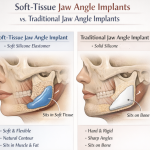
Most lateral only jaw angle implants are made of silastic or firm but flexible polymerized silicone.  Because it has a very smooth and slippery surface, it is not a good material for dropping the jaw angle lower. Even if a curved or notched area exists at its lower edge, it will not stay in position as it easily slides upward by the force of the overlying masseter muscle. More ‘three-dimensional’ jaw angle implants are made of Medpor or porous polyethylene. Their textured and rougher surface offers higher frictional resistance against the bone and are less prone to upward migration. While this is surface biomaterial characteristic is more favorable, I do not trust it enough to not use screw fixation to prevent after surgery migration.

Lowering the jaw angle also causes it to acquire a more 90 degree or square shape versus a more open angle (greater than 90 degrees) when it is higher. This is a profile jaw aesthetic that can be gender-specific. A lower jaw angle means more masseter muscle and a flatter jaw line from front to back, a more masculine facial feature. A high jaw angle reduces the amount of bone for masseter attachment and placed the jaw angle point above the horizontal plane of the chin. This can be more feminine in appearance.

Jaw angle augmentation is more than just about widening the jaw. It requires three-dimensional planning  and proper implant selection to get the desired result.


Dr. Barry Eppley

http://www.eppleyplasticsurgery.com

http://www.ologyspa.com

Indianapolis

Common Questions about Jaw Angle Augmentation (Implants)

Wednesday, February 10th, 2010

1.      Who would benefit from jaw angle augmentation?


The shape of one’s jaw is influenced by its horseshoe or U-shape. From angle to angle, the lower jaw (mandible) is a curved bone that is most recognized by its frontal prominence, the chin. But recent trends in men have placed new emphasis on the aesthetics of the jaw angle. From famous actors like Brad Pitt to male models, a prominent jaw angle and jaw line cast an image of masculinity and virility.


While the benefits of chin augmentation have long been recognized for balancing one’s face seen in profile, enhancing the jaw angle helps the face from a frontal perspective. Flaring the jaw angle outward and making the jaw angle more square (angular)makes the entire jaw line a more prominent facial feature.


Weak jaw angles are evident if the lower face is narrow and the cant of the jawline is steep (oblique) rather than more horizontal. If the point of the jaw angle sits above the point of the chin, jaw angle augmentation may be aesthetically beneficial.  


2.      Are there special implants just for the jaw angle?


Like all facial bony highlights, there is a unique shape to them. The jaw angle is no different. It requires a specially-shaped implant that can provide a widening (lateral projection) and/or a lowering. (inferior projection) There are a variety of different jaw angle implants amongst several manufacturers. Some provide more lateral projection, other more inferior projection. The most common jaw angle implants usually provide a bit of both projections. In each specially-designed shape, there are different sizes as well.


3.      What are jaw angle implants made of?


There are two basic materials from which jaw angle implants are manufactured. These are silastic (silicone)and Medpor. (polyethylene) Each has some different handling properties which affects the flexibility and stiffness of the implants. While they are all chemically and structurally different, the body sees them all the same way…as a foreign material which it tolerates by surrounding it with scar tissue. (capsule)


Different plastic surgeons may have their preference but that choice is not based on whether it is a ‘better’ implant material. It is a function of what they are familiar with and have had good handling and placement experiences. For me, I am more interested in the shape of the jaw angle implant and how it matches the patient’s jaw angle need. The material from which the jaw angle is made is not as important as its shape.


4.      How are jaw angle implants placed?


Access to the jaw angle is done from inside the mouth. This is the most direct route underneath the masseter muscle to where the implant needs to go without creating any external scar. While it is certainly possible to place the implant through an incision right below the jaw angle (as in mandibular fracture repair), this would not only leave a scar but would be more painful and disrupt more muscle tissue.


Through an incision behind the posterior molar teeth along the ascending ramus of the jaw, the bone and the front edge of the masseter muscle are immediately found. Most of the entire masseter muscle must be lifted off the bone to properly place the jaw angle implant into the correct position.


5.      What keeps the jaw angle implant from shifting around after surgery?


Proper positioning of the jaw angle implant is the most important factor in keeping it from moving around after surgery. Silicone, which is very smooth and slick, is much more likely to shift from its intended position than Medpor which has a much higher frictional (gripping) surface. Regardless of the material, I always secure it with a screw when possible to eliminate any doubt about potential implant migration.


6.      How painful is jaw angle augmentation after surgery?


Because it is a submuscular (under the muscle) operation, there is some significant discomfort and swelling afterwards. More pertinently, every patient will have some difficulty opening one’s mouth very wide for several weeks after. Known as trismus, this is the direct result of pain and stiffness from the traumatized muscle. When comfortable, patients should start on range of motion exercises to resume their normal oral opening as soon as possible.


7.      Can jaw angle implants be done with other facial surgeries?


It is common to do jaw angle augmentation with other facial surgeries. Most commonly, this would be chin and cheek augmentation and rhinoplasty. But it can be done with any other desired facial or body plastic surgery procedure.

Dr. Barry Eppley

http://www.eppleyplasticsurgery.com

http://www.ologyspa.com

Clarian North Medical Center, Carmel, Indiana

Clarian West Medical Center, Avon, Indiana

Indianapolis

Chin and Jaw Angle Implants for Male Jawline Enhancement

Tuesday, September 22nd, 2009

I frequently get e-mailed and asked…’What can I do to get a stronger jawline?’ This is exclusively a male question and usually, but not always, is from a younger patient. In looking at a lot of photographs of male patients with this concern, the most common problem is that the chin is short and the jawline is ill-defined. Some cases are more severe while others are much more mild. In either case, the strong jawline of male models and some famous male actors has set a beauty standard for males to aspire to.

In making a jawline more distinctive, there are three areas to consider improving or highlighting. Anterior projection (chin), posterior lateral width (jaw angle) and inferior border or circumferential jawline are the areas that can be surgically augmented with implants. Other than the chin, there are no bony moving or bone grafting procedures that will work.

From a practical standpoint, the two most common and easiest implants to place are the chin and jaw angle. The available implants are well made with numerous styles (chin) and a good range of sizes that will fit all but the very largest, or most bony deficient, patients. By bringing the chin forward (and more square) and making the back of the jaw (jaw angle) wider, the jawline becomes much more distinctive. This approach will work for the vast majority of male patients.

The use of a chin and jaw angle implant for jawline augmentation does leave a gap in the body of the mandible between the two. Depending upon the type of chin implant used (how far back the wings of the chin implant goes), that gap can be up to several cms. in length. While this may seem unfavorable, it is usually not discernible and the aesthetic benefits of considering ‘filling in that gap’ are not usually worth it in my Indianapolis plastic surgery experience. Having three separate implants (five actually along the entire jaw) is bound to have some irregularities that certainly will be felt.

Implants for the body (middle) of the jaw are not commercially available. No such stock implants exist. That fact should tell you that their need, or more pertinently their importance, is really quite limited. To use such an implant, it has to be hand-carved during surgery. Actually this is not that difficult as the use of Gore-tex blocks or sheets can be easily used and shaped. I have no qualms about the ability to shape or place them but my concerns revolve around the ability to feel them, particularly the transition with the chin implant on the front edge and the jaws angle implant on the back edge. Because of these concerns, there has to be a really compelling reason to use them.

There is an alternative to a piece-meal implant approach to total mandibular augmentation. A one-piece custom implant can be fabricated before surgery off of a 3-D CT mandibular scan of the patient. This is best used when the objective is vertical lengthening of the jawline as this is how it must be placed. It can not be used to provide posterior width like a traditional jaw angle implant.

 
Barry L. Eppley, M.D., D.M.D.

http://www.eppleyplasticsurgery.com

http://www.ologyspa.com

Clarian North Medical Center, Carmel, Indiana

Clarian West Medical Center, Avon, Indiana

Indianapolis


Dr. Barry EppleyDr. Barry Eppley

Dr. Barry Eppley is an extensively trained plastic and cosmetic surgeon with more than 20 years of surgical experience. He is both a licensed physician and dentist as well as double board-certified in both Plastic and Reconstructive Surgery and Oral and Maxillofacial Surgery. This training allows him to perform the most complex surgical procedures from cosmetic changes to the face and body to craniofacial surgery. Dr. Eppley has made extensive contributions to plastic surgery starting with the development of several advanced surgical techniques. He is a revered author, lecturer and educator in the field of plastic and cosmetic surgery.

Read More


Free Plastic Surgery Consultation

*required fields


Pricing

The cost of any type of elective plastic surgery plays a major role in the decision to undergo the procedure(s).

More Info


Military Discount

We offer discounts on plastic surgery to our United States Armed Forces.

More Info


Categories