
Introduction
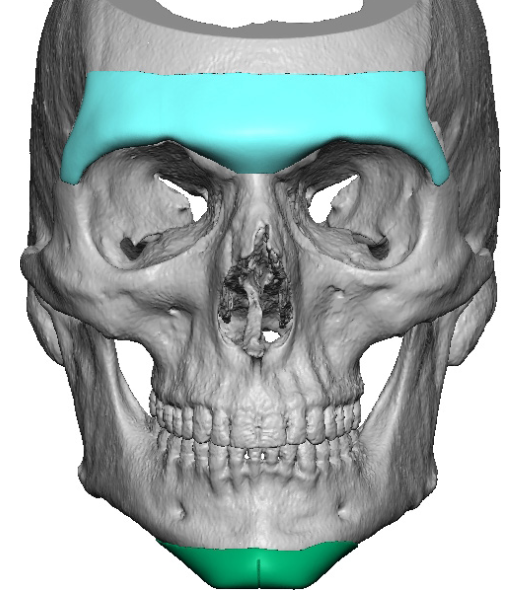
A custom brow bone implant is a patient-specific facial implant designed to enhance or reconstruct the supraorbital rims (brow ridges). Aesthetically, it is most commonly used for facial masculinization or for correction of flat or recessed brows. With the growing popularity of facial feminization surgery (FFS), custom brow bone implants have also become an effective method to reconstruct the brow region following prior brow bone reduction surgery, serving as a means of brow re-masculinization (FFS reversal).
What Makes It “Custom”
Because no standardized brow bone implants exist, surgeons have historically relied on intraoperative shaping of various implant materials or hydroxyapatite cements to recreate brow projection. With the advent of high-resolution 3D CT imaging and digital design software, brow bone implants can now be precisely designed preoperatively, allowing surgery to focus primarily on accurate placement.
Key features of custom design include:
- CT-based design: A 3D CT scan is used to digitally design an implant that precisely matches the patient’s unique brow anatomy.
- Exact contouring: Selective augmentation of the central brow, lateral brow, or entire supraorbital rim without affecting adjacent areas.
- Symmetry control: Particularly valuable for correcting asymmetries that cannot be addressed with stock implants.
Brow Bone Masculinization: Design Concept
Primary design goals include:
- A strong, assertive upper facial appearance
- A more horizontal brow ridge
- Clearly defined masculine skeletal contours
Visual effects achieved:
- Increased brow shadowing
- Eyes that appear more protected and moderately deep-set
- Enhanced facial dominance and masculinity
Design characteristics:
- Projection: Typically 4–7 mm (greater in larger skulls)
- Shape: Straight or mildly angular
- Coverage: Full supraorbital rim (medial and lateral)
- Brow break: A clearly defined ridge over the orbital rim
- Edge transition: Sharper superior margins with smoother inferior blending
Case Study
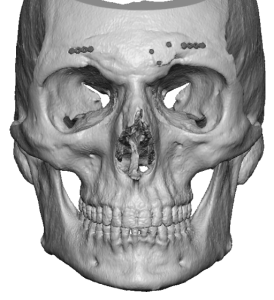
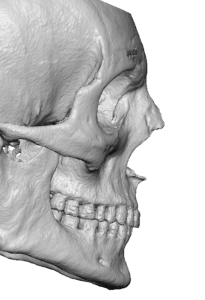 This patient had previously undergone facial feminization surgery, including a Type III brow bone reduction. The procedure resulted in a flattened or absent brow ridge.
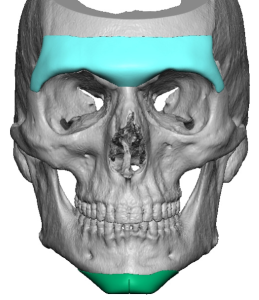
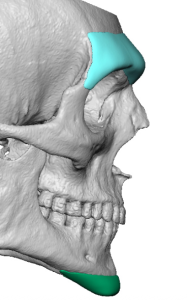
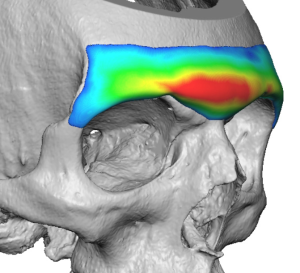 A custom brow bone implant was designed with 5 mm of projection in the glabellar region and 3.5 mm of projection at the lateral brow. The inferior extensions (“legs”) of the implant extended to the anterior zygomatic suture line.
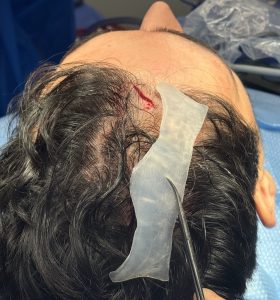
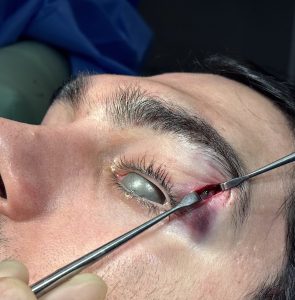 Surgical Placement
- Anesthesia: General
- Incisions:
- A 3 cm scalp incision placed just behind the frontal hairline, coinciding with an area of alopecia
- Supplemental small upper eyelid incisions for accurate lateral brow positioning
- A 3 cm scalp incision placed just behind the frontal hairline, coinciding with an area of alopecia
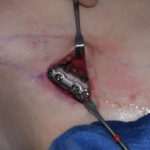
- Fixation: The implant is secured with small microscrews along the lateral orbital rims
- Operative time: Approximately 1.5 hours
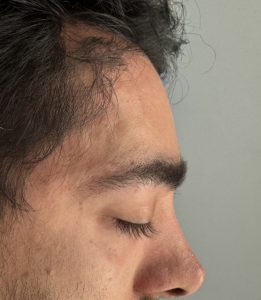
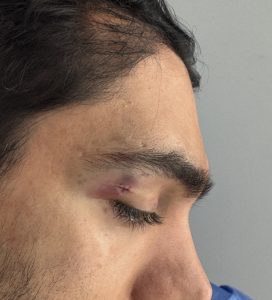 The immediate improvement in brow projection is most evident on lateral (side-view) examination.
Recovery
- Forehead tightness and swelling for 1–2 weeks
- Typical periorbital bruising resolving over approximately 3 weeks
- Most visible swelling subsides within 2–3 weeks
- Final contour refinement continues for up to 3 months
Discussion
Most patients seeking reversal of brow bone feminization desire a complete restoration of a masculine brow contour. Ideally, implant design would replicate the patient’s original brow anatomy; however, this information is rarely available unless a pre-FFS 3D CT scan exists. Consequently, standardized masculine design principles must often be applied.
Key design guidelines for a masculinized brow include:
- Projection of 4–7 mm (or more for larger skulls)
- Straight or mildly angular shape
- Full supraorbital rim coverage
- A distinct brow break over the orbit
- Sharp superior and blended inferior transitions
From a surgical standpoint, the emphasis is on accurate implant placement. In patients with an existing frontal hairline incision from prior FFS, this incision may be reused. However, reopening a distant coronal incision is unnecessary. Instead, a small incision just behind or at the frontal hairline is sufficient for pocket creation and implant insertion.
Small lateral upper eyelid incisions are often required to verify proper positioning of the implant legs along the lateral orbital rim and to allow for secure microscrew fixation. When the lateral extensions are correctly positioned, the remainder of the implant across the brow ridge will be accurately aligned.
Although brow bone and forehead reduction represent one of the most significant components of facial feminization surgery, re-masculinization of the forehead using a custom brow bone implant is considerably simpler and less invasive to undergo.
Key Points
- Brow bone feminization can be effectively reversed using a custom brow bone implant.
- When a pre-reduction 3D CT scan is unavailable, re-masculinizing implant design can reliably follow established masculine brow guidelines.
- Implant placement can be accomplished through a small frontal hairline incision when an existing FFS incision is not present.
Barry Eppley, MD, DMD
World-Renowned Plastic Surgeon