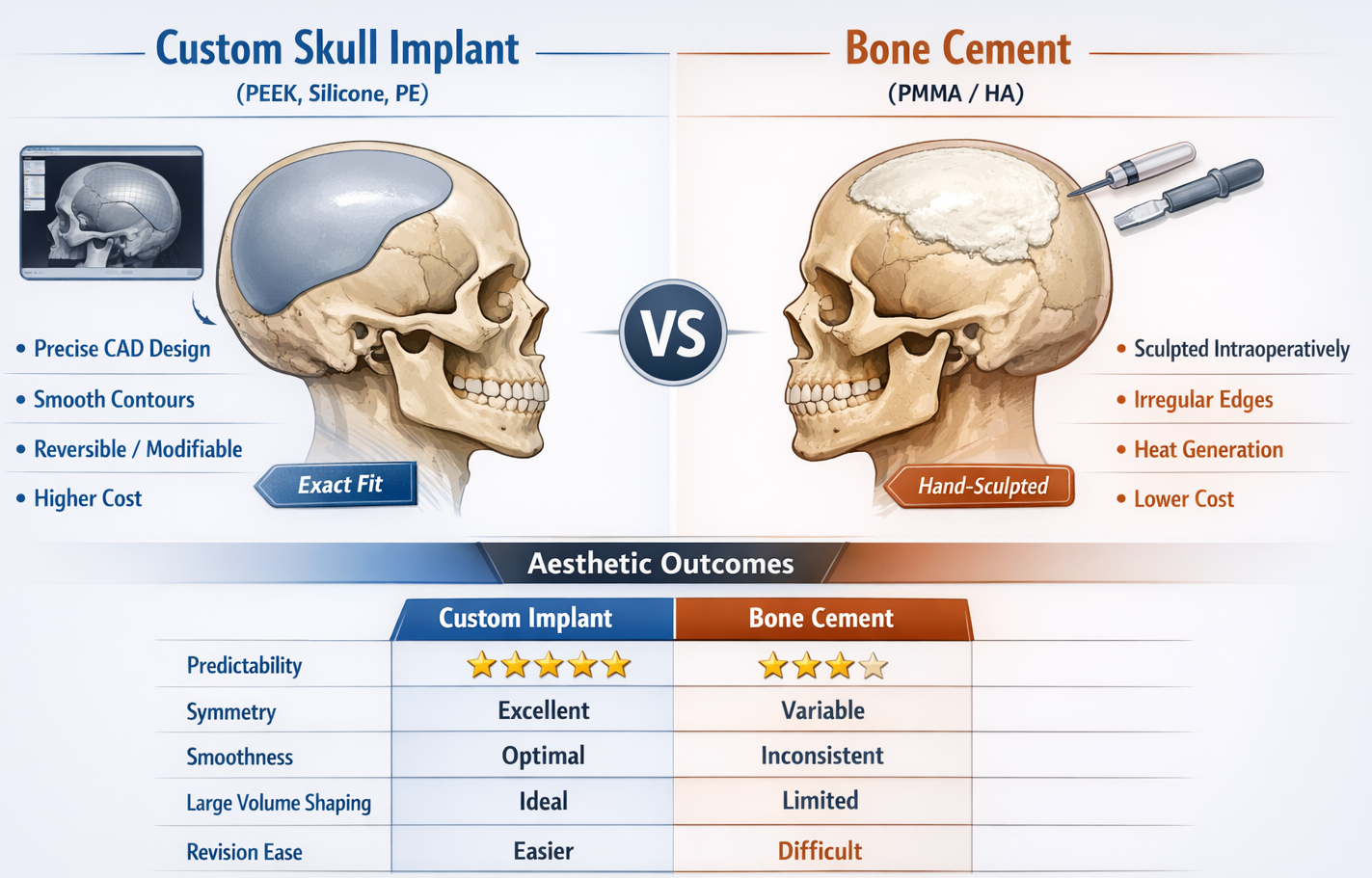
Aesthetic skull augmentation focuses on cosmetic contouring rather than reconstruction. That is a very important distinction as aesthetic augmentation requires material onlay on top of existing bone while reconstruction requires inlay material placement for bony skull defects. Such onlay augmentations can be done using a custom implant vs. bone cement (PMMA/HA). While they represent two available methods of skull augmentation their differences are significant from their techniques to effectiveness.
Custom Skull Implant
Advantages
- Precision & predictability
- CAD/CAM design from CT ? exact control of contours, symmetry, and thickness
 Ideal for larger global shape changes (covering two or more of the skull’s five surfaces)
- Smooth, continuous contours
- No intraoperative sculpting variability
- Can be placed on the temporal fascia on the sides of the head
- Lower operative time
- Implant placement vs prolonged sculpting
- Reversible / modifiable
- Can be removed or replaced if patient desires change
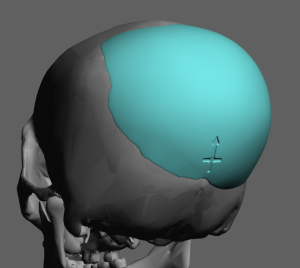 Ideal for larger global shape changes (covering two or more of the skull’s five surfaces)
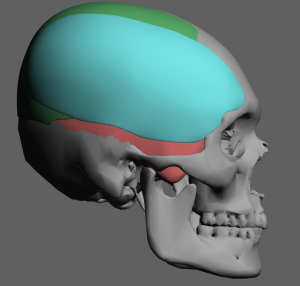 Smooth, continuous contours
Disadvantages
- Cost
- CT scan + design + fabrication
- Lead time
- Typically 6 – 8 weeks
- Foreign-body implant
- Long-term tolerance generally excellent, but still an implant
Best Indications
- Primary aesthetic skull reshaping
- Large surface area augmentation
- High-demand cosmetic patients
- Asymmetry correction
- Ideal for sensitive aesthetic areas such as the forehead and sides of the head
Bone Cement (PMMA or Hydroxyapatite)
Advantages
- Immediate availability
- No preoperative design or manufacturing delay
- Lower upfront cost
- Intraoperative flexibility
- Surgeon can adjust shape in real time although this is very limited
- Osseointegration
- Hydroxyapatite (calcium phosphate), although a synthetic ceramic, will actually bone to the bone. PMMA, a plastic material will not.
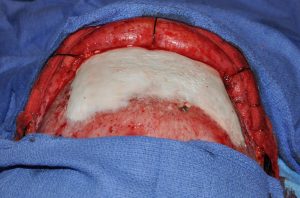 Hydroxyapatite (calcium phosphate), although a synthetic ceramic, will actually bone to the bone. PMMA, a plastic material will not.
Disadvantages
- Sculpting variability
- Outcome highly surgeon-dependent
- High limited by incisional access
- best aesthetic outcomes come from wide open incisional access/visibility. Limited more injection like techniques exist but they also have limited augmentation capabilities.
- Heat generation (PMMA)
- Risk to underlying bone and scalp vascularity
- Irreversibility
- Difficult to remove or revise cleanly
- Edge transitions
- More challenging to feather smoothly over large areas
- Higher irregularity risk
- Palpability, contour imperfections
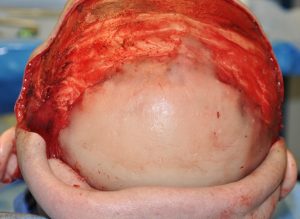 Sculpting variability
Best Indications
- Small, focal augmentations
- Secondary touch-ups
- Minor contour defects
- Patients refusing implants
Aesthetic Outcomes (Key Difference)
|
Factor |
Custom Implant |
Bone Cement |
|
Predictability |
????? |
??? |
|
Symmetry |
Excellent |
Variable |
|
Smoothness |
Excellent |
Surgeon-dependent |
|
Large-volume shaping |
Ideal |
Suboptimal |
|
Revision ease |
Easier |
Difficult |
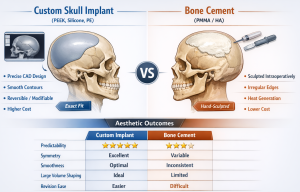 Practical Takeaway (Aesthetic Bias)
- Custom implants are superior for aesthetic skull reshaping
- Especially for occipital augmentation, global contour enhancement, and symmetry-driven cases
- Bone cement remains useful
- For small defects, revisions, or patients strongly opposed to implants
- In cosmetic patients, predictability and smooth contours favor custom implants
Barry Eppley, MD, DMD
World-Renowned Plastic Surgeon