
This is where skull augmentation stops being about adding volume and becomes about sculpting geometry. An ideal occiput isn’t “round everywhere” — it has a very specific curve architecture.
The ideal occipital curvature (in profile)
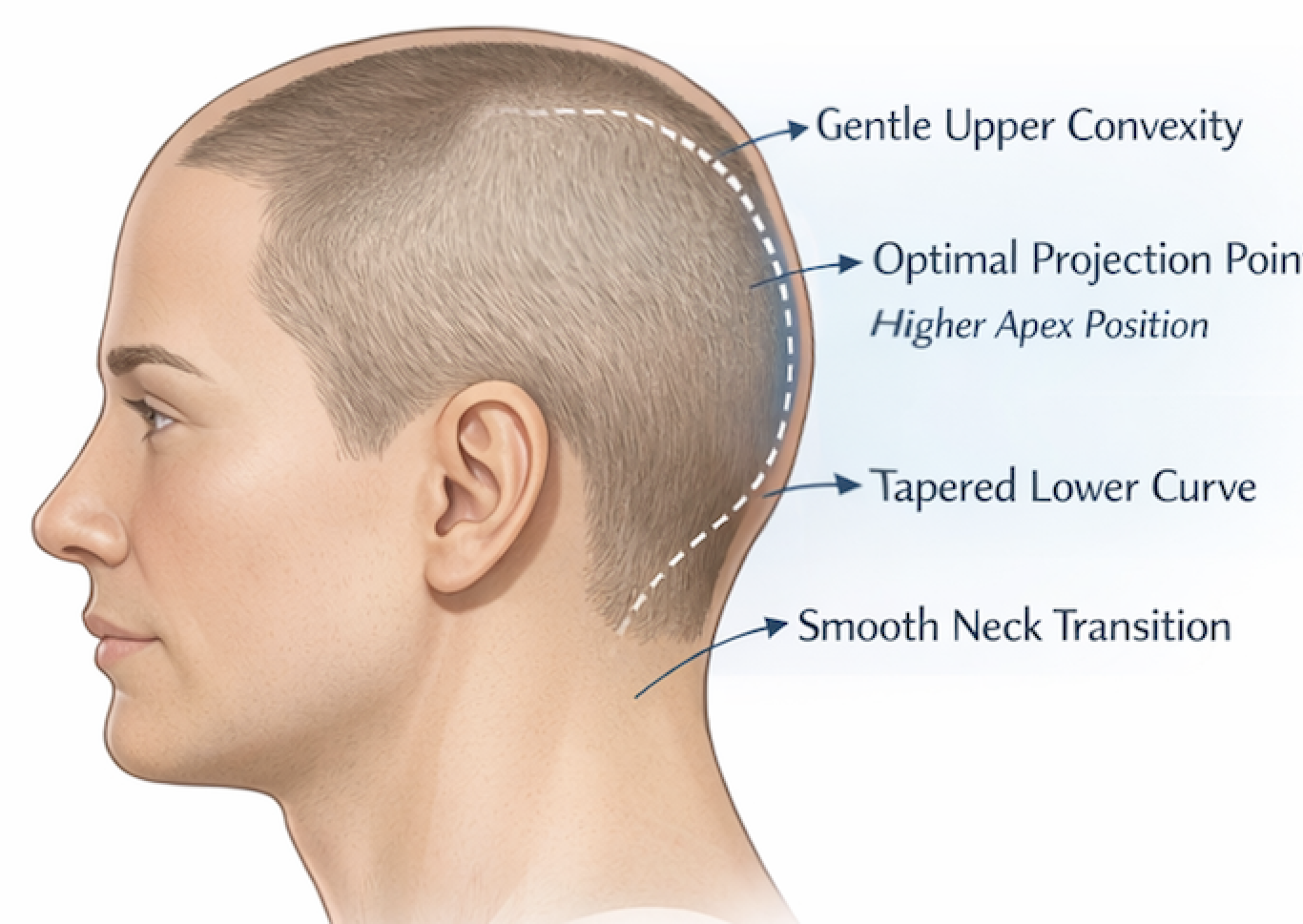
 Think of the back of the head as a long, continuous S-curve, not a single arc.
1. Upper occiput: gentle convexity
- Begins just behind the crown
- Smooth, shallow outward curve
- No sharp angle or step-off
? This is where the illusion of length starts.
2. Maximal projection point (the keystone)
- Located above the midline, not at the bottom
- Usually ~1–2 cm below the crown
- This point defines the whole silhouette
? Natural heads project higher than people expect
? Low projection looks heavy or “shelved”
3. Lower occiput: accelerating taper
- Curve tightens as it approaches the neck
- Should flow into the cervical angle
- Never straight or flat at the base
? This prevents the “ledge” or “helmet” look.
4. Occipital–cervical junction (critical transition)
- Smooth inflection into the neck
- No visible angle, step, or edge
- Light reflection should fade gradually
This is where bad implants are instantly obvious.
Ideal curvature in 3D (not just profile)
Width
- Slight lateral expansion
- Avoids a narrow, pointed look
 Creates a rounded back-view contour
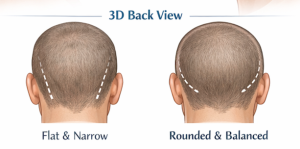 Creates a rounded back-view contour
Vertical height
- Mild fullness above the occipital point
- Prevents “ball-on-neck” appearance
Good implants shape volume distribution, not just thickness.
Male vs female ideal curvature (general tendencies)
Masculine occiput
- Broader curve
- Slightly flatter apex
- Wider footprint
- Less vertical height
Reads as strong and solid.
Feminine occiput
- More continuous roundness
- Higher apex
- Smoother transitions
- Slightly more projection tolerated
Reads as soft and elegant.
(These are aesthetic tendencies, not hard rules.)
Common non-ideal shapes (what to avoid)
Shelf occiput
- Projection too low
- Flat upper curve
- Sudden drop at the neck
Reads as “implant.”
Bulbous occiput
- Too much focal projection
- Narrow footprint
- Over-round
Reads as unnatural volume.
Helmet contour
- Uniform thickness everywhere
- No tapering
- Poor blending
Looks artificial even at modest mm.
Why custom design matters
The ideal shape depends on:
- Skull size
- Scalp thickness
- Hair density
- Neck angle
- Overall head proportion
That’s why CT-based custom implants consistently outperform any other method of augmentation
One sentence summary
An ideal occiput looks like the skull slowly grows backward, peaks gently, then melts into the neck — never like something was added to it.
Dr. Barry Eppley
Plastic Surgeon