
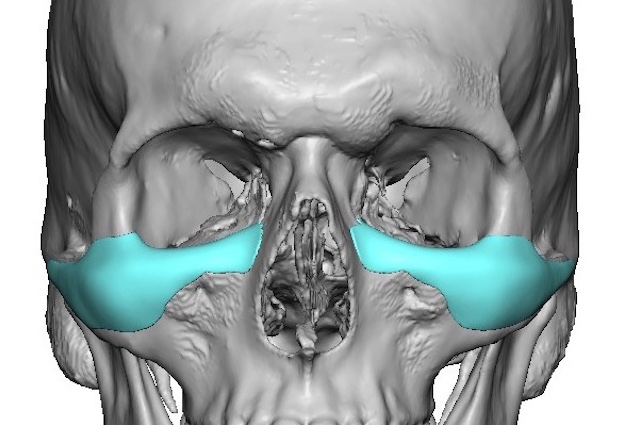
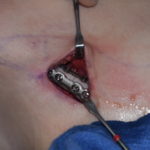
Vertical infraorbital rim lengthening is one of the most important—but often under-appreciated—design variables in custom infraorbital-malar (IOM) implants. Its value lies in correcting the three-dimensional skeletal deficiency of the upper midface, not just adding projection. Below is a structured explanation of why it matters biomechanically and aesthetically.
1. What “vertical infraorbital rim lengthening” actually means
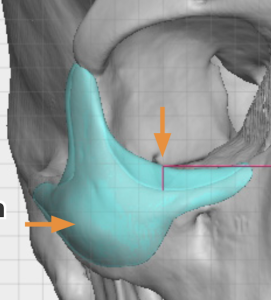 In custom IOM implants, vertical rim lengthening refers to adding inferior height to the infraorbital rim, effectively lowering the skeletal boundary of the orbit.
Instead of only pushing the rim forward, the implant extends the rim downward, increasing the vertical distance between the orbit and the cheek platform.
This transforms the augmentation from 2-dimensional rim projection to 3-dimensional orbital expansion.
Conceptually it does three things simultaneously:
- Expands the orbital aperture inferiorly
- Creates a stronger lid–cheek skeletal junction
- Increases the structural platform beneath the lower eyelid
2. Why vertical lengthening is often more important than projection
Many patients with under-eye hollowing or midface deficiency have a short vertical midface skeleton, not just a retruded rim.
Common skeletal features include:
- High infraorbital rim relative to cheek
- Negative orbital vector
- Short lower orbital height
- Poor lid–cheek support
Simply adding anterior projection does not change this vertical relationship.
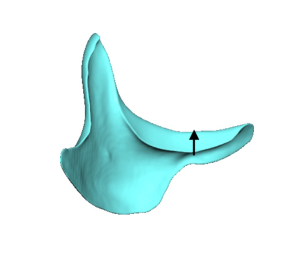 Vertical rim lengthening instead:
- Increases lower eyelid skeletal support
- Moves the lid–cheek junction inferiorly
- Reduces tear trough depth by altering the bony base
Because the infraorbital rim and cheek skeleton support the eyelid and midface soft tissues, inadequate projection predisposes to lower lid descent and visible bags.
Vertical augmentation addresses this structural deficiency directly.
3. Its role in correcting the negative orbital vector
Vertical rim lengthening is especially valuable in negative vector patients.
Negative vector =
globe projects anterior to the infraorbital rim and malar eminence.
Effects include:
- Prominent eyes
- Scleral show tendency
- Tear trough deformity
- Weak lid-cheek support
Augmenting the infraorbital rim (especially vertically) can reverse the negative vector relationship by bringing the rim into a more favorable relationship with the globe.
In practice this:
- reduces apparent eye prominence
- improves eyelid position
- improves midface balance
4. Integration with malar augmentation
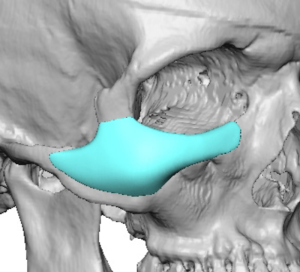 Custom IOM implants are unique because they treat the infraorbital rim and cheek as one skeletal unit.
Vertical rim lengthening contributes to:
A. Continuous lid-cheek transition
Instead of a sharp rim step-off, the implant creates a smooth slope from eyelid to cheek.
B. Tear trough elimination
The trough disappears not by filling it but by changing the bony platform underneath it.
C. High cheekbone line
When combined with lateral zygomatic extension, the implant produces the horizontal high-cheekbone line from nasal bones to arch.
5. Aesthetic effects specific to vertical rim lengthening
The aesthetic changes are subtle but powerful:
1. Lower lid support
Improves lower eyelid tone and reduces risk of scleral show.
2. Less hollow appearance
The tear trough fades because the orbital–malar junction is expanded.
3. More masculine midface structure
Particularly in male aesthetic cases.
4. Reduced eye prominence
Eyes appear less protrusive because the skeletal frame expands.
5. Improved cheek height
Vertical rim lowering visually raises the cheek prominence.
6. Why standard implants cannot do this
Standard infraorbital implants mainly produce horizontal augmentation along the rim and cannot produce significant vertical change.
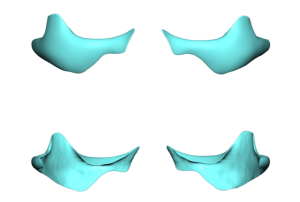 Only custom IOM implants can:
- saddle the rim
- extend inferiorly
- reshape the orbital-malar complex in 3D
This is why custom designs often provide a much more anatomically correct correction for midface deficiency.
7. Practical design considerations
When designing vertical rim lengthening:
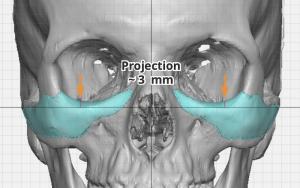 Typical augmentation values:
- 2–5 mm inferior rim lengthening
- 3–7 mm anterior projection
- smooth transition to malar body
Key design points:
- medial rim extension near tear trough
- gradual inferior transition into anterior maxilla
- avoid sharp step-offs
- maintain infraorbital nerve clearance
8. When vertical lengthening is most valuable
It is particularly helpful in:
- negative orbital vector patients
- congenital maxillary/midface deficiency
- deep tear troughs resistant to fillers
- prominent eyes
- short midface morphology
- male facial masculinization cases
Summary
Vertical infraorbital rim lengthening in custom infraorbital-malar implants:
- converts rim augmentation from 2D projection to 3D orbital expansion
- improves lid-cheek skeletal support
- helps reverse negative orbital vector
- smooths the tear trough–cheek transition
- enhances cheekbone definition and midface balance
In many patients, it is the key design element that determines whether the implant simply adds volume or truly corrects upper midface skeletal deficiency.
Dr. Barry Eppley
Plastic Surgeon