
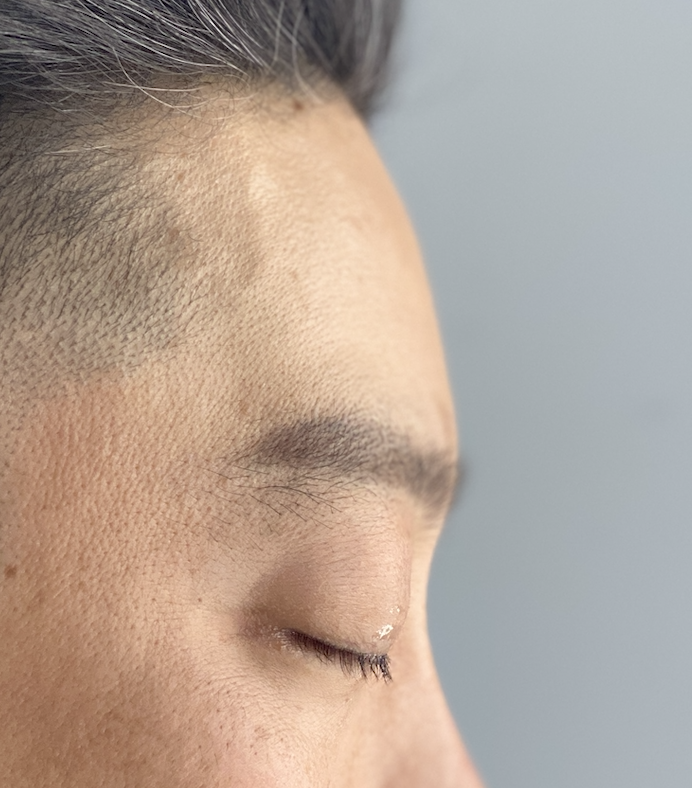
Despite the many potential custom forehead implant types that can be designed,patient requests for forehead implants tend to cluster into a few very consistent aesthetic patterns. Most patients fall into five common forehead reshaping goals.
1. Flat Forehead Correction
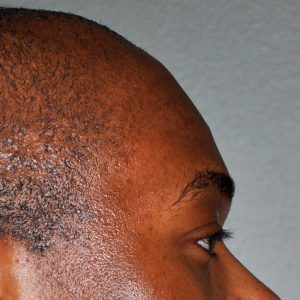 Most common request overall in females
Typical patient description
- “My forehead looks flat.”
- “My forehead profile looks recessed.”
- “My forehead slopes back too much.”
Aesthetic issue
- Insufficient forehead projection above the brow bones
Typical implant design
- Central or total forehead implant
Typical thickness
- 3–6 mm central projection
Patients
- Both men and women
- Often noticed in profile photos
2. Stronger Brow Ridge (Masculinization)
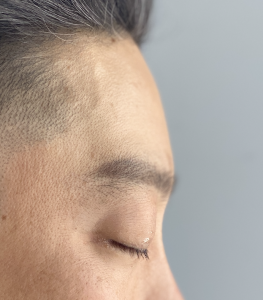 Almost always in male patients
Typical patient description
- “I want a stronger brow”
- “My eyebrows look flat”
- “Seeking a Hunter Eye look”
Aesthetic issue
- Weak supraorbital ridge
Typical implant design
- Brow bone augmentation implant
Typical thickness
- 4–7 mm over brow ridge
- Eagle shape design
Patients
- Men seeking more masculine facial structure
3. Rounder / More Convex Forehead (Feminization)
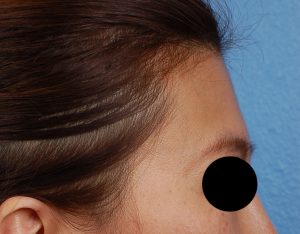 Common in female patients and facial feminization surgery.
Typical patient description
- “My forehead looks flat”
- “I want a smoother, rounder forehead”
Aesthetic issue
- Lack of forehead projection and convexity
Typical implant design
- Total forehead implant with minimal brow augmentation
Typical thickness
- 3–5 mm across central forehead
Patients
- Women
- Transgender feminization patients
4. Forehead Asymmetry Correction
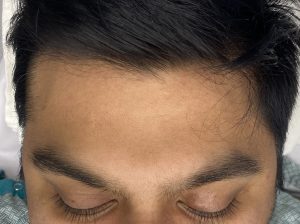 Commonly seen in congenital plagiocephaly and facial asymmetry patients
Typical patient description
- “One side of my forehead flatter than the other”
- “My skull is uneven.”
Aesthetic issue
- Congenital or developmental skull asymmetry
Typical implant design
- Unilateral or asymmetric complete forehead implant. May be an extension of a skull implant
Typical thickness
- Highly variable
- Often only 2–3 mm correction
Patients
- Both genders
- Sometimes post-trauma but usually congenital in origin
5. Forehead Width Enhancement
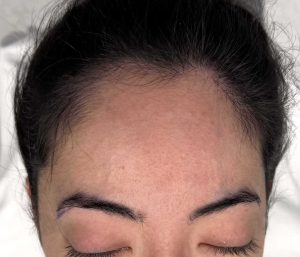 A forehead shape need that frequently goes unrecognized by surgeons
Typical patient description
- “My upper face looks narrow”
- “My temples look hollow”
- “My forehead looks pinched”
Aesthetic issue
- Narrow forehead (deceased bitemporal width)and temporal hollowing
Typical implant design
- Forehead implant with temporal extensions, crosses bony temporal line
Typical thickness
- 2-3 mm temporal region
Patients
- Both genders equally
- Sometimes patients wanting stronger upper facial proportions
Interesting Notice
Most patients are not actually describing implants needs per se. They are describing visual shape problems:
Common phrases:
- “My forehead slopes too much”
- “My brow is weak”
- “My skull is uneven”
- “My upper face looks narrow”
The implant design is just the surgical solution.
Another interesting observation:
About 70–80% of custom forehead implants fall into just three categories:
- Total forehead augmentation
- Brow ridge augmentation
- Forehead widening
Dr. Barry Eppley
Plastic Surgeon