
The most common form of facial asymmetry in my experience is right sided and affects the cheek and jawline most significantly. Provided the occlusion is well aligned and stable, or previously optimized with double jaw surgery, implants are the secondary approach to lower facial asymmetries of the cheek and jaw. While implants have been around for a long time of numerous compositions and shapes their historic use in a 2D or ‘eyeball’ approach to placement and facial asymmetry improvement is limited at best and in many cases actually makes the facial asymmetry worse.
Custom designed or 3D jaw implants are the contemporary workhorse in lower facial asymmetry corrections. With modern patient-specific CT-based implant designing virtual planning an be done to design different right and left dimensions, matching the right and left sides of the jawline and centering the chain can be done far more accurately than stock implants ever could. 3D imaging is important because facial asymmetry is a true 3D problem and standard 2D assessment, even with plain x-rays and 2D CT scans, can not fully appreciate the extent of the asymmetries down to the millimeter level.
In treating secondary facial asymmetries in which a 2D approach has been taken to the mplant used and their placement it can be very much an historical adventure. The implants used and their position is known beforehand by the 3D CT scan but unearthing them and digging them out poses it own set of challenges in many cases.
Case Example
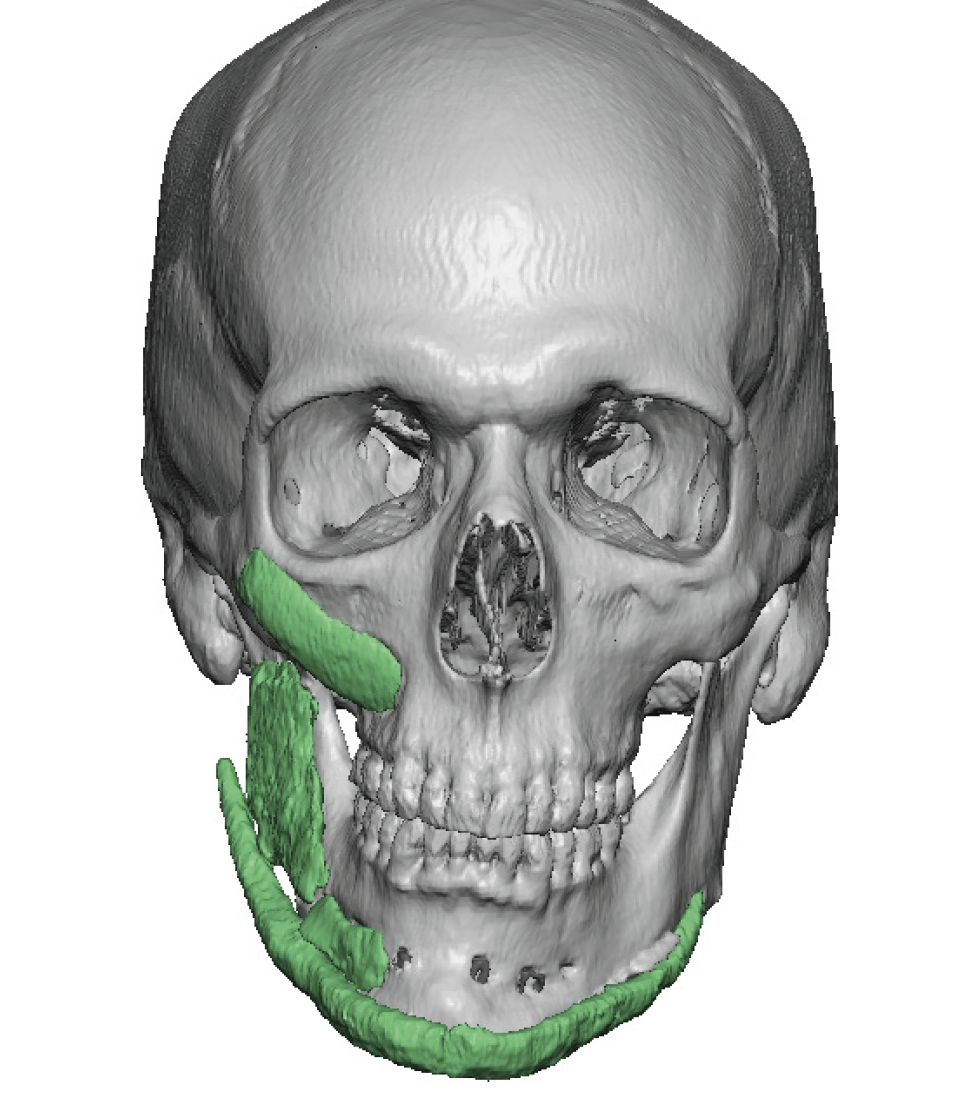
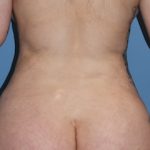
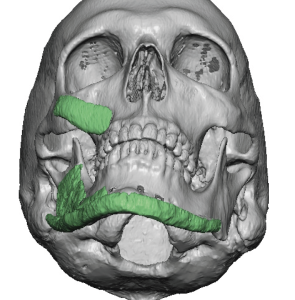
 This male had right facial asymmetry which had been previously treated over 20 years ago by a standard implant approach over a decade ago done in two stages by his description.. This included right Proplast blocks cut and placed along the right jawline as well as a right submalar-maxillary augmentation done with the same material. A secondary two piece hand made
 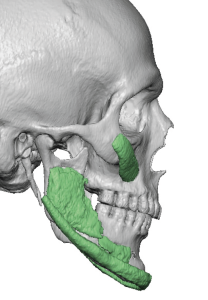 silicone wrap around jawline implant was placed which was laid on top of the Proplast implant material on he right side.
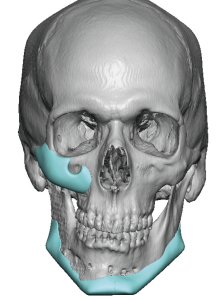
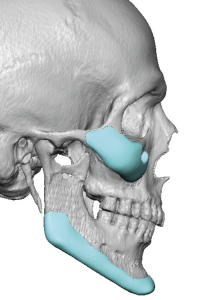 A custom jawline implant was designed for improved cheek and jaw asymmetry based on removal of the right Proplast implant material.
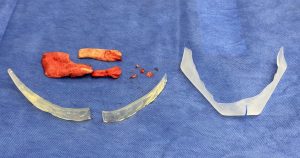
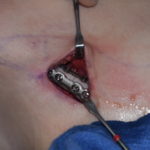
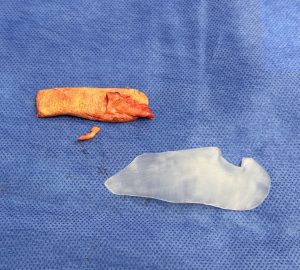 The indwelling implants were removed through existing submental and intraoral incisions. Comparing the removed standard implants vs the custom replacement implants showed their differences and ultimately the imprived aesthetic effect.
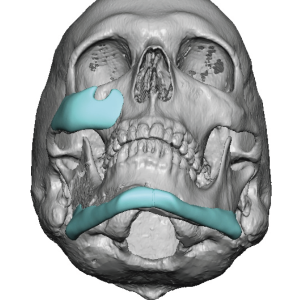 The improvement in the jaw and facialasymmetryies could be anticipated.
Discussion
In treating facial asymmetries:
Determine the exact bony nature of the asymmetry.
- digitally remove any existing implant materials
- Identify the bony asymmetries
- Smaller mandibular angle/body on one side
- Flat gonial angle
- Chin deviation/asymmetry
- Higher wider jaw angle on opposite side from the major jaw asymmetry
- Decreased/flatter cheek projection on major jaw asymmetry side
- ??Primary solution: Custom jawline implant
Best for:
- Unilateral mandibular hypoplasia
- Jawline contour asymmetry
- Normal occlusion
Strengths
- Precise side-to-side correction
- Permanent structural change
- Can widen, lengthen, and reshape jaw
Limitations
- Does NOT fix jaw position or bite
- Soft tissue asymmetry may persist
- Requires accurate diagnosis (easy to over/under-correct)
Think of it as:
“Adding missing bone where it should have been”
Is there a soft tissue component (soft tissue asymmetry)
- Volume differences (fat/muscle)
- Skin thickness differences
- Post-traumatic or idiopathic soft tissue imbalance
?? Primary solution: Fat grafting ± fillers
Best for:
- Soft tissue volume asymmetry
- Mild contour irregularities
- Adjunct to skeletal correction
Strengths
- Minimally invasive
- Natural tissue
- Good for fine-tuning
Limitations
- Unpredictable resorption
- Not structural
- Often requires repeat sessions
Think of it as:
“Camouflaging or blending surface asymmetry”
Key Case Insights
- Facial asymmetry is a multi-dimensional hard and softC tissue problem whose contemporary treatment requires 3D assessment and treatment planning.
- Secondary facial asymmetry surgery will run into prior implant placements and osteotomy fixation hardware which must be considered in the treatment planning.
- Most jaw asymmetries are best treated by a wrap around jawline implant approach to manage the bilateral deformities.
- Cheek flatness/hypoplasia is almost always part of a significant jaw asymmetry.
Dr. Barry Eppley
Plastic Surgeon