
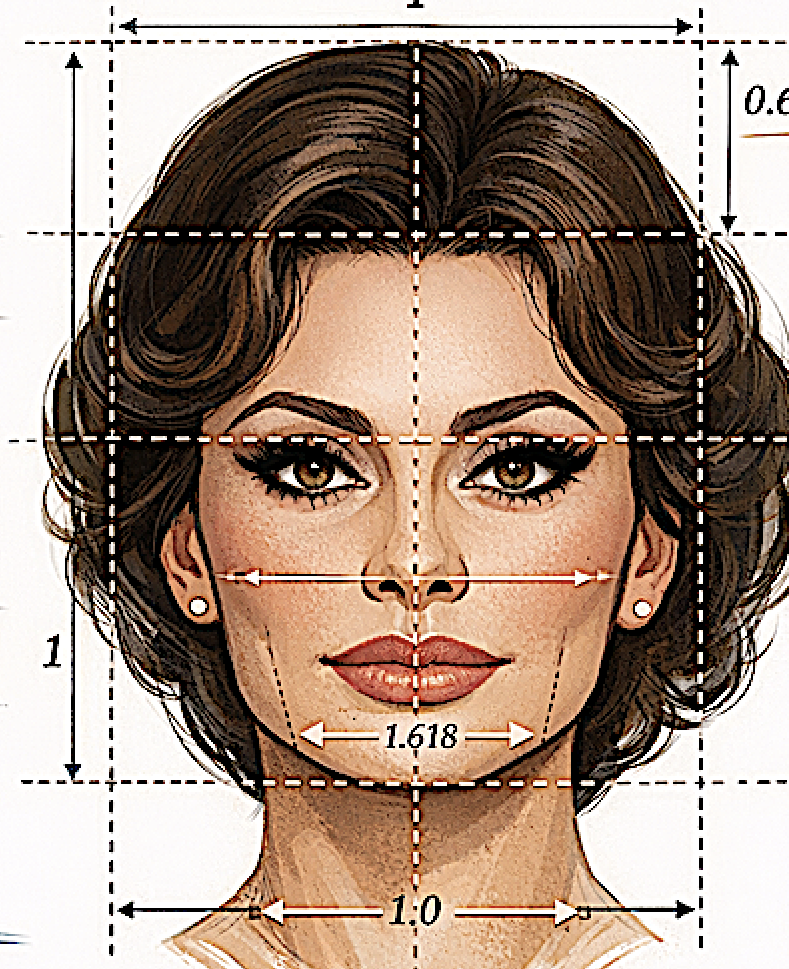

A wider jaw in women is mostly about the mandibular angle—the point where the lower jaw (mandible) turns upward toward the ear. This usually refer to a broader lower face, where the jawline extends outward more and the angle of the mandible is less sharp.
What it looks like
- Wide/obtuse jaw angle (more open angle):
- Lower face appears broader
- Jawline looks softer, less sharply contoured
- Often associated with a more rounded or square face shape
- Narrow/acute jaw angle (sharper angle):
- More defined, angular jawline
- Creates a “V-shaped” or tapered lower face
What creates a wide jaw
Several things can contribute:
- Bone structure (mandible width): The primary factor—some people naturally have a wider jawbone
- Masseter muscle size: Enlarged chewing muscles can make the jaw look square or bulky
- Gonial angle shape: A more open (obtuse) angle gives a broader, less tapered look
- Chin shape: A wider or shorter chin can accentuate jaw width
- Facial fat distribution: Can soften or visually widen the lower face
Common face shapes associated
- Square
- Rectangular
- Some round faces (if the jaw is not tapered)
Aesthetic perceptions
- A wide jaw can read as:
- Strong / defined
- Balanced (especially with prominent cheekbones)
- Less traditionally “delicate” in cultures that favor V-shaped faces
But trends shift—many modern beauty standards (especially in Western media) actually appreciate strong jawlines in women for a more striking, model-like appearance.
Big picture
A wide jaw isn’t inherently a flaw—it’s just a structural trait. In facial aesthetics, what matters most is proportion and harmony, not whether the jaw is wide or narrow in isolation.
Case Example
This older Italian female desired jaw augmentation with a goal to have lower facial proportions like Sophia Loren. She had chin and jaw angle implants initially in her home country but they made her lower face exactly the opposite from her goal…an elongated face that was more masculine in appearance.
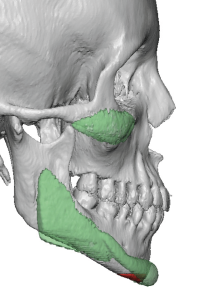
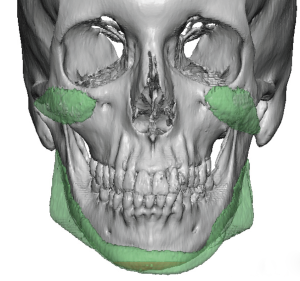 A 3D CT scan showed standard vertical lengthening jaw angle implants positioned anteriorly and a square style chin implant with uptilted wings posteriorly
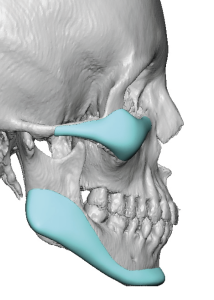
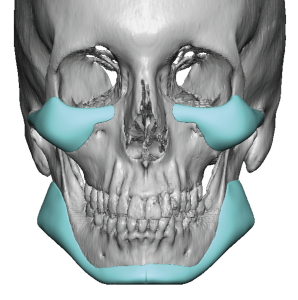 A different jaw augmentation was planned with 5mm vertical chin reduction and a wrap around jawline implant that only provided jaw angle width.
This new surgical plan provided good jaw shape improvement but she wanted further improvement.
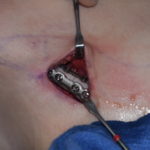
A 2nd stage procedure was done including an additional 5mms of vertical chin reduction and overlay jaw angle implants placed through existing facelift scars adding another 10mms of jaw angle width.
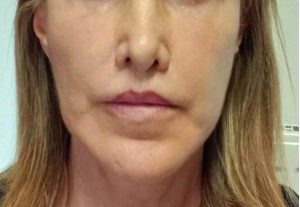
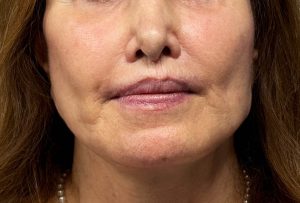 This was finally able to achieve the lower facial shape that she desired. Maybe not exactly like Sophia Loten but the general concept was achieved.
Discussion
Sophia Loren is a classic example of a square-to-oval facial shape with strong angular features.
Key characteristics of her face
- Jawline:
- Relatively broad and defined, but not overly heavy
- Has a noticeable angle (not a soft taper), giving structure
- Face shape overall:
- Often described as square-oval (or “rectangular oval”)
- Longer than it is wide, but with strong lateral definition
- Cheekbones:
- High and prominent, which balance her wider jaw
- Add elegance and vertical lift to her face
- Chin:
- Moderately broad, slightly rounded—not pointy
- Helps avoid a harsh square look
- Forehead:
- Proportionate, not overly wide, keeping the face balanced
Why her face is considered iconic
Sophia Loren’s beauty works because of contrast and harmony:
- Strong jaw + high cheekbones = sculpted, powerful look
- Angular structure + soft features (eyes, lips) = femininity with presence
She’s a great example that a wider or stronger jaw in women can be very attractive, especially when paired with:
- Defined cheekbones
- Good facial proportions
- Soft tissue balance
How Does Her Facial Proportions Fit Classic Aesthetic Ratios
Sophia Loren’s face aligns closely with several classical aesthetic ratios used in art, sculpture, and modern facial analysis—but not in a perfectly “idealized” way. What makes her striking is how she slightly deviates while maintaining overall harmony.
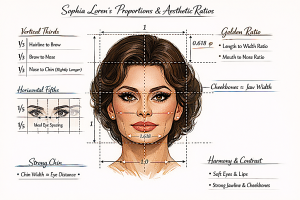
Here’s a structured breakdown:
1. Vertical thirds (facial height proportions)
The face is often divided into three equal parts:
- Hairline ? brow
- Brow ? base of nose
- Base of nose ? chin
Loren’s proportions:
- Her lower third (nose to chin) is slightly longer than the upper thirds
- This adds:
- Maturity
- Elegance
- A more dramatic, less “baby-faced” look
? This deviation gives her that regal, elongated appearance rather than a perfectly balanced “cute” face.
2. Horizontal fifths (facial width)
The face ideally fits into five equal vertical sections:
- Each eye ? one “fifth”
- Space between eyes ? one eye width
Loren’s proportions:
- Eyes are close to ideal spacing
- Her jaw width slightly exceeds the outer fifths
? This is key:
- The wider jaw breaks strict symmetry
- But it creates a powerful frame for the face
3. Golden ratio (? ? 1.618)
In facial aesthetics, this shows up in relationships like:
- Face length ÷ face width
- Mouth width ÷ nose width
- Eye spacing relationships
Loren’s case:
- Her face length-to-width ratio is close to golden ratio but slightly longer
- Her mouth is wider relative to nose than classical ideal
– Result:
- More expressive lower face
- Stronger sensuality and presence (a signature feature)
4. Jaw-to-cheekbone balance
Classic ideal:
- Cheekbones slightly wider than jaw
Loren:
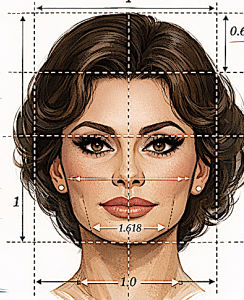
- Cheekbones and jaw are nearly equal in width
–This is unusual—and important:
- Prevents the face from looking top-heavy
- Creates a column-like, sculptural balance
5. Chin proportion
Ideal:
- Chin width ? inner eye distance
- Chin gently tapered
Loren:
- Chin is slightly wider and more squared
- Reinforces strength and structure
- Keeps the lower face from looking narrow or delicate
6. Feature contrast (not a ratio, but critical)
Classical beauty often assumes harmony through similarity. Loren’s beauty uses contrast:
- Strong jaw ? soft lips
- Angular structure ? large, rounded eyes
- Broad lower face ? lifted cheekbones
– This contrast creates visual tension, which is often more memorable than perfect ratios.
Bottom line
Sophia Loren doesn’t perfectly follow classical ratios—she balances near-ideal proportions with deliberate deviations:
- Slightly longer lower face
- Wider jaw than “ideal”
- Strong chin
- Balanced by high cheekbones and soft features
That combination gives her:
- Structure without harshness
- Strength without masculinity
- Harmony without bland perfection
Dr Barry Eppley
Plastic Surgeon