
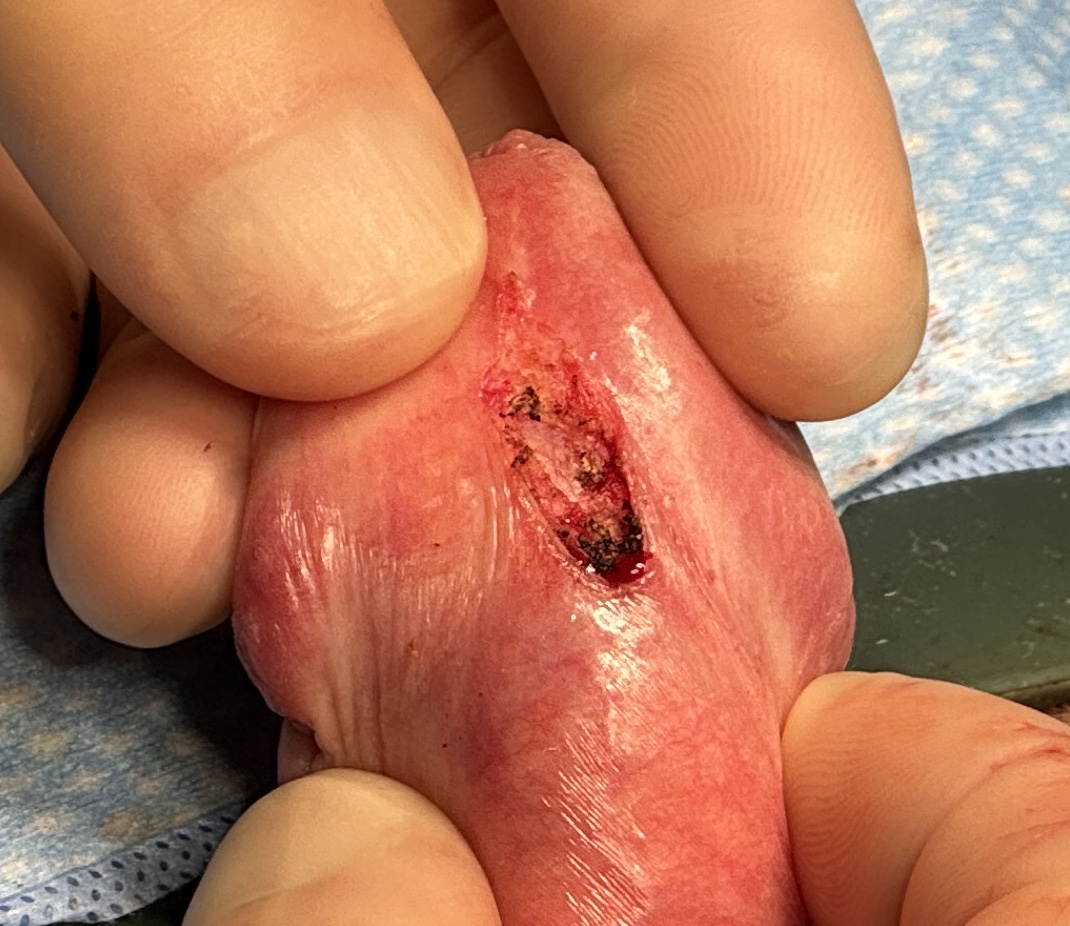
A penile frenulectomy is a minor surgical procedure that involves cutting or removing the frenulum—the small band of tissue on the underside of the penis that connects the glans (head) to the shaft.
The procedure
- Can be done under local anesthesia (numbing injection)
- The frenulum is either released (frenulotomy) or removed (frenulectomy)
- The area may be stitched with dissolvable sutures
- Takes about 30 minutes
Recovery
- Healing typically takes 1–3 weeks
- Temporary swelling, mild pain, or sensitivity is common
- Avoid sexual activity and masturbation for about 3–4 weeks (or as advised)
- Good hygiene is important to prevent infection
Risks
- Complication rates are low (minor bleeding, infection, or scar sensitivity are possible but uncommon)
Case Example
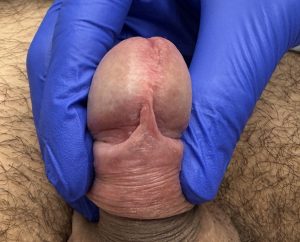 This male was to undergo custom testicular implant surgery and asked about removal of his penile frenulum. He had a significant band of tissue between the head and the shaft.
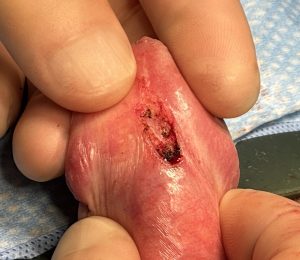
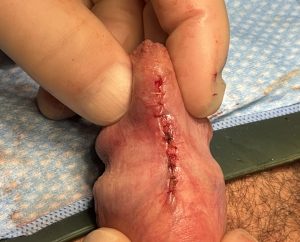 Once the testicle implants were placed the penile frenum was excised with the followng technique:
Surgical details illustrated:
- Incision: Elliptical around the frenulum to fully remove fibrous tissue
- Dissection: Includes release of deeper soft tissue fibers to prevent recurrence
- Hemostasis: Achieved before closure
- Closure: Linear closure with removal of upper and lower dog ears (redundant tissue)
Key surgical principles:
- Remove both superficial and deep attachments
- Avoid leaving residual fibers (reduces relapse/diastema reopening)
- Closure with the penile head on extension to optimize scar length to prevent recurrence
Discussion
A penile frenulectomy is a minor surgical procedure where the frenulum (the small band of tissue connecting the underside of the glans to the shaft) is partially or completely removed. It’s typically done when the frenulum is too tight (a condition called frenulum breve).
Here are the main benefits, when the procedure is medically indicated:
1. Reduced Pain or Discomfort
A tight frenulum can cause pain during erections or sex. Removing or releasing it usually eliminates that tension and discomfort.
2. Improved Sexual Function
Some men experience tearing, bleeding, or difficulty with penetration due to a short frenulum. Frenulectomy can allow more normal movement of the foreskin and improve overall function.
3. Lower Risk of Recurrent Tears
If the frenulum repeatedly tears during intercourse or masturbation, surgery prevents ongoing injury and scarring.
4. Increased Range of Motion
It allows the foreskin (if present) to retract more freely, which can improve hygiene and comfort.
5. Potential Improvement in Premature Ejaculation (in select cases)
There’s some evidence that a tight or hypersensitive frenulum can contribute to rapid ejaculation. Removing it may reduce sensitivity for some individuals, though this is not guaranteed.
When it’s typically recommended
- Painful erections or intercourse
- Frenulum tears or bleeding
- Diagnosed frenulum breve
- Functional limitation of foreskin movement
Important considerations
- It’s not necessary for everyone—only when symptoms are present
- Alternatives (like stretching exercises or topical treatments) may be tried first
- A frenulectomy technique is better than a frenuloplasty in many cases due to a more complete elimination of the banding.
Dr. Barry Eppley
Plastic Surgeon