 Safe removal of Medpor implants is really about controlled dissection, preservation of vital structures, and managing the consequences of tissue ingrowth. Surgeons approach it more like a reconstructive exposure procedure than a simple explant. Here are the key techniques:
1. Meticulous Layer-by-Layer Sharp Dissection
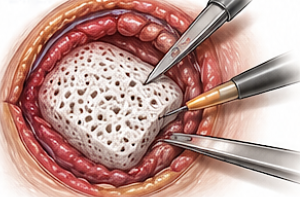
- Primary principle: never “pull”—always cut the ingrowth
- Use:
- Fine scissors
- Scalpel (often #15 blade)
- Needle-tip cautery
- The implant is freed by progressively releasing fibrous attachments
- Blunt dissection is generally avoided because:
- It can tear tissue
- It risks nerve injury
2. Subperiosteal vs. Supraperiosteal Approach
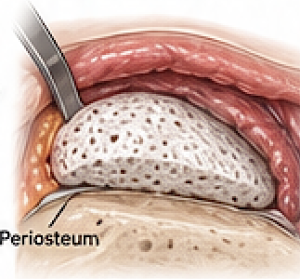
- If possible:
- Re-enter the original surgical plane
- Often this is subperiosteal, but:
- Medpor frequently bridges planes due to ingrowth
- Strategy:
- Stay on bone when safe to avoid soft tissue damage
- Or stay superficial to protect nerves depending on location
3. Implant “Debulking” / Piecemeal Removal
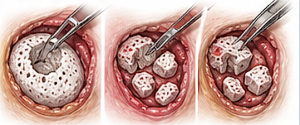
- En bloc removal is often impossible
- Technique:
- Core out the implant
- Remove in sections or fragments
- Tools:
- scalpel
- osteotome
- reciprocating saw
- Reduces:
- Traction on surrounding tissue
- Risk of nerve injury
4. Hydrodissection (Limited Use)
- Injection of:
- Saline ± epinephrine
- Helps:
- Expand tissue planes
- Reduce bleeding
- Limited effectiveness because:
- Tissue ingrowth is mechanical, not just compressive
5. Use of Electrocautery / Bipolar for Hemostasis
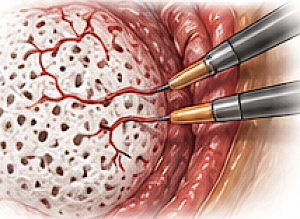
- Essential due to:
- Vascularized ingrowth into implant
- Bipolar cautery preferred near nerves for precision
- Helps maintain a clean operative field
6. Nerve Identification and Protection
Critical step depending on implant location:
- Infraorbital nerve (cheek implants)
- Mental nerve (chin implants)
Techniques:
- Early visual identification
- Use of:
- Nerve stimulator (occasionally)
- Gentle retraction
- Avoid:
- Traction
- Thermal injury
7. Capsule and Residual Tissue Management
- Unlike silicone, Medpor doesn’t have a true capsule
- Surgeons may:
- Leave some integrated tissue remnants if removal risks damage
- Goal:
- Functional safety > complete microscopic removal
8. Bone Surface Management
- After removal:
- Bone may be irregular or resorbed
- Techniques:
- Rasping or burring to smooth contour
- Irrigation to remove debris
9. Copious Irrigation
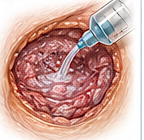
- Saline irrigation:
- Removes debris and small fragments
- Reduces infection risk
- Especially important if:
- Implant was fragmented
- There was prior infection
10. Immediate Replacement (Often Planned)
Because removal creates deficits:
- Fat grafting
- Replacement with silicone or PEEK implant
This is often done simultaneously since a wide open pocket exists
11. Gentle Soft Tissue Handling
- Critical to avoid:
- Skin thinning
- Contour deformities
- Techniques:
- Minimal retraction force
- Maintain vascularity of overlying tissues
Key Surgical Mindset
- With care, patience and persistence complete Medpor implant removal is usually possible
- Protect nerves and soft tissue first
- When a fragmentation method is needed reassemble all pieces extracted to ensure complete implant removal.
Dr Barry Eppley
Plastic Surgeon