
Bersides being far less commonly performed forearm implants are designed for different anatomical goals, muscle groups, and visual effects thsn upper arm implants.
Forearm Implants
These are placed to enhance the lower arm between the elbow and wrist.
Common goals:
- Increase forearm thickness and definition
- Create a more athletic or muscular appearance
- Correct asymmetry or congenital underdevelopment
- Improve contour after trauma or nerve injury
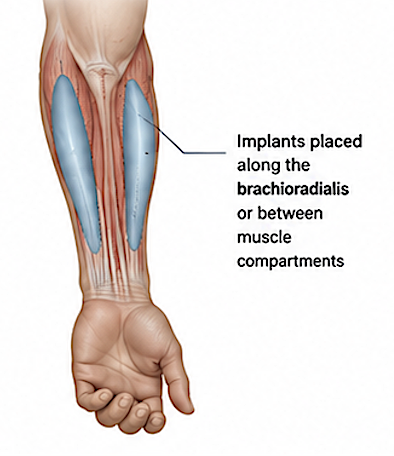
Typical implant locations:
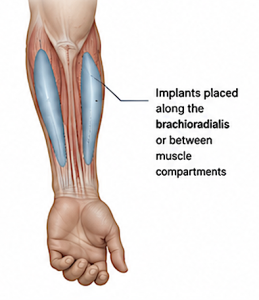
- Along the brachioradialis muscle (outer forearm)
- Along the flexor/extensor muscle compartments
Characteristics:
- Shorte, narrower and less thick than biceps implants
- Designed to follow the tapered shape of the forearm
- Often challenging because the forearm has:
- thinner soft tissue coverage
- many tendons and nerves
- less space for implants
Visual effect:
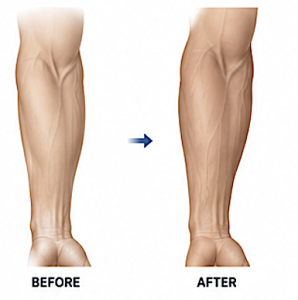
- Gives the appearance of naturally developed forearm musculature
- Improves arm balance when someone already has large upper arms
Upper Arm Implants
These enhance the area between the shoulder and elbow.
They are usually divided into:
- Biceps implants
- Triceps implants
- Sometimes deltoid implants near the shoulder
Common goals:
- Create larger, more prominent upper arm muscles
- Improve peak and roundness
- Restore volume loss or congenital deficiency
Characteristics:
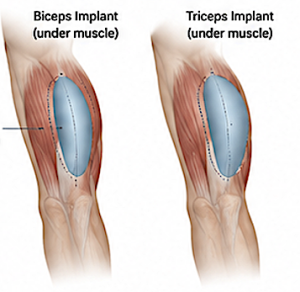
- Thicker longer and wider than forearm implants
- Can be placed either under the muscle fascia or completely under the muscle
- More soft tissue coverage than the forearm, making edges less visible
Visual effect:
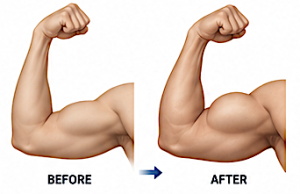
- Produces a more obvious “bodybuilder” upper-arm appearance
- Enhances arm circumference and muscle projection
Key Differences
|
Feature |
Forearm Implants |
Upper Arm Implants |
|
Location |
Elbow to wrist |
Shoulder to elbow |
|
Muscles Enhanced |
Brachioradialis/flexors |
Biceps/triceps |
|
Shape |
Long, tapered |
Fuller, rounded |
|
Soft Tissue Coverage |
Thin |
Thicker |
|
Technical Difficulty |
Higher |
Moderate |
|
Visibility of Implant |
More possible |
Less common |
|
Main Aesthetic Goal |
Definition and proportion |
Size and bulk |
Functional Considerations
Forearm implants must be designed carefully because:
- the forearm is highly mobile,
- tendons glide constantly,
- and there is limited space around nerves.
Upper arm implants generally tolerate larger volumes better and are often easier to conceal anatomically.
Custom vs Standard Implants
- Upper arm implants are more commonly available as standard silicone implants.
- Forearm implants are customized because no such standard implants exists.
In modern body contouring, I now now use 3D-designed custom solid silicone implants for both areas in many cases to better match the patient’s anatomy and goals.
Case Example
This older male was to undergo upper arm implants (tricep and trapezius) with prior pectoral biceps implants in placed. For more complete arm proportions he also desired forearm implants.
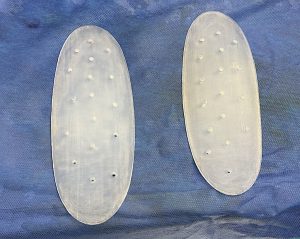 Custom forearm implants were designed of 18cms in length, 6.5cms in width and 6mm thick.
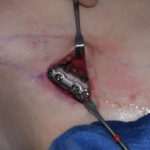
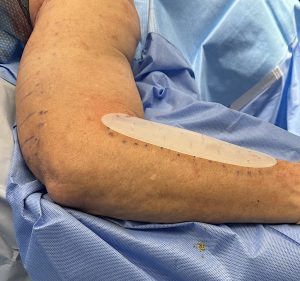 In the prone position the trapezius and tricep implants were placed. With his arm on an armband extension a lateral upper forearm incision was made to expose the brachioradialis fascia. A subfascial pocket was made, the implants inserted and the incision.
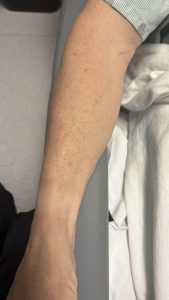
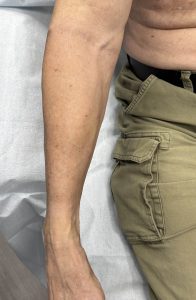
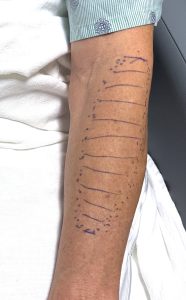
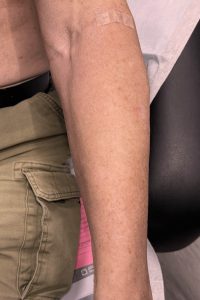 One year later the upper forearm augmentation was seen with no implant edges and a well healed scar.
Upper vs Lower Arm Implants
Besides the obvious implant size differences forearm implants are usually more about improving arm proportion than they are about having a muscular effect. As a result forearm implants are usually low profile with very fine edging.Their effects come from the extent of muscle area coverage in an otherwise tight subfascial pocket.
Dr. Barry Eppley
Plastic Surgeon
Dr. Barry Eppley
Plastic Surgeon