
Aesthetic norms influence custom facial implant design at almost every level: proportions, contours, symmetry targets, gender expression, ethnic preservation, age-related expectations, and even how “natural” a result should appear. In modern facial implant surgery, the goal is rarely just “bigger” or “more projected.” It is usually to create harmony according to a culturally and individually informed aesthetic framework.
Here are the main ways aesthetic norms shape implant design:
1. Facial Proportion Ideals
Most implant designs start from proportional relationships that are widely perceived as attractive.
Examples include:
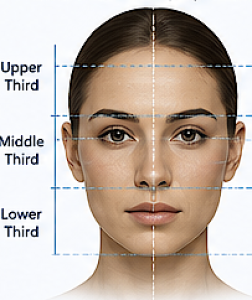
- Facial thirds balance
- Jaw width relative to cheekbone width
- Chin projection relative to nose and lips
- Bigonial width (jaw angle width)
- Midface projection
- Nasofrontal and cervicomental angles
Designers often reference classical proportional systems such as:
- Golden ratio concepts
- Neoclassical canons
- Contemporary cephalometric norms
- Population-specific anthropometric databases
For example, chin augmentation may aim to bring the pogonion into better balance with the lips and nose rather than simply enlarging the chin.
2. Gender-Specific Aesthetic Standards
Masculine and feminine facial ideals differ substantially, so implant geometry changes accordingly.
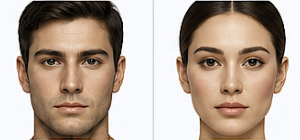
Masculine norms often favor:
- Wider lower face
- Stronger jaw angles
- More anterior chin projection
- Flatter cheeks
- Sharper transitions
- Greater skeletal definition
Feminine norms often favor:
- Softer contours
- More ogee curve in the cheeks
- Narrower chin taper
- Less gonial flare
- Smoother skeletal transitions
A custom jaw implant for a male patient may intentionally increase posterior gonial width and mandibular definition, while a female design may avoid excessive lateral expansion.
3. Ethnic and Cultural Aesthetic Preferences
This is one of the most important modern considerations.
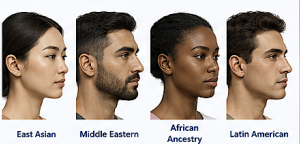
Older implant philosophies often imposed Westernized ideals. Contemporary custom implant planning increasingly emphasizes:
- Preservation of ethnic identity
- Population-specific skeletal norms
- Avoidance of “over-Westernization”
Examples:
- East Asian patients may seek V-line narrowing or controlled midface augmentation
- Middle Eastern patients may prefer stronger profile balancing
- African ancestry patients may seek contour enhancement without altering ethnic identity
- Latin American aesthetic preferences often favor stronger cheek and jaw definition
There is no single universal “ideal face.” Implant design now attempts to reflect the patient’s own cultural aesthetic framework.
4. The “Naturalness” Standard
Modern aesthetic norms heavily prioritize results that:
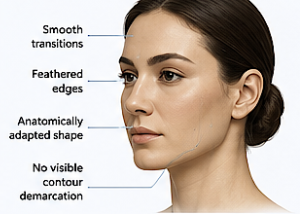
- Look anatomically believable
- Preserve facial movement
- Avoid operated appearance
- Maintain soft-tissue harmony
This affects implant design by encouraging:
- Feathered implant edges
- Smooth contour transitions
- Subtle augmentation gradients
- Anatomically adaptive shapes
For example, a custom infraorbital-malar implant may intentionally taper into native bone to avoid visible demarcation.
5. Social Media and Digital Imaging Influence
Current aesthetic standards are increasingly shaped by:
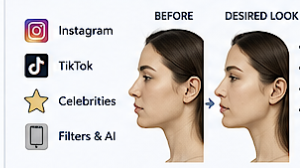
- Instagram filters
- Celebrity facial structures
- AI-enhanced imagery
- High-definition photography
- Video-based self-perception
Patients often request:
- Sharper jawlines
- Higher cheekbones
- More angular lower faces
- Better profile definition
This has increased demand for:
- Extended jaw angle implants
- Wraparound chin implants
- High malar augmentation
- Infraorbital support implants
However, surgeons must balance these trends against anatomical reality and long-term stability.
6. Aging Norms and Rejuvenation Goals
Implants are also designed according to perceptions of youthfulness.
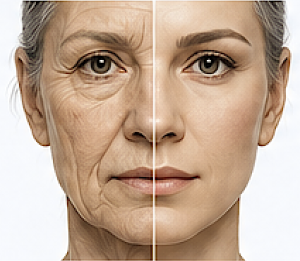
Youth-associated skeletal characteristics include:
- Stronger midface support
- Better infraorbital projection
- Defined mandibular border
- Stable chin-neck relationship
Custom implants may therefore:
- Restore pyriform support
- Augment infraorbital rims
- Rebuild prejowl areas
- Improve jawline continuity
Rather than merely enlarging structures, designs aim to recreate youthful skeletal architecture.
7. Symmetry Expectations
Human faces are naturally asymmetric, but aesthetic norms strongly favor perceived balance.
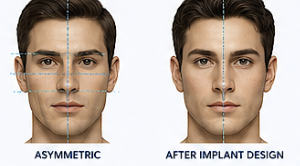
Custom implants often compensate for:
- Hemifacial deficiencies
- Mandibular asymmetry
- Orbital asymmetry
- Congenital irregularities
- Prior trauma
The target is usually perceived symmetry, not mathematically perfect symmetry, because overly exact symmetry can appear unnatural.
8. Functional Anatomy Limits Aesthetic Goals
Aesthetic ideals must still respect:
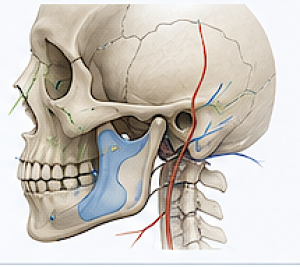
- Soft tissue thickness
- Mental nerve location
- Bite mechanics
- Facial muscle dynamics
- Airway considerations
- Bone stock
An aesthetically desirable implant may be biomechanically or anatomically unsafe if overextended.
Thus, good custom implant design is a negotiation between:
- Patient aesthetic desires
- Cultural norms
- Anatomical feasibility
- Long-term stability
9. Shift From Standardized to Personalized Beauty
Traditional stock implants assumed generalized beauty ideals.
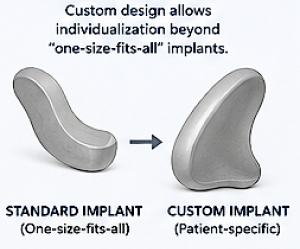
Custom implants now allow:
- Individualized asymmetry correction
- Patient-specific contour goals
- 3D simulation
- Personalized skeletal enhancement
The trend is moving toward:
“Optimization of the individual face”
rather than forcing faces toward one universal template.
10. Psychological and Identity Factors
Patients often seek implants not only for attractiveness but for:
- Identity congruence
- Gender affirmation
- Confidence
- Facial presence
- Professional image
- Aging control
Therefore, aesthetic norms operate psychologically as well as anatomically.
Two patients with identical anatomy may request completely different implant designs because they define attractiveness differently.
In Practical Custom Implant Workflow
Aesthetic norms influence:
- CT-based virtual planning
- Implant vector direction
- Amount of projection
- Surface transitions
- Symmetry corrections
- Width-to-height ratios
- Edge tapering
- Material thickness distribution
The final design is usually a synthesis of:
- Objective craniofacial measurements
- Surgeon aesthetic philosophy
- Patient preference
- Cultural/gender norms
- Soft-tissue behavior prediction
Core Principle
The best custom facial implants do not create an obviously augmented face. They create:
- structural harmony,
- proportionate enhancement,
- and identity-consistent refinement.
Modern facial implant design is therefore less about imposing a universal beauty standard and more about translating individualized aesthetic ideals into anatomically viable skeletal architecture.
Dr Barry Eppley
Plastic Surgeon