

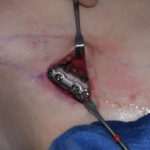
The golden ratio can influence the conceptual framework of custom facial implant design through the application of mathematically derived proportional relationships used in facial aesthetic analysis. However, its role is interpretive and heuristic rather than deterministic.
The golden ratio, defined mathematically as:

It serves as a proportional constant that has historically been associated with visually harmonious geometric relationships. In facial morphology, this ratio may be applied to evaluate spatial relationships between craniofacial landmarks, including:
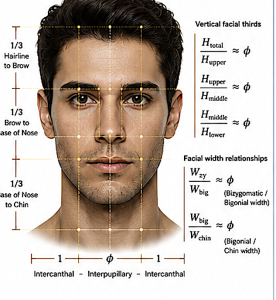
- Facial height-to-width ratios
- Bizygomatic-to-bigonial width relationships
- Nasal projection relative to chin projection
- Intercanthal and interpupillary spacing
- Vertical facial thirds
- Lower facial proportionality
In the context of custom facial implants, these proportional analyses may guide the three-dimensional augmentation of skeletal structures to optimize overall facial balance and geometric coherence.
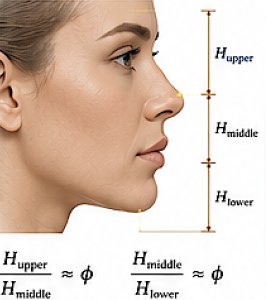
Examples include:
- Increasing pogonion projection through custom chin implants to improve sagittal lower facial proportionality
- Expanding mandibular width via jaw angle implants to achieve improved transverse facial balance relative to bizygomatic width
- Augmenting malar projection to optimize midfacial convexity and orbital support relationships
- Modifying infraorbital or paranasal contours to improve continuity of facial curvature vectors
Modern custom implant planning utilizes advanced three-dimensional cephalometric and morphometric analysis derived from CT-based skeletal modeling. Implant geometries are therefore determined through a synthesis of:
- Anthropometric facial measurements
- Skeletal topology
- Soft tissue response characteristics
- Sexual dimorphism
- Ethnic craniofacial norms
- Occlusal relationships
- Functional biomechanics
- Patient-specific aesthetic objectives
Accordingly, the golden ratio is not employed as a rigid numerical target, but rather as a mathematical reference model within a broader system of proportional facial analysis.
Contemporary facial implant design is therefore better characterized as a process of individualized geometric optimization rather than strict adherence to a universal proportional constant.
Dr. Barry Eppley
Plastic Surgeon