

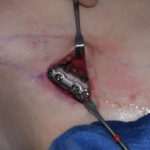
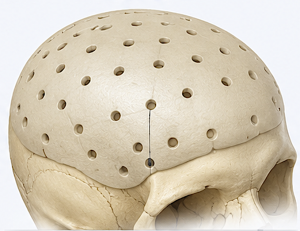
 Perfusion holes in aesthetic skull implants serve several important biologic and mechanical purposes. Since onlay skull implants for aesthetic augmentation are made of solid silicone these holes are intentionally made intraoperatively for multiple purposes. Some of these effects are for intraoperative use while others have postoperative benefits. In either case they have the biologic effects of improving tissue integration, healing, and long-term implant stability. Mechanically they help intraoperative implant positioning and infection prevention.
Postoperatively their major roles include:
Fibrovascular Tissue Ingrowth
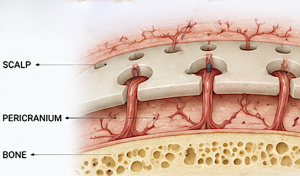

Small perforations allow soft tissue and blood vessels to grow through the implant. Over time, this creates biologic attachment between the scalp tissues above and the pericranium/bone beneath the implant. This ingrowth acts like multiple anchoring points that stabilize the implant and reduce dead space.
Reduction of Seroma Formation
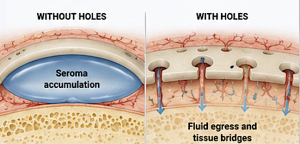
One of the biggest postoperative issues in large skull implants is fluid accumulation (seroma) between the implant and scalp. Perfusion holes help prevent this by:
allowing fluid egress,
eliminating large uninterrupted pockets,
and creating tissue “bridges” across the implant.
Functionally, they work similarly to quilting sutures used in body contouring surgery.
Improved Implant Stability
Once tissue grows through the holes, the implant becomes biologically “interlocked” to surrounding tissues. This supplements screw fixation and decreases micromotion over time. Studies on cranial implant fixation emphasize that stability at the implant–skull interface is critical for long-term success.
Enhanced Biologic Integration
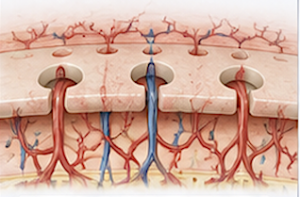
Perforations allow vascular communication across the implant. Instead of creating a complete barrier between scalp and skull, the holes preserve some physiologic tissue continuity. This is believed to improve tissue health and reduce chronic encapsulation.
Intraoperatively their major roles include:
Implant Alignment
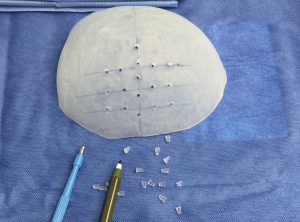
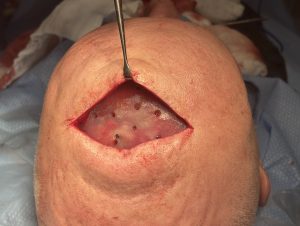
Placing a skull implant through limited scalp incisions does not permit its orientation to be seen once inside the pocket. Placing implant holes in the midline of the implant as well as from side to side allows them to be used like a ‘compass’ in surgery to align the implant on the bone as it was designed on the preoperative 3D CT scan.
Implant Positioning
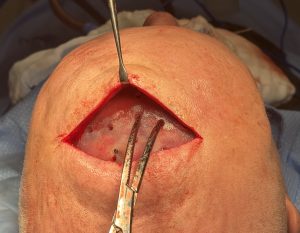
The implant holes serve as a means to overcome the implant around inside the pocket which would be difficult to do othewise. A clamp placed between two of the holes serves as a ‘handle’for implant movement and positioning.
Antibiotic Wells
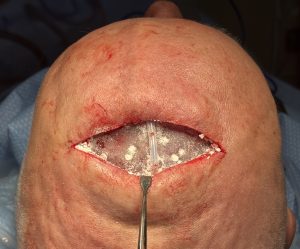
The implant has an impenetrable surface to any fluids or medications. To allow for antibiotic impregnation into the implant the perfusion holes can be filled with antibiotic powder prior to closure. This allows for antibiotic release into the implant space for a short time after surgery.
While called perfusion holes their use in aesthetic skull implants belies that description.Their many biologic and mechanical effects provides an invaluable role in the long term success of onlay skull augmentations.
Dr. Barry Eppley
Plastic Surgeon