

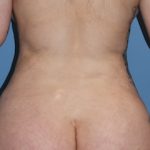
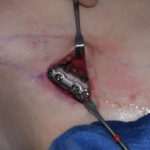
In many experience with pectoral implats, standard and custom, reported loss of chest muscle strength has not been reported. Thus it is fair to say that it is not a significant postperatiive concer and a general statement that pectoral implants generally do not directly weaken the pectoralis major muscle, But they can potentially affect muscle function and performance depending on implant placement, size, surgical technique, healing. and the patient’s postoperative level of physical activity.
Here’s how:
Typical Implant Placement
Most male pectoral implants are placed:
- Under the pectoralis major muscle (subpectoral/submuscular)
- In larger implants the patient may desifre extending the lateral border of the implant beyond muscle border
This means the muscle is elevated during surgery to create a pocket for the implant.
Short-Term Effects
After surgery, patients commonly experience:
- Temporary weakness
- Tightness
- Reduced range of motion
- Pain with pushing or lifting movements
These effects are mainly from:
- Surgical dissection
- Muscle stretching
- Postoperative inflammation
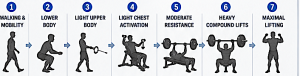
Strength usually returns gradually over weeks to months. A useful postoperative acitivity program over an eight (8) week after the surgery i as follows:
 .
.
Long-Term Strength
In most patients:
- The pectoralis major retains normal contractile ability
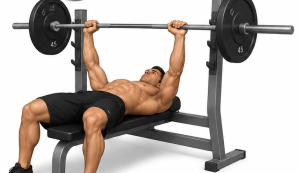
- Bench press, push-ups, and chest exercises can often return to baseline
- Significant permanent weakness is rare
However, some patients nay notice:
- A feeling of tightness during maximal contraction
- Mild reduction in explosive power
- Discomfort with heavy bodybuilding movements
This is more likely when:
- Large implants are used
- The implant pocket is tight/not adequate
- Scar tissue (capsular contracture) develops
- The muscle attachment is altered during surgery
Athletes and Bodybuilders
High-level athletes sometimes report:
- Altered biomechanics
- Reduced comfort during deep chest stretching
- Visible implant movement during flexion (“animation deformity”)
Because the implant occupies space beneath or within the muscle plane, force transmission and muscle excursion can feel different even if true muscle strength is preserved.
Surgical Factors That Matter
Strength outcomes depend heavily on:
- Preservation of muscle attachments
- Avoiding nerve injury (medial/lateral pectoral nerves)
- Implant size relative to chest anatomy
- Postoperative rehabilitation
Poor technique can theoretically cause:
- Muscle denervation
- Chronic pain
- Functional weakness
—but these are uncommon in experienced hands.
Compared With Breast Implants
The effect is somewhat analogous to subpectoral breast implants in women:
- Most regain normal strength
- Elite athletes may perceive subtle performance changes
- Larger implants increase the likelihood of functional complaints…but still rare
Bottom Line
For most patients, pectoral implants:
- Do not significantly reduce pectoralis major strength
- Cause mostly temporary postoperative weakness
- May subtly alter chest mechanics or comfort during intense upper-body activity
Serious permanent functional loss is uncommon when surgery is properly performed
Dr. Barry Eppley
Plastic Surgeon