

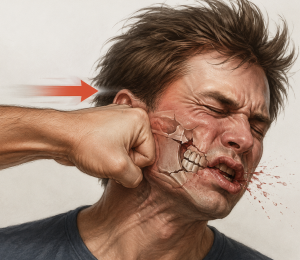
 One of the common questions I get about facial implants, and custom facial implants in particular, is what will happen to them if I sustain trauma to the face. Will the implant break/fracture or become displaced? Let me address how facial implant materials respond to trauma or more specifically what is their impact resistance (aka will they fracture or break apart).
There is surprisingly little published data on direct impact testing of facial implant materials specifically (like drop-tower or ballistic-style testing). Most implant literature instead reports:
- tensile strength,
- compressive strength,
- elastic modulus,
- fracture toughness,
- and fatigue resistance.
These values are what surgeons and engineers use to estimate real-world impact resistance.
Measured Mechanical Properties Relevant to Impact
|
Material |
Tensile Strength |
Elastic Modulus |
Fracture Behavior |
Practical Impact Behavior |
|
Medical Silicone |
5–15 MPa |
0.005–0.05 GPa |
Highly elastic |
Deforms instead of fractures |
|
Porous Polyethylene (Medpor) |
20–30 MPa |
0.5–1 GPa |
Moderately brittle |
Can crack under high-force trauma |
|
PEEK |
90–110 MPa |
3–4 GPa |
Tough, semi-flexible |
Excellent impact/fatigue resistance |
|
Titanium (Ti-6Al-4V) |
900–1100 MPa |
100–110 GPa |
Very high toughness |
Extremely resistant to fracture |
What These Numbers Mean Clinically
Silicone
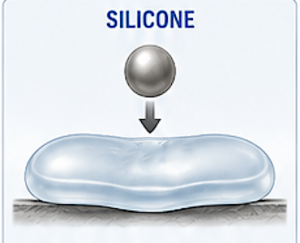
Silicone has low strength numerically, but very high impact resilience because it stretches rather than cracks.
Typical measured values:
- Tensile strength: ~5–12 MPa
- Elongation at break: 300–700%
That means:
- a silicone chin implant can deform significantly from a punch or sports impact,
- but usually rebounds without permanent damage.
Failure mode:
- displacement,
- tearing,
- or capsule distortion,
not fracture.
Medpor (Porous Polyethylene)
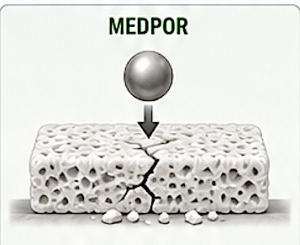
Medpor is much stiffer.
Typical values:
- Tensile strength: ~20–30 MPa
- Elastic modulus: ~0.5–1 GPa
Because it is porous:
- tissue ingrowth stabilizes it,
- but pores reduce crack resistance.
Impact behavior:
- better fixation,
- lower flexibility,
- more susceptible to fracture propagation from concentrated force.
In real trauma:
- the surrounding facial bone often fractures simultaneously.
PEEK
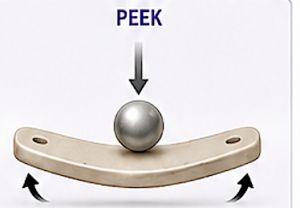
PEEK has some “bone-like” impact mechanics.
Typical measured values:
- Tensile strength: ~90–100 MPa
- Elastic modulus: 3–4 GPa
- Fracture toughness: ~4 MPa?m
Importantly:
PEEK absorbs energy without brittle catastrophic failure.
That is why it is widely used for:
- cranial plates,
- orbital implants,
- custom jawline implants,
- spinal cages.
Its modulus is close to cortical bone, reducing stress concentration.
Titanium
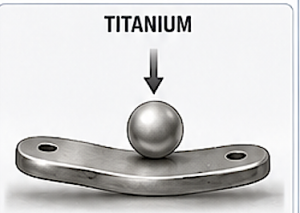
Titanium is mechanically the strongest.
Typical values for Ti-6Al-4V:
- Tensile strength: 900–1100 MPa
- Yield strength: ~800–950 MPa
- Fracture toughness: 55–115 MPa?m
?ultimate ?900 to 1100 MPa
This is vastly stronger than facial bone itself.
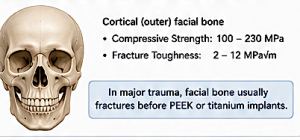
Cortical facial bone:
- compressive strength ? 100–230 MPa,
- fracture toughness ? 2–12 MPa?m.
Meaning:
- in major trauma, bone usually fails before titanium does.
Relative True Impact Resistance
If you define impact resistance as:
“ability to survive sudden high-energy loading without catastrophic failure”
then the ranking is approximately:
- Titanium
- Silicone
- PEEK
- Medpor
But if you define it as:
“ability to absorb impact without transmitting force”
then:
- Silicone
- PEEK
- Medpor
- Titanium
because titanium transfers force directly due to rigidity.
Real-World Facial Trauma Interpretation
Approximate force thresholds are difficult because:
- implant geometry matters,
- screw fixation matters,
- surrounding bone changes load transfer,
- and impact angle changes outcomes dramatically.
But clinically:
Silicone
Usually survives:
- punches,
- sports contact,
- falls,
without material fracture.
PEEK
Often survives:
- significant blunt trauma,
- motorcycle crashes,
- sports injuries,
with intact implant structure.
Titanium
Rarely fractures outside:
- major vehicle trauma,
- industrial accidents,
- ballistic injuries.
Medpor
Most vulnerable to crack propagation under concentrated impact.
For contact Facial Bone Strength (typical values)
Important Engineering Point
Impact resistance is not just “material strength.”
A large custom implant distributes force across:
- broader surface area,
- multiple fixation points,
- and surrounding bone.
So a well-designed custom implant can actually improve local load distribution and reduce focal fracture risk.
In short there are some measurable benchtop differnces between the four implant materials but on a practical basis all of them are more than capable of handling most common types of external impact forces. And this alone would not be a primary reason for material selection.
Dr. Barry Eppley
Plastic Surgeon