

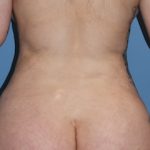
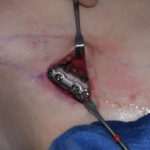
Aesthetic hip implants are solid silicone body-contouring implants used to widen or smooth the lateral hip/“hip dip” area. They are a specialized aesthetic surgery option for patients seeking lateral hip width or hip-dip correction when fat grafting is inadequate or unavailable
Hip Implant Concepts::
- Best use: thin patients or patients without enough fat for hip fat grafting.
- Alternative: fat transfer is usually preferred when enough donor fat exists.
- Placement: typically in a soft-tissue pocket over/around the lateral hip fascia..
- Benefits: more predictable, permanent volume than fat grafting.
- Limitations/Complications: visible/palpable edges, implant show, asymmetry, displacement, infection, seroma, and revision risk.
There are some unique features of hip implants that make them prone to some of the aesthetic issues:
- Vertical orientation:
- Shape: thinner at bottom half than upper half, taller than wide
- Pocket location: deep subcutaneous location
- Lack of tissue integration: As with any silicone implant encapsulation occurs around the implant but without tissue adherence to it
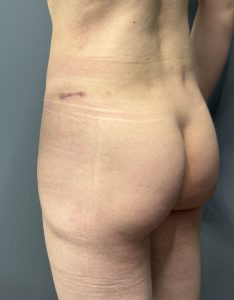 As a result they are prone to bending or folding at the bottom of the implant pocket creating edge show.
While numerous implant techniques had been used to prevent implant edging, such as application of ePTFE patches to the underside of the implant and perforations through the implant top encourage tissue ingrowth, they are not always successful.
In search of other techniques to prevent the weight of the implant from causing it to bend on its bottom end, and borrowing from how hip implants are used in the Pelvic Plasty procedure, the concept of anchoring the implant to the iliac crest was conceived.
Technique:
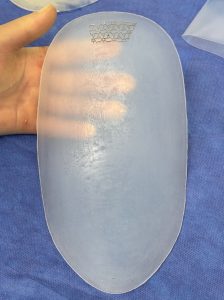
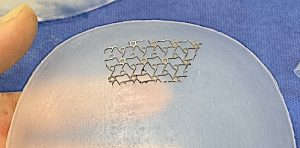
 A thin titanium mesh piece is fashioned to be applied at the upper edge of the implant.
- A 2.9mm suture anchor (Juggerknot)is secure into the iliac crest
- The suture from the anchor is passed through the implant on its underside through the mesh on its outer surface and then passed back through the mesh and implant to its underside. The suture is then tied down to the other suture on the anchor.
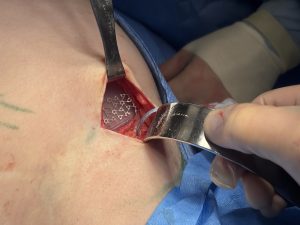
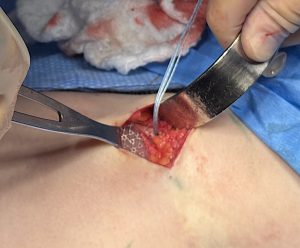
 A thin titanium mesh piece is fashioned to be applied at the upper edge of the implant.
Discussion
Anchoring hip implants to the iliac crest is not new. That is done routinelyas part of the Pelvic Plasty in which a silicone hip implant is attached to a titanium iliac crest plate for a composite hip augmentation effect. One of the benefits of a hip implant being superiorly suspended is that there is no inferior implant folding. Borrowing from this experience is borne the idea of a suture anchor suspension technique.
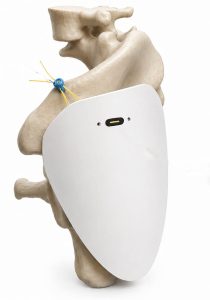 Suture anchors have been around a long time and are traditionally used for anchoring soft tissue to bone. When. using a suture anchor to attach/suspend a hip implant the key is to provide a method of secure suture purchase to the implant. This requires a ‘button’, or in this case a thin titanium mesh plate, to prevent the suture passing through the implant from tearing through the silicone implant material. This is especially important given the flexion around the implant with leg motion.
Dr Barry Eppley
Plastic Surgeon