
Adult brachycephaly refers to a persistently short, wide head shape (increased cranial width relative to length) that began in infancy and remained into adulthood.
What it is
- Definition: Brachycephaly = reduced front-to-back skull length with increased width
- Cephalic index: Typically > 80–85
- In adults, the skull bones are fused, so the shape is stable and non-progressive
- The most common cause is positional infant supine sleeping with prolonged occipital pressure
Adult presentation
- Broad, short skull
- Flat posterior head
- Possible high forehead
- Facial features may appear wide or retrusive
Common Functional issues
- Hat/ Helmet fit issues
- Psychosocial distress related to head shape
Treatment in adults
Non-surgical:
- Limited to camouflage (hair styling, headwear)
Surgical:
- Cosmetic cranial contouring
- Considered when:
- Significant deformity
- Severe psychosocial impact
Case Study
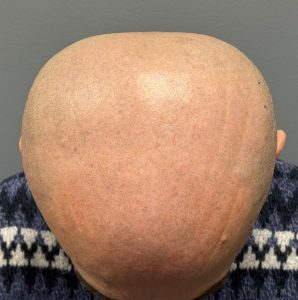 This adult male had long been bothered by a flat back of the head with a wide head shape from the frontal view. When he had hair his head shape was not a major concern but with a shaved head it becomes a different matter. His scalp was affected by slight cutis vertices gyrata (CVG) as evidenced by the numerous front to back linear scalp lines.
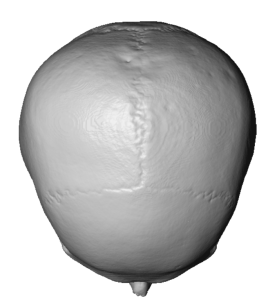
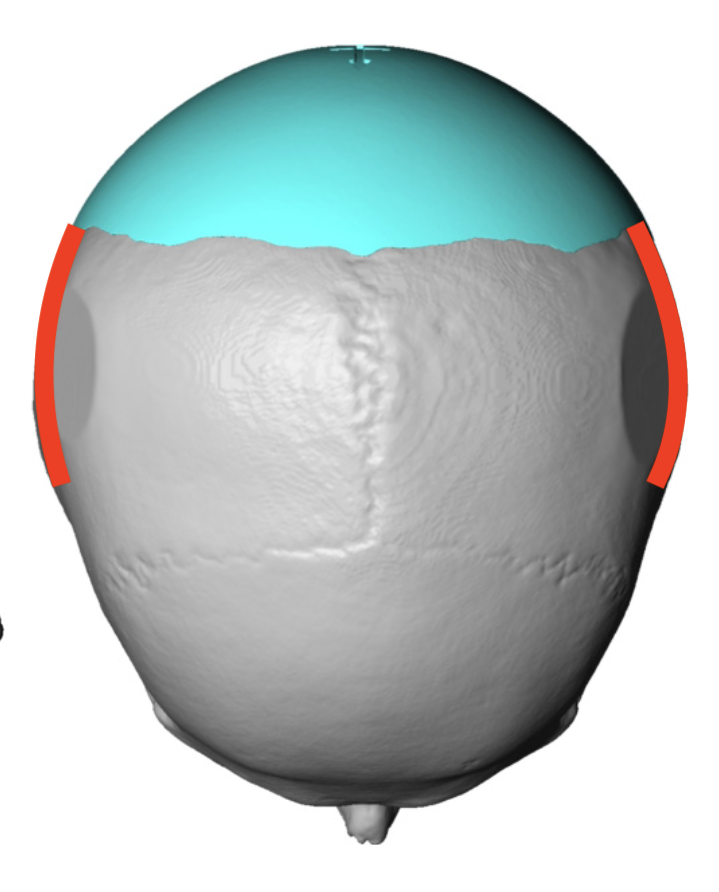
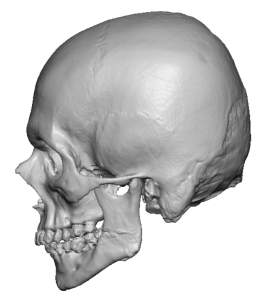 His 3D CT scan showed a brachycephalic head shape with a flat occiput and a wide parieto-temporal skull as a result.
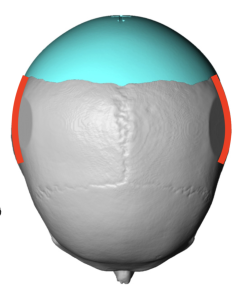
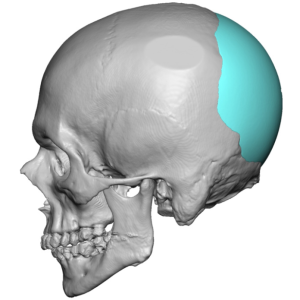 The surgical plan was for a bidimensional skull shape change. The major effect was for a back of the head augmentation with a custom skull implant of 14mm projection and 110cc volume. (red = reduced areas)
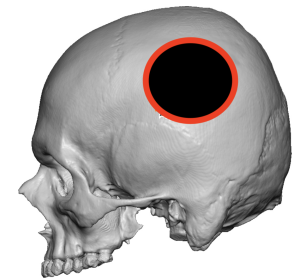 Biparietal-temporal bone reduction was planned based on the thickness of bone. Color skull bone thickness mapping showed a reduction of 4mms was possible in the needed area of reduction.
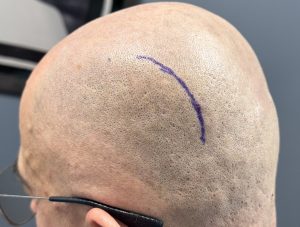
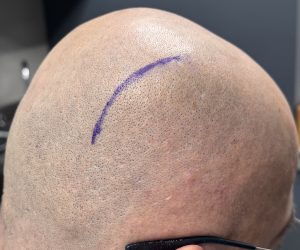 A novel incisional approach was devised that could achieve the dual purposes of implant insertion and bone reduction conveniently using his CVG scalp lines. Bilateral incisions placed along the high posterior temporal line of 5cms was planned.
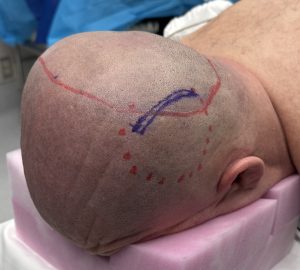
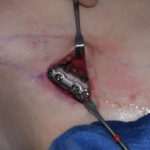
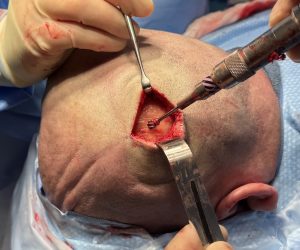 Under general anesthesia in the prone position through the posterior temporal incisions the temporal muscle was raised to expose the underlying bone. Using.a high speed handpiece and burr the parieto-temporal bone areas were reduced until the thin diploic spaced was encountered.
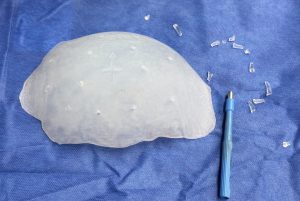
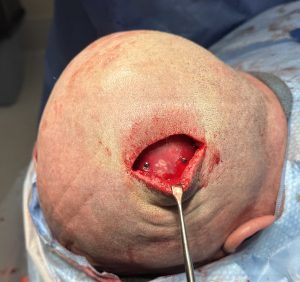 Once the bilateral bone reductions were completed the subperiosteal implant pocket was created. The custom skull implant was inserted through one of the side incisions, positioned and secured with microscrews at the incision sites. The microscrews also served as anchorage sites for the posterior temporal muscle resuspension.
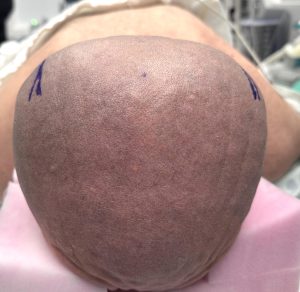
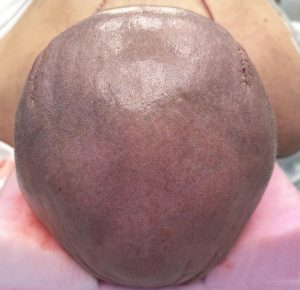 The scalp incisions were closed with resrobable suture over a drain on each side. The immediate effects of the change to the back of his head shape was apparent looking from above.
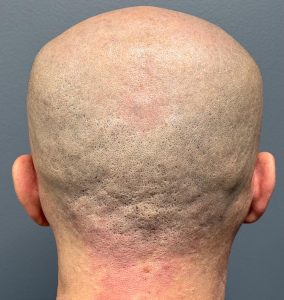
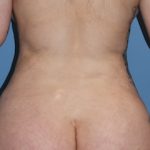
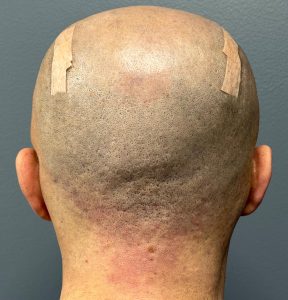 When seen days later after drain removal the head narrowing effects could be seen in the back view.
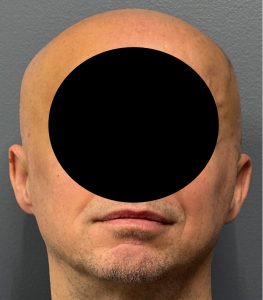
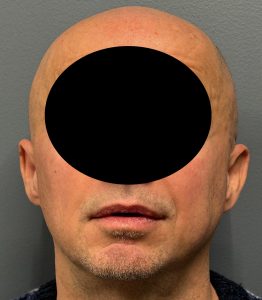 The narrowing of the wide head shape could be seen in the front view as well.
Discussion
Brachycephaly Surgical Options & Limitations
Overview
- In adults, cranial sutures are fused ? no growth potential
- Surgery is purely cosmetic, not growth-modifying
- Goals are contour improvement, not normalization
- Risk–benefit threshold is much higher than in children
Preoperative 3D CT Skull Scan
-
- Necessary for custom implant design
- Assess skull thickness for reduction area
- Evaluate the shape relationship between augmented areas vs reduction areas
Surgical options
1. Posterior Cranial Augmentation
What it can do
- Improve posterior projection/more convex shape
- Reduces“boxy” head shape
- Improve profile head shape
Limitations
- Projection limited by scalp stretch
Implant Materials
- Solid sillcone (preferred due to placement being possible with smaller incision s
- PEEK (requires long scalp incision for placement, less projection possible)
- Bone cements are poor choices due too limited augmentation capabilit
Advantages
- Precise shape control
- Custom design via CT
Risks
- Implant-related risks:
- Infection
- Seroma
- Edge visibility
2. Side of the Head Narrowing
What it can do
- Narrow the wide posterior temporal area
- Synergistic effect with occipital augmentation
Indications
- Wide temporo-parietal area as a result of the flat back of the head
- Flared temporal muscles due to wide bone shape
Techniques
- Temporo-parietal bone bursing
- Posterior temporal muscle excision
Limitations
- Skull bone thickness (3 to 4mms reduction ion each side
- Thinnest part of the temporal muscle us along the posterior temporal bony line
What surgery CANNOT do in adults
? Create normal infant-like cranial proportions
? Increase intracranial volume/space
? Reliably normalize cephalic index
Potential Complications
- Scalp sensory changes
- Scarring (coronal/occipital)
- Infection
- Hematoma/seroma
- Implant palpability
- Asymmetry
Best candidates
? Severe posterior flattening
? Clear deformity in profile
? Will accept improvement, not perfection
Bottom line
Adult brachycephaly surgery is about strategic camouflage and contour, not correction. The posterior vault with custom implants offers the best risk-to-reward ratio. The side off the head narrowing has a more limited effect but is aided by the occipital augmentation.
Dr. Barry Eppley
World-Renowned Plastic Surgery