
Testicle implants have traditionally been used to replace a missing testicle. To achieve this goal, a range of standard implant sizes is available in both saline-filled and solid silicone forms. However, when a natural testicle exceeds standard implant sizes, a custom implant design is required. This approach allows for precise control of size and shape, although the material is always an ultrasoft solid silicone.
A lesser-known variation is the custom “wrap-around” testicle implant.
What They Are
Traditional testicular implants are oval or spherical prostheses placed within the scrotum to simulate a natural testicle.
“Wrap-around,” or custom-contoured implants, represent a more specialized concept. These implants are designed to:
- Enlarge an existing natural testicle by surrounding it with implant material
- Contain an inner chamber that matches the dimensions of the native testicle
- Uses an outer silicone layer whose thickness determines the degree of enlargement
Because the implant encases a natural testicle, this is an enhancement procedure rather than a replacement.
Custom, patient-specific implants are FDA-approved, as they are uniquely manufactured for each individual. This is not considered an off-label use.
Important Considerations
Fully custom wrap-around implants are not widely available off-the-shelf. Some surgeons instead modify standard FDA-approved implants into a partial wrap-around or “clamshell” design. These modified implants are not equivalent to a true custom wrap-around implant.
Risks
Wrap-around implants carry the same general risks as traditional testicular implants, including:
- Infection (rare)
- Implant malposition
- Firmness or unnatural feel
- Scrotal tightness or discomfort
- Need for revision surgery
A unique risk specific to wrap-around implants is secondary disengagement, in which the implant may separate from and slip off the natural testicle. While uncommon, this remains a possibility.
Case Example
A male patient lost his left testicle due to torsion during adolescence. It had been replaced with two textured silicone implants to achieve maximal size. Despite this, the result was still undersized, high-riding, and uncomfortable due to fixation.
The patient desired enlargement of his natural right testicle and a larger, more proportionate implant on the left side. Ultrasound measured the right testicle at 5.2 cm. A 6.75 cm solid implant for the left side and a 6.75 cm hollow (wrap-around) implant for the right side were selected to achieve bilateral enlargement.

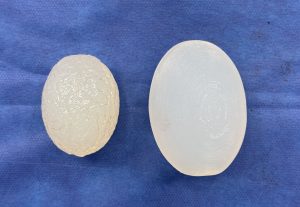 Under anesthesia, the existing left implant, along with its capsule and fixation suture, was removed. A new solid implant was placed and compared intraoperatively to the removed device.
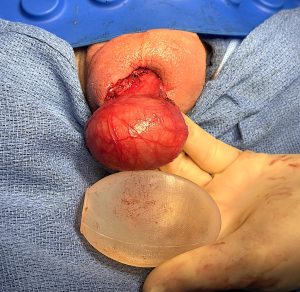
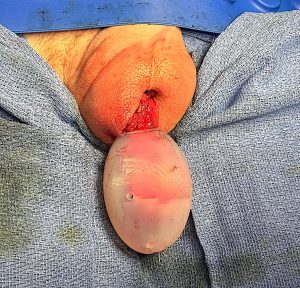 On the right side, the natural testicle was carefully dissected on its vascular pedicle. It was then guided into the wrap-around implant using a suture technique. Once securely positioned, the composite structure was returned to the scrotum.
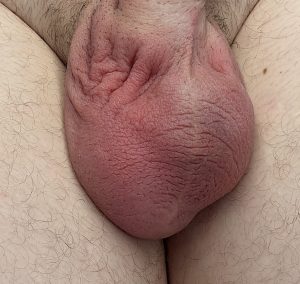
 At one-year follow-up, the midline scrotal incision had healed well. Bilateral enlargement was successfully achieved using this dual implant approach. Although the left implant remained slightly higher than the right, overall symmetry was significantly improved compared to the preoperative condition.
Discussion
This case illustrates a unique application of custom testicular implants, combining both solid and wrap-around designs to achieve optimal aesthetic and functional results.
Dr. Barry Eppley
Plastic Surgeon