
If you already have saline testicular implants and want to increase their size, that’s something that requires a revision surgery—it’s not something that can be adjusted or “filled up” after placement like some other implants.
Here’s the reality of how it works:
1. Implants aren’t expandable once placed
Testicular implants (saline or silicone) come in fixed sizes. Unlike breast tissue expanders, they don’t have ports for later enlargement. To increase size, the existing implants must be removed and replaced with larger ones.
2. Key surgical considerations
- Scrotal tissue capacity: The skin and internal pocket need to accommodate a larger implant. If the current pocket is tight, it may need to be surgically expanded.
- Blood supply & healing: Overstretching tissue increases risks like thinning, poor healing, or even extrusion.
- Symmetry & comfort: Larger implants can feel heavier and may sit differently, which affects aesthetics and comfort.
3. Limits to size increase
There are some limitations on implant size increase such as
- Your anatomy (scrotal laxity, prior surgeries)
- Scar tissue from the first procedure
- Risk tolerance
Some surgeons may only recommend a gradual size increase rather than a more dramatic jump but that conservative approach is usually not warranted.
What limits most surgeons in increasing testicle implant sizes is being stuck in using what is available off-the -shelf or with standard implant sizes. They fail to consider custom implant designs and sizes.
4. Risks of upsizing
- Infection
- Implant malposition
- Skin thinning or erosion
- Chronic discomfort
While these are typical risks of any testicle implant these risks are not any higher in replacement cases than in first-time surgeries.
Case Example
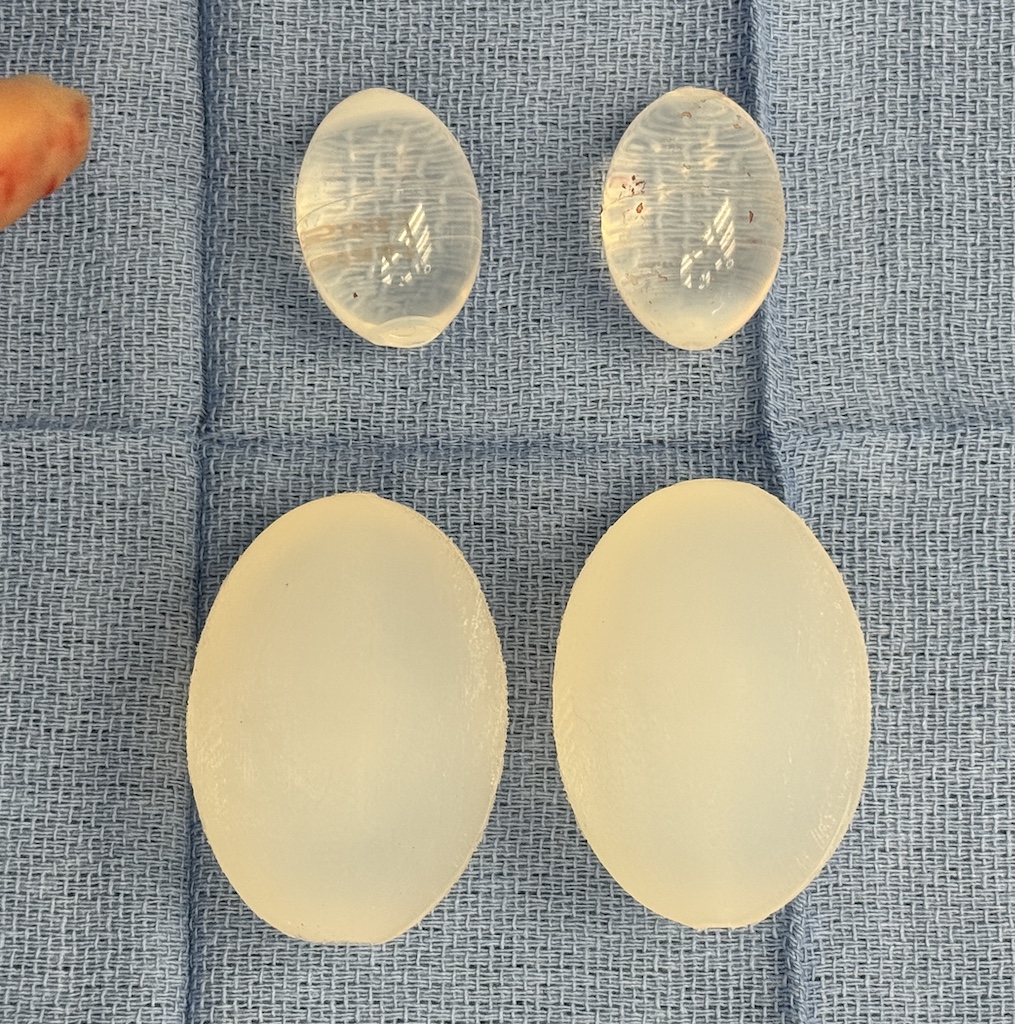
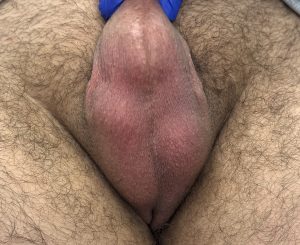 This male presented with a history of saline filled implants (4.0cms, 16cc volume) as a displacement method for his small but functional natural testicles. Postoperatively he developed a ‘three ball’ appearance due to incomplete displacement of his native testicles. This was a sequelae of inadequate implant volume and that they had a high position in the scrotum. The implants also felt hard and did not have a natural feel to them. His goal was to have the largest implant replacement as possible that would fit within his scrotum. The replacement strategy was to go with a much larger solid silicone hollow chamber implant of 6.25cm size (60cc volume)…. technically and implant size increase of threefold as judged by volume.
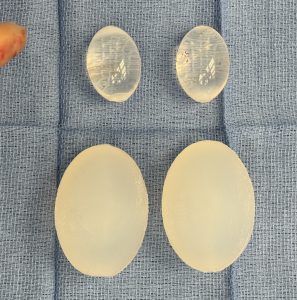
 The saline implants were removed through a low midline scrotal incision. Comparing them by size and volume showed the significant difference. Despite bthe much larger size the hollow chamber silicone implants were softer than that of the saline implants.
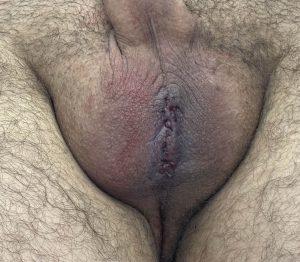 The new larger implants will most certainly adequately camouflage email much smaller native testicles.
Discussion
Most surgeons typically use the following approach to implant sizing and upsizing decisions in testicular implant revision cases.
1. Available Implant Sizes (General Ranges)
Testicular implants are usually measured by volume (cc) and sometimes by dimensions.
Typical ranges:
- Small: ~10–15 cc
- Medium: ~15–20 cc
- Large: ~20–25 cc
- Extra large: ~25–35+ cc
Most adult males naturally fall somewhere in the 15–25 cc range, so going above that starts to theoretically become more “augmented” rather than anatomical.
2. How Surgeons Decide on a New Size
A. Current Implant Size
They start with what you already have:
- If you’re at 15 cc, they might suggest – 18–20 cc
- If you’re at 20 cc, they might suggest – 22–25 cc
This may be perceived as a safe approach but such small size increases will make little if any visible change in implant size.
My guideline is a minimum of a 30% to 50% implant volume change to make enough difference in most patients for the surgery to be worthwhile.
B. Scrotal Laxity (Key Factor)
This is a major consideration but fortunately the scrotal tissues are very elastic.
Assess:
- How loose or tight the scrotal skin is
- How much stretch it already has from the current implants
- Whether it can safely accommodate more volume
If the scrotum is tight, and for upsizing it always is, a capsulotomy or capsulectomy is needed otherwise known as surgical pocket expansion.
There is no need for conservative implant upsizing if the scrotum is tight….release and expand it
C. Implant Pocket & Capsule
A tight implant pocket will exist because of the scar tissue (capsule) that naturally surrounds the indwelling implant. The capsule needs to be excised (capsulectomy) for significant pocket expansion. The question is not whether it should be done but to what extent it needs to be done to accommodate the new implant size.
D. Aesthetic Goals
You and the surgeon align on:
- How much size increase are you seeking
- Implant asymmetry adjustment if it exists
- New incision location (low midline scrotum)
Some patients want:
- Subtle increase – 5 to 10ccs or 1cm size increase
- Moderate increase – 10 to 20ccs or 1.5cm size increase
- Large increase – +20–40 cc or greater than 1.5cm size increase
3. Practical Example
Let’s say:
- Current: 18 cc implants or 4.0 size implant
- Moderate scrotal laxity
- Conservative: 24cc or 5.0 size implant
- Moderate increase: 28 to 30cc or 5.5 size implant cc
- Large increase: 33 to 35cc or 6.0 size implant
- XL increase: 40cc+ or 6.5 size implant
This case example is a good illustration that significant testicle implant sizes can be effectively achieved in secondary implant replacment surgery with a customer implant design, surgical pocket expansion through capsulectomies and approaching the procedure from a lower scrotal incision. A conservative implant size replacement is fine if that is what the patient wants. But it should not be the limiting strategy used in the patient who wants a more appreciable implant size increase.
Dr Barry Eppley
Plastic Surgeon