
Does the effects of custom facial implants change based on the material used?
Not really. It is a common misconception that the implant material used will affect the aesthetic result. Most pertinently it is believed that the more rigid the material is the more facial definition it is going to create or the better the outcome will be.
But this is based on a flawed understanding of the differences between an onlay versus an inlay implant material. This means is the material being used to fill in a full or nearly full thickness bony defect (inlay) or is it being used to build out the contour of a more normal bone (onlay). That is a critical difference and one in which the material rigidity is important.
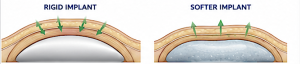
- Implant rigidity is critical in an inlay application because it is being asked to assume some of the mechanical properties of the lost bone.
- As an onlay such absolute rigidity is not essential since what is required is forced displacement of the overlying soft tissues and that is a function of volume and shape of the implant material. The material should not be soft but its flexion capability is irrelevant to its ability to cause significant and sustained soft tissue displacement.
The most common materials for modern custom facial implants are:
- Solid silicone
- Porous polyethylene (Medpor)
- PEEK (polyetheretherketone)
- Titanium
Each behaves differently biologically (significant) mechanically (less so)
1. Silicone Implants
Characteristics
- Smooth, solid, nonporous
- Flexible
- Easy to shape and remove
- Historically the most common facial implant material
Effects on outcomes
Advantages
- Softer transition under thin tissues
- Easier revision/removal
- Lower cost
- Can be repositioned more easily
Disadvantages
- No tissue ingtegration
- Slightly greater risk of movement if not rigidly fixed
- Bone underneath can remodel (imprinting)
Visual/feel effects
Silicone’s greatest aesthetic value is that when it comes to implants with a large surface area coverage (e.g., wrap around jaw, extended IOMs, midface mask, skull implants) this is the preferred material due to its handling properties.
2. Porous Polyethylene (Medpor)
Characteristics
- Microporous structure
- Tissue and blood vessels grow into it
- No flexibility
Effects on outcomes
Advantages
- Becomes integrated with surrounding tissue
- Very stable once healed
- No risk of shifting
- Can produce sharper definition
Disadvantages
- Harder to remove/revise
- More difficult surgery
- Tissue ingrowth can make complications more challenging
- Requires screw fixation to drive adapt the implant to the bone (compression)
- Must be designed and placed in multiple pieces in larger implant designs which introduces placement challenges and complications
Visual/feel effects
May feel more“fixed” and skeletal but this may be more psychological than real
3. PEEK
Characteristics
- Rigid thermoplastic mayterial
- Can only be made custom
- Has some limited flexibility if thin enough
Effects on outcomes
Advantages
- Very stable with screw fixation
- Closely mimics cortical bone stiffness
- Newest material option
Disadvantages
- More expensive
- Must be designed and placed in multiple pieces in larger implant designs which introduces placement challenges and complications
Visual/feel effects
Hard to tell any real differences from the other materials.
4. Titanium
Characteristics
- Metal implant
- Extremely strong and biocompatible
- Usually used for reconstruction rather than pure cosmetics
Effects on outcomes
Advantages
- Permanent structural stability
- Excellent osseointegration
- Very thin yet strong, no flexibility
Disadvantages
- Can sometimes be palpable
- Thermal conductivity concerns
- Imaging artifacts
- Difficult revisions
- Overly rigid for some cosmetic uses
Titanium is more common in:
- Orbital reconstruction
- Craniofacial trauma
- Custom cranial implants
Less common for purely facial augmentation
The material affects:
|
Factor |
Silicone |
Medpor |
PEEK |
Titanium |
|
Tissue ingrowth |
0 |
++++ |
++ |
++ |
|
Ease of removal |
++++ |
+ |
++ |
+ |
|
Flexibility |
++++ |
+ |
++ |
+ |
|
Stability |
+++ |
++++ |
++++ |
++++ |
|
Infection handling |
++++ |
+ |
++ |
++ |
|
Precision |
+++ |
++ |
+++ |
+++ |
|
Bone Imprinting |
+++ |
++ |
++ |
+ |
Implant scores 18 15 17 14
The conclusion is there is no clear material winner and they are just different. It its understanding these material differences that will determine how effective the surgical result will be.
Does the Aesthetic Result Look Different?
Overall not really but it depends on what criteria is being used to judge their effectiveness.
External appearance
- Silicone ? slightly softer contours ???
- PEEK/titanium ? sharper skeletal definition
- Medpor ? intermediate but not crisp
But this is highly design and facial location dependent. This may have some merit in the jawline but no where else in the face,.
Large augmentations
For major jawline or midface augmentation:
- Rigid materials preserve geometry better
- Silicone can flex slightly under tissue pressure
Thin-skinned patients
Material edges matter more:
- Hard materials may show edges
- Silicone can camouflage better
Does Material Affect Long-Term Aging?
Unknown but unlikely. Important variables include:
- Bone remodeling
- Soft tissue thinning
- Implant stability
- Capsular formation
Long-term what counts is the expansion of the bony contours to hang onto the soft tissue better.Less tissue sag occurs when there is better bony support. The material doing the bony expansion does matter, the volume expansion it creates does.
In Modern Custom Facial Implant Surgery
The “best” material depends on:
- Desired aesthetic
- Size of augmentation
- Anatomy
- Revision likelihood
- Surgeon preference
- Risk tolerance
But surgical design and placement matter more than the material alone
Dr Barry Eppley
Plastic Surgeon