

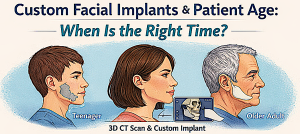
 Patient age matters with custom facial implants, but not because there is one magic cutoff. The real issue is whether facial skeletal growth is essentially complete and whether the patient has the maturity and expectations for a permanent implant procedure. Teens in particualar should meet milestones in growth and physical maturity before plastic surgery, and also have realistic goals and sufficient emotional maturity.
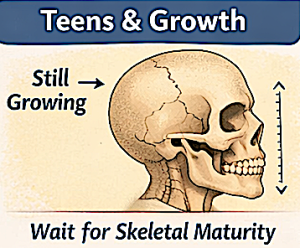 For elective facial skeletal augmentation, the main concern is operating too early, before the jaws and facial bones have finished growing. In general, growth finishes earlier in girls than boys, but there is wide individual variation. A commonly cited benchmark in the orthognathic literature is that about 98% of facial growth is complete by around age 15 in girls and 17 to 18 in boys, but that does not mean every patient is ready at those exact ages.
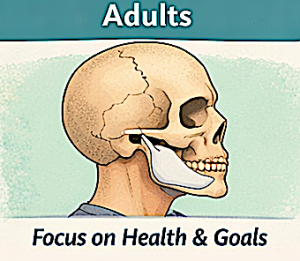 That leads to the practical rule: custom facial implants are usually best reserved for patients who are skeletally mature, which often means late teens or adulthood for cosmetic cases. For younger patients, especially males, waiting longer reduces the risk that future jaw or midface growth could change the facial balance around a permanent implant. Orthognathic guidance makes the same general point from a different angle: jaw surgery is typically timed when skeletal growth is close to completion because ongoing growth can change the outcome.
Where age matters most is in the type of implant. Jawline, chin, and other lower facial implants are more growth-sensitive because the mandible can continue changing through adolescence. Midface and orbital implants also depend on skeletal maturity, but they are sometimes considered earlier in reconstructive or congenital cases when the issue is structural deficiency rather than elective aesthetic enhancement. Craniofacial growth disturbances and jaw deformities are part of the clinical framework for skeletal procedures, which is why timing is individualized.
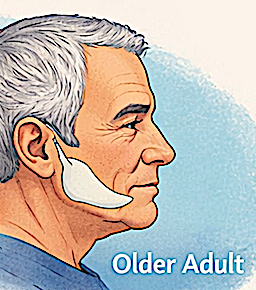 At the other end of the age spectrum, there is usually no strict upper age limit for custom facial implants. In adults, candidacy is driven more by health, bone anatomy, occlusion, skin and soft-tissue quality, smoking status, healing capacity, and the specific aesthetic goal than by chronological age alone. That is especially true because facial aging continues over time even after skeletal growth is complete.
Custom facial implants are described as patient-specific devices designed from a 3D CT scan, intended to create a permanent structural change rather than a temporary soft-tissue effect. That makes the age discussion even more important: the implant can be custom-made at almost any age, but the best timing is when the underlying facial framework is stable enough that the design will stay harmonious as the patient ages.
 So the bottom line is this: for purely cosmetic custom facial implants, age is less about a birthday and more about skeletal maturity. Younger teens are usually poor candidates for permanent facial implants; older teens may be candidates only after careful growth assessment; and adults are generally evaluated on anatomy and health rather than age itself. Congenital, post-traumatic, or reconstructive cases are the main exception, because treatment may be justified earlier.
Dr. Barry Eppley
Plastic Surgeon