
A direct browlift is a brow-lifting operation in which skin is removed just above the eyebrow, and the brow is elevated by closing that excision. It is mainly used to treat brow ptosis, especially when the droop affects the upper visual field or creates significant asymmetry.
Compared with endoscopic or coronal brow lifts, the direct approach is usually valued for its precision and predictability, particularly in patients with marked brow descent, facial nerve weakness, or significant asymmetry. Its main tradeoff is that it leaves a visible scar above the brow, so patient selection matters.
Typical advantages are:
- very targeted lift
- good control of brow shape and symmetry
- can be useful in older patients or functional brow ptosis
Typical disadvantages and risks are:
- visible scar
- numbness or altered forehead sensation
- asymmetry or recurrence
- infection, bleeding, poor wound healing, and dissatisfaction with contour or scar quality, which are recognized brow lift risks in general.
In plain terms: it is often a functional, straightforward brow-elevation procedure, but it is chosen only when the benefit of a precise lift outweighs the downside of a scar.
Case Example
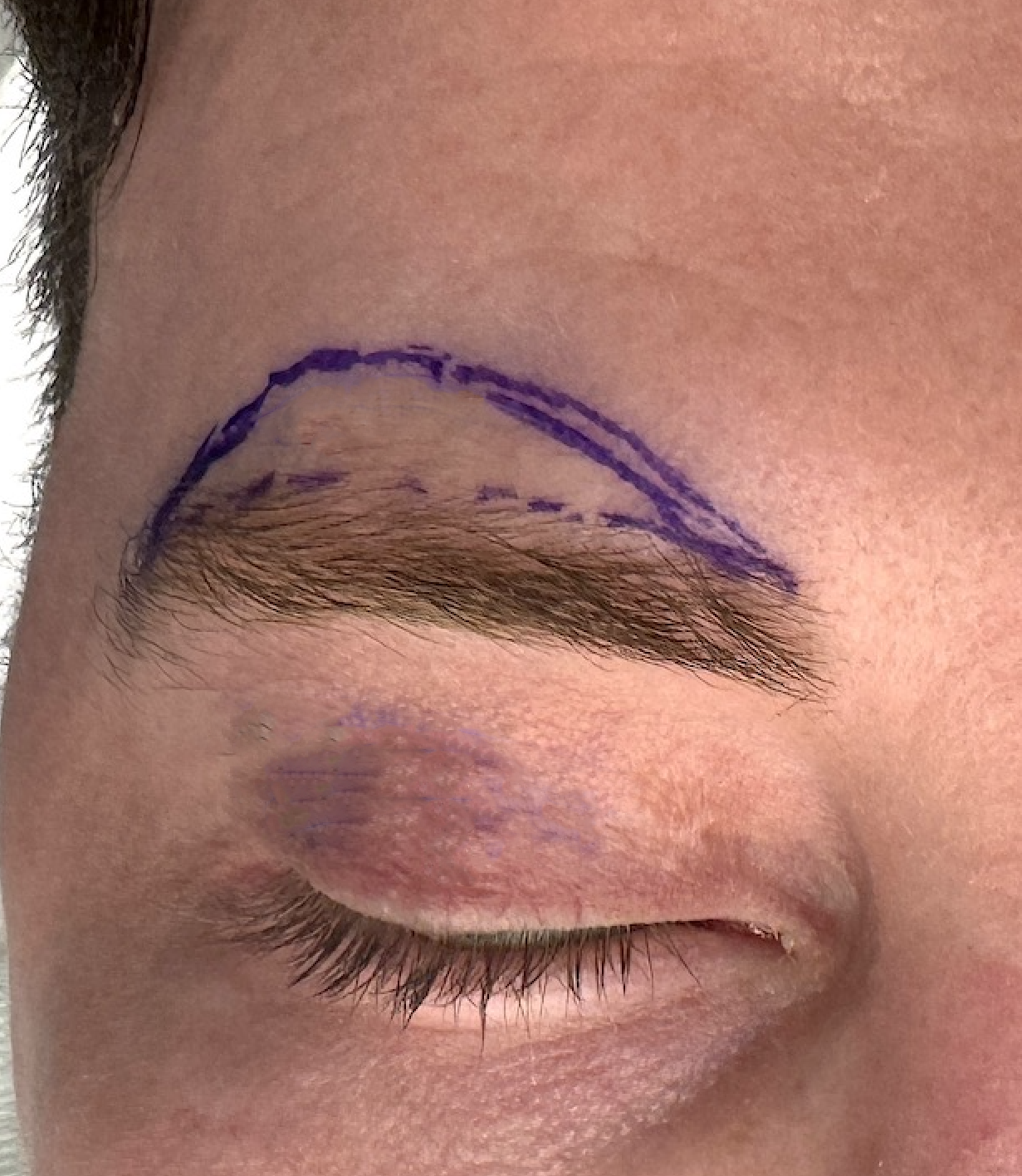
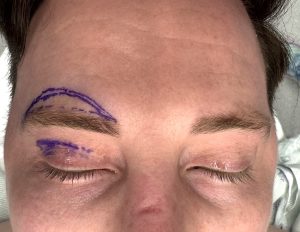 This male had a congenital right facial hypoplasia of which the vertical orbital dystopia portion was the mosgt visible. He underwent vertical orbital dystopia surgery consisting of orbital floor rim and cheek implan t augmentations with upper and lower eyelid adjustments and an endoscopic brow lift. The unilateral right brow lift result was not able to be maintained and a secondary brow lift procedure was planned. Given the lack of success of the endoscopic technique a direct brow lift approach was taken. A crescent shaped excision pattern was marked at the junction of the right eyebrow hairs.
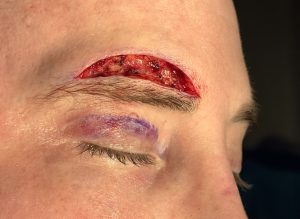
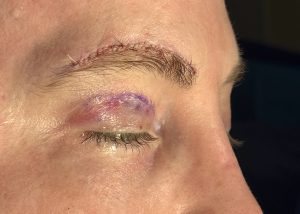 The crescent skin excision was carried out including the underlying fat but being vigilant for the supraorbital nerve branches. The brow was then elevated and closed in multiple layers with small resolvable sutures.
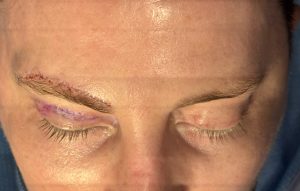 The improvement in the symmetry between the two brows was immediately apparent.
Discussion
Using a direct browlift for facial asymmetry is one of the situations where this technique really stands out compared to other browlift options.
Why it works well for asymmetry
A direct browlift allows independent, side-specific control of brow position. Because the excision is made just above each brow, you can:
- remove different amounts of skin on each side
- adjust peak position and arch shape asymmetrically
- fine-tune intraoperatively with the patient sitting up if needed
That level of control is hard to match with endoscopic or coronal approaches, which tend to lift both brows more uniformly.
Common asymmetry scenarios where it’s useful
- Unilateral brow ptosis (e.g., aging, post-Botox imbalance)
- Facial nerve weakness/paralysis
- Post-traumatic asymmetry
- Congenital brow differences
- Compensation patterns (one brow chronically elevated)
In facial nerve palsy especially, the direct browlift is often the most reliable way to restore symmetry.
Technical considerations
- Differential excision design: ellipse height varies per side
- Brow peak positioning: often intentionally asymmetric to match contralateral normal anatomy
- Overcorrection: sometimes slight overcorrection on the ptotic side to account for relapse
- Fixation: dermal/subcutaneous anchoring to frontalis or periosteum for stability
Advantages in asymmetry cases
- Maximum precision and predictability
- Ability to correct each brow independently
- Works well even in non-elastic or heavy tissues
- Can be done under local anesthesia in many cases
Limitations
- Scar visibility (less ideal in younger patients or those without thick brow hair)
- Doesn’t address forehead rhytids globally (unlike endoscopic/coronal)
- Requires careful design to avoid overcorrection or unnatural arch mismatch
Practical takeaway
If the primary problem is asymmetry rather than global brow descent, a direct browlift is often the most controllable and reliable option, especially in:
- older males
- congenital facial asymmetry
- facial nerve palsy patients
- Failed prior brow lift
Dr. Barry Eppley
Plastic Surgeon