
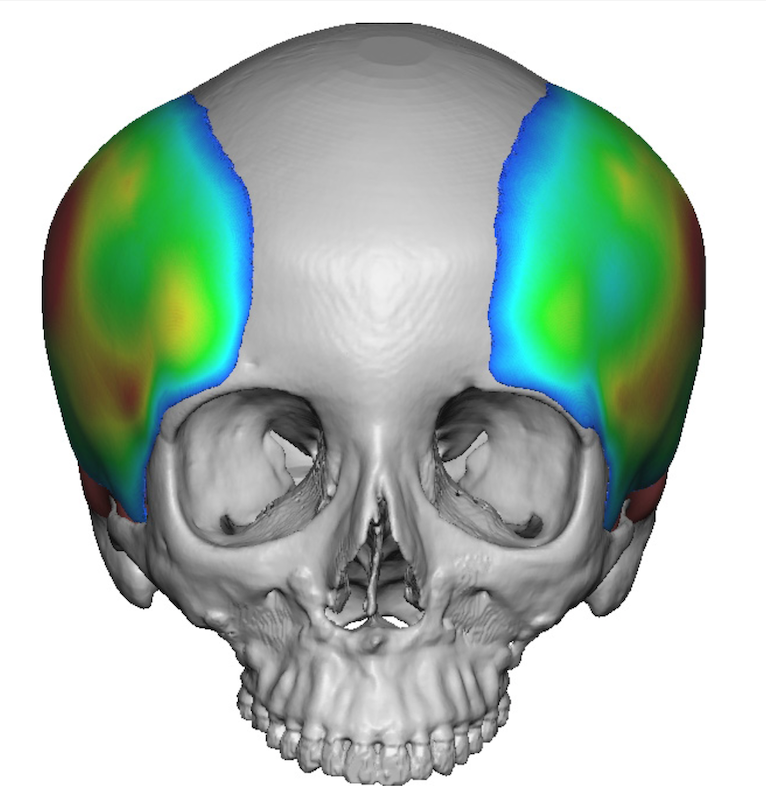
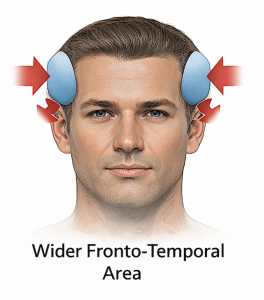
 Custom Fronto-Temporal Implants are patient-specific cranial implants designed to widen the upper temporal region and the lateral forehead in one continuous contour.
They address the transition zone between the forehead and the side of the head — an area that strongly influences facial width and upper facial balance.
What Area They Augment
Fronto-temporal implants cover:
- Anterior-posterior temporal region
- Lateral forehead (outer third of the forehead)
- The transition from frontal bone to temporal bone
This creates a smoother, broader upper facial frame.
What They Correct
They are used for:
- Narrow upper face (forehead)
- Indented or concave lateral forehead
- Hollow anterior temples
- Strong central forehead with flat sides
- Imbalance between jaw width and upper face
They are especially helpful when both:
- The temples are hollow./narrow
AND - The lateral forehead is flat or pinched
Visual Effect
They create:
- Wider upper third of the face
- Reduced “hourglass” narrowing
- Improved balance with wide jaw or cheekbones
- Stronger masculine cranial framing (when desired)
- Smoother forehead-to-temple contour
Even small increases (3–4mm per side) are noticeable because they alter the facial frame.
Case Study
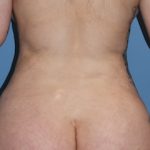
This young female desired a widening effect for her narrow forehead and temporal (side of the head) areas. She was a petite female with an overall small head.
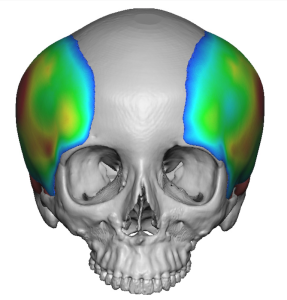
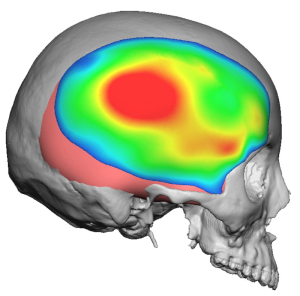 Because this region transitions between curved surfaces, custom fronto-temporal implants were designed with emphasis on:
- Prevent edge visibility
- Avoid unnatural bulging
- Blend smoothly into central forehead and parietal bone
Their maximum width was 6mm above the ear area. Total implant volume per side was 40ccs.
Surgical Placement
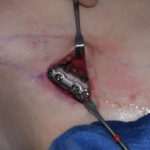
 Primary incisions placed b behind the ears for most of the dissection and implant insertion
- Implant placed on top of the deep temporal fascia laterally and sub periostea on the side of the forehead
- Screw fixation at three points, behind their, top of the forehead and at the lateral brow bone area.
- Incisional closures over a drain on each side
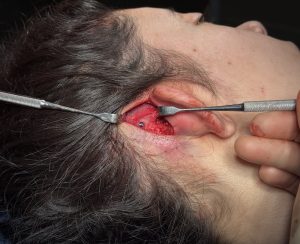
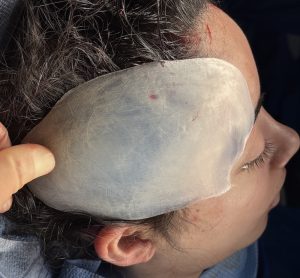 Primary incisions placed b behind the ears for most of the dissection and implant insertion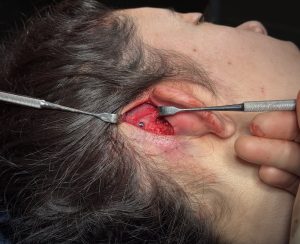
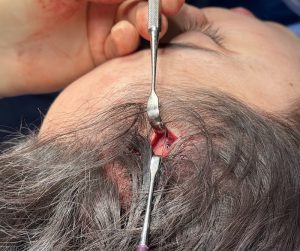 Screw fixation at three points, behind their, top of the forehead and at the lateral brow bone area.
No bone cutting is required.
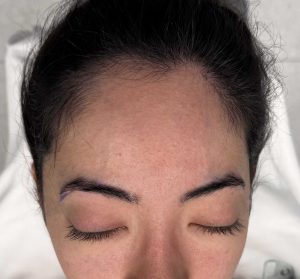
 The implant’s immediate effect show a proportionate change in the side of her forehead and temporal skull shape.
Recovery
- Swelling for 2–3 weeks
- Mild tightness when chewing (temporalis muscle beneath)
- Most patients return to normal activity in 10–14 days
- Final contour visible after swelling resolves in 4 to 6 weeks.
Discussion
How much fronto-temporal widening looks natural depends on maintaining proportional balance between three horizontal zones:
- Upper third – Fronto-temporal width
- Midface – Zygomatic (cheekbone) width
- Lower face – Bigonial (jaw angle) width
The goal is not maximum widening — it’s proportional harmony.
The Key Rule of Natural Proportion
For most balanced faces:
- Upper third width should be
equal to or slightly narrower than cheekbone width - It should also be
equal to or slightly narrower than jaw width
If the upper third becomes wider than both, it starts to look:
- Top-heavy
- Artificial
- “Helmet-like”
Typical Natural-Looking Ranges
For most adults (example framework):
If cheekbone width is average:
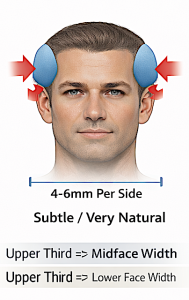 Subtle / Very Natural
3-5–6mm per side
- Gentle widening
- Rarely looks surgical
- Soft improvement
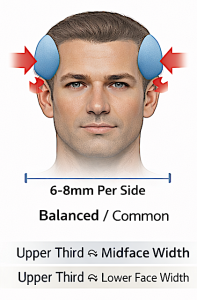 Balanced/Most Common
5–7mm per side
- Noticeable improvement
- Maintains facial harmony
- Strong but natural appearance
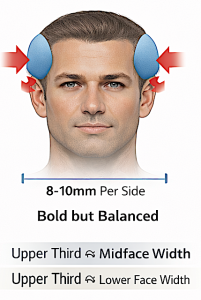 Bold but Still Proportional
8–10mm per side
- More structural change
- Works best if jaw is wide
- Must be carefully designed
? Often Too Much for Most Faces
>10–12mm per side
- Risk of top-heavy look
- May overpower midface
- Only appropriate in select narrow upper faces
When Larger Widening Looks Natural
You can go bigger safely if:
- You have a wide jaw (strong gonial angles)
- Your cheekbones are prominent
- Your upper temples are significantly concave
- Your current upper face is clearly narrower than midface
In those cases, 8–10mm per side can still look harmonious.
When Smaller Is Better
Keep it conservative (5–6mm per side) if:
- Your cheekbones are narrow
- Your jaw is narrow
- Your face is already vertically long
- You want refinement rather than transformation
Visual Impact vs Numbers
Even:
- 6mm per side (12mm total)
can dramatically change the facial frame.
Because widening occurs at eye level, the brain registers it immediately.
Small millimeter changes = big visual effect.
A Practical Proportion Formula
For a natural result:
Fronto-temporal width should not exceed cheekbone width.
And ideally:
Upper third width ? cheekbone width ± 0–2mm
This keeps the face structurally coherent.
Dr Barry Eppley
Plastic Surgeon