
Female forehead augmentation is a cosmetic procedure designed to add volume and create a smoother, more rounded, feminine forehead shape—as opposed to reducing bone (which is done in forehead feminization surgery).
What it is
- A procedure to enhance a flat, concave, or under-projected forehead
- Aims for a gentle convex contour with a more vertical slope, which is typically considered more feminine
- Often subtle—small changes can significantly improve facial balance
Techniques
There are 3 forehead augmentation methods:
1. Fat grafting (fat transfer)
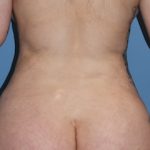
- Your own fat is taken (e.g., abdomen) and injected into the forehead
- Pros: natural, no foreign material
- Cons: some fat will be reabsorbed ? prone to irregular contours, limited augmentation effect
2. Custom implants (most common for structural change)
- Silicone or custom-designed implant placed under the skin
- Best for:
- Significant contour change
- Long-lasting results
- Can precisely shape the forehead
3. Bone cement / osteobond materials
- Used to build up small areas of the skull
- Prone to edging/irregular contours
- Difficult to revise or secondarily contour
Who considers it
Typical candidates:
- Flat or sloped forehead
- Irregular contour (dents, asymmetry)
- Wanting a more feminine or balanced facial profile
Recovery
- Swelling/bruising: 1–2 weeks
- Back to normal activity: ~1–2 weeks (varies)
- Final shape settles over a few months
Risks (important)
Like any surgery:
- Infection
- Placement asymmetry
- Over/under augmentation
- Need for revision surgery
How it differs from “forehead feminization”
- Augmentation = adds volume
- Feminization/reduction = removes or reshapes bone (e.g., brow bone reduction)
Key takeaway
Female forehead augmentation is about shape refinement —creating a more vertically inclined curvature to the upper third of the face.
Case Example
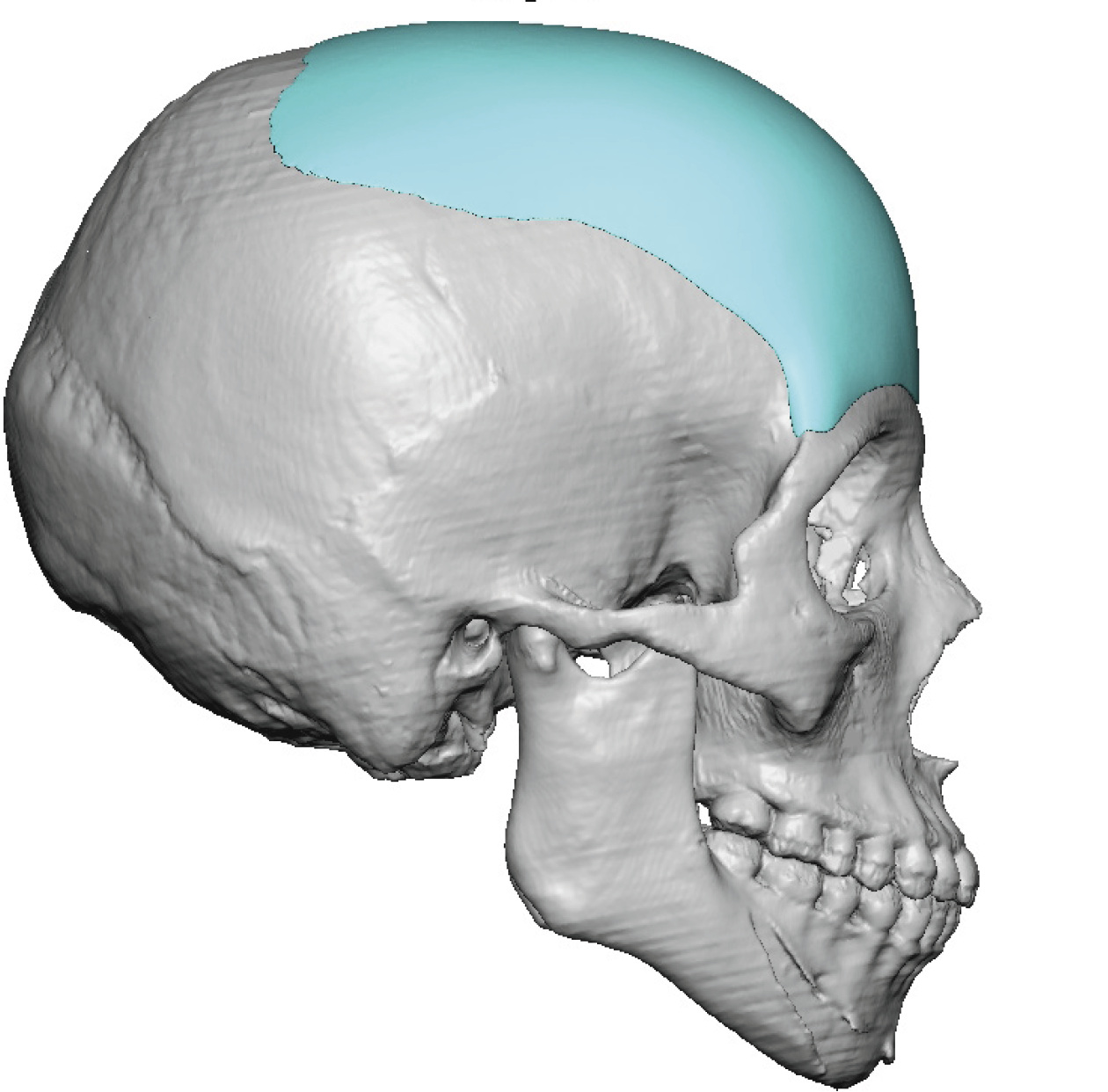
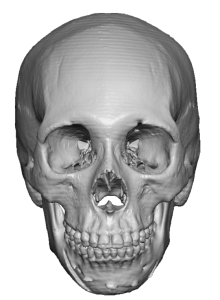 Thus female desired a forehead augmentation that addressed her backward sloped forehead. The negative slope extended back onto the top of the head back to the crown area.
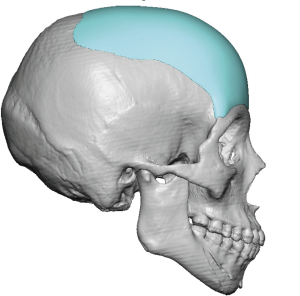
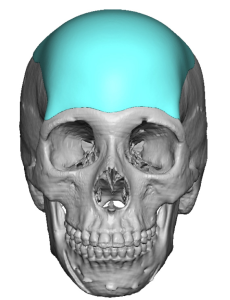 With a goal of a much more vertical forehead shape the design of the implant needed to extend significantly onto the top of the head.
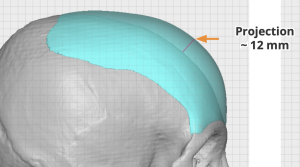 As forehead augmentation goes a 12mm upper forehead implant thickness is considerable. To avoid creating an unnatural ‘porpoise-like’ appearance the implant design must augment more than the forehead…as much of the implant’s footprint is on the top of the head as it is on the forehead.
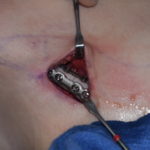
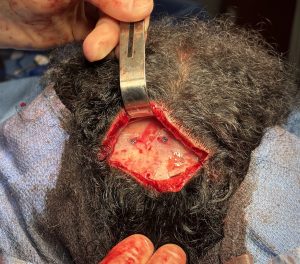 With a long extended forehead implant the scalp incison must be very posterior on the top of the head . This poses challenges for getting all the way down onto the brow bones to create the needed implant pocket.
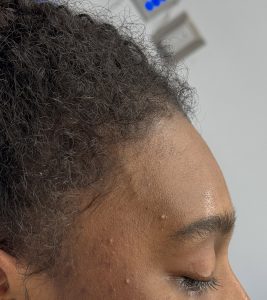
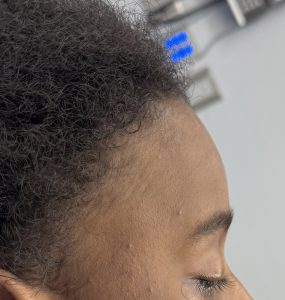 The immediate effects of the implant show the desired chnage in the slope of the forehead.
Discussion
Like all facial prominences the forehead has gender specific features. The difference between male vs. female forehead augmentation isn’t just “more vs less”—it’s about completely different aesthetic goals and shapes.
Core difference: shape goal
Female forehead
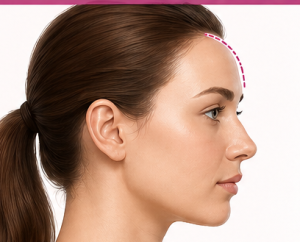
- Smooth, rounded (convex) contour
- Fullness in the central forehead
- Softer transition into the brow
- Minimal or no brow ridge prominence
- More vertical forehead slope
? Aim: soft, youthful, feminine curvature
Male forehead
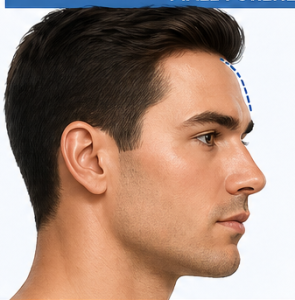
- Flatter or slightly sloped forehead
- More defined brow ridge (supraorbital bossing)
- Stronger transition between forehead and brow
- Less central convexity
? Aim: strong, structured, masculine profile
Augmentation strategy differences
Female augmentation
- Focus on:
- Central and upper forehead fullness
- Eliminating concavity or flatness
- Avoid:
- Any brow ridge augmentation
Male augmentation
- Focus on:
- Enhancing brow ridge projection
- Maintaining a flatter upper forehead
- Avoid:
- Excess roundness (can feminize appearance)
Visual concept (simplified)
Female: ) ? smooth, rounded curve
Male: /?? ? flatter with a ridge
Key surgical planning differences
- Implant design is completely different
- Female: thicker centrally, tapered edges, more vertical inclination, design goes further back along top of skull
- Male: more volume in lower forehead (brow area)
- Balance with other features
- Female: harmonizes with softer nose, lips, cheeks
- Male: complements stronger jawline and chin
Bottom line
- Female = round, smooth, continuous contour
- Male = flatter forehead with defined brow strength
Dr. Barry Eppley
Plastic Surgeon