

 For extra large pectoral implants, there are basically two categories:
- Largest standard implants
- Custom oversized implants
 Most standard male pectoral implants are in the 300–400cc range. Large standard implants go up to about 600c. Anything beyond that usually requires a custom-made implant.
Custom XL Pectoral Implants
Surgeons doing “extreme” chest augmentation often use:
- Custom solid silicone implants
- CAD/3D-designed implants
- Volumes around 700–900cc+
- Projection up to 5 cm or more
One published case described custom implants just under 800cc placed submuscularly in a broad-chested male patient.
Implant Materials
Pectoral implants are usually:
- Solid silicone elastomer
- Softer than older-generation implants
- Designed to mimic the feel of pectoralis muscle
Manufacturers like Implantech offer multiple high-projection styles specifically for dramatic chest enhancement.
Surgical Considerations with XL Implants
Very large chest implants increase the risk of:
- Implant visibility
- Edge palpability
- Seroma
- Muscle stretch deformity
- Malposition
- Axillary scar widening
- Long-term thinning of soft tissue
Patients also need:
- Larger subpectoral pockets
- Longer incisions
- More extensive lateral dissection
- Often drains post-op
Typical Candidates
XL pectoral implants work best in:
- Broad-chested males
- Bodybuilders
- Patients seeking exaggerated aesthetics
Very lean patients can have visible implant borders unless there is sufficient muscle/fat coverage.
Case Example
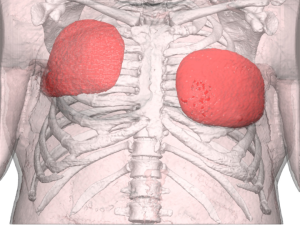
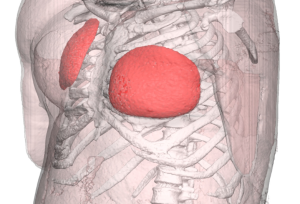 This body builder male (5’9” 220lbs) had standard pectoral implants placed that were both too small and asymmetrically placed. He did have some chest asymmetry due to differences in the pectoralis major muscle. The left muscle was retracted superiorly due to a prior insertion detachment and secondary surgical reattachment. A 3D CT scan showed the current position of the indwelling implants as well as their 265cc volume.
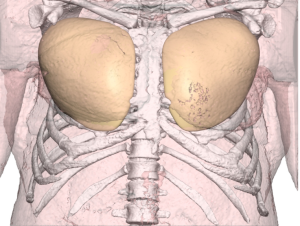
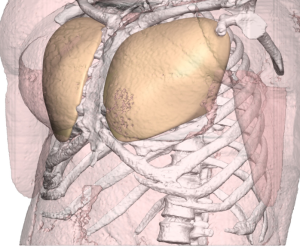 New larger and better shaped pectoral implants were designed of 625cc volume using the 3D CT scan.
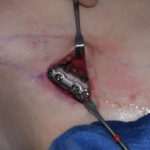
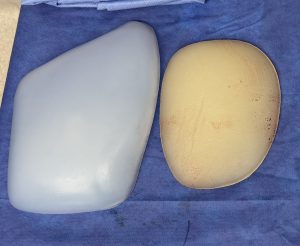 Through high axillary incisions the existing implants were removed and compared to the new larger custom implants.
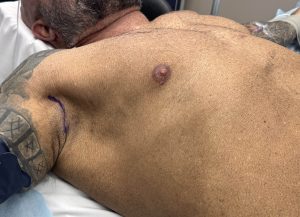
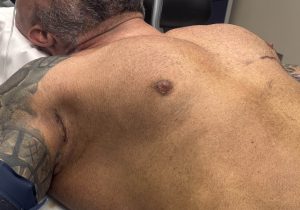
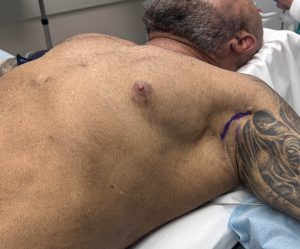
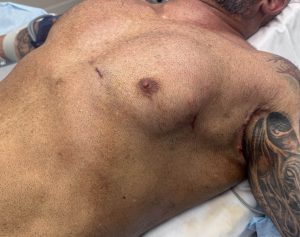 The pockets were modified to accommodate the new implants in which showed an immediate and significant chest enlargement as would be expected with a 100% implant volume increase.
Discussion
When managing pectoral implant asymmetry a 3D CT scan is the best approach to understanding the exact location, style and shape of the existing implants. Besides visually assessing the implant asymmetry any changes to the shape and size of the implant can be done by a custom implant design. Such a custom design is aided by seeing the existing implants and determining their volume if not already known.
Dr. Barry Eppley
Plastic Surgeon