
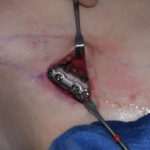
Shortening the clavicle bone length for shoulder narrowing presents a different scenario from clavicle fracture repair where the goal is to re-establish or maintain natural bone length. This poses some plating considerations that are different in displacememt resistance as well as the limited incisional access in which to place the fixation hardware.
Here’s a biomechanics-focused breakdown of superior vs anterior vs dual plating for clavicle osteotomies—especially in the context of shortening where construct demands are higher.
Big picture first
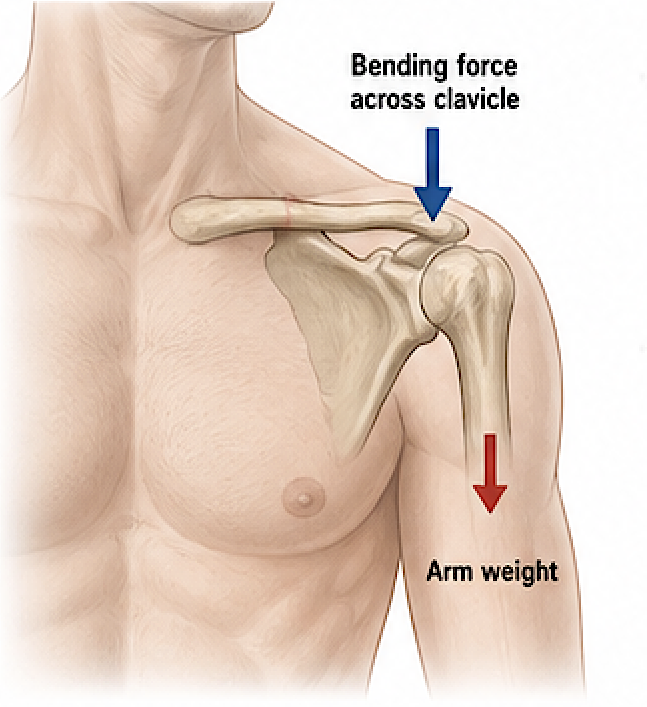
The clavicle primarily experiences:
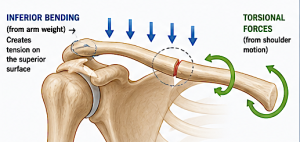
- Inferior bending forces (from arm weight)
- Torsion (shoulder motion)
- Cyclic fatigue loading
So the question is:
Where do you put the plate to best resist those forces?
1. Superior plating (top of clavicle)
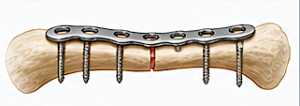
Biomechanics
- Plate sits on the tension side during normal loading
- With inferior bending:
- superior cortex = tension
- inferior cortex = compression
This is mechanically advantageous because:
- Plates are strongest in tension
- Converts bending into plate-supported load
Strengths
- Best resistance to bending
- High axial stiffness
- Proven track record in fractures and osteotomies
- Efficient load sharing when compression achieved
Weaknesses
- Less effective for torsion alone
- Prominent hardware (less soft tissue coverage)
- Stress concentrated in a single plane
Summary
Best single-plate option for bending resistance
Baseline choice in most cases
2. Anterior plating (front surface)
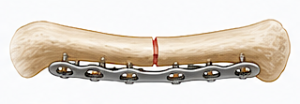
Biomechanics
- Positioned off the primary tension axis
- Less effective in resisting pure superior-inferior bending
But:
- Better alignment with torsional forces
Strengths
- Better torsional control than superior alone
- Lower hardware prominence
- Easier contouring in some anatomies
Weaknesses
- Weaker in bending
- Not ideal as sole fixation in high-load or shortening cases
- More plate strain under vertical load
Summary
Good adjunct, weaker primary construct for bending
3. Dual plating (superior + anterior, orthogonal)
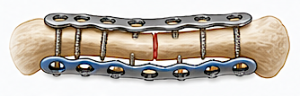
This is where things change significantly.
Biomechanics
- Two plates at ~90° to each other:
- superior plate ? handles bending
- anterior plate ? handles torsion + adds stability
Result:
- Converts a single-plane construct into a multi-plane system
Mechanical advantages
1. Bending resistance
- Superior plate carries tension
- Second plate reduces deformation
- Lower strain per plate
2. Torsional stiffness
- Orthogonal orientation resists rotation effectively
3. Fatigue life
- Load shared between two plates
- Less cyclic stress per implant, lower failure risk
4. Construct rigidity
- Less micromotion at osteotomy
- Better conditions for primary bone healing
Trade-offs
- More dissection
- Potentially higher soft tissue irritation (though often offset by lower profile plates)
- Slightly longer operative time
Summary
Most biomechanically robust construct
especially valuable in:
- larger patients
- 1.5–2 cm shortening
- revision / high-risk healing
Direct comparison
|
Property |
Superior |
Anterior |
Dual (Orthogonal) |
|
Bending resistance |
++++ |
++ |
+++++ |
|
Torsional resistance |
++ |
+++ |
+++++ |
|
Fatigue resistance |
+++ |
++ |
+++++ |
|
Load sharing |
Moderate |
Low |
High |
|
Suitability for shortening |
Good (>1.5–2 cm) |
Limited |
Best for >1.5 cm / high load |
Key insight (clinically important)
In cosmetic clavicle shortening, you are:
- reducing bone length
- increasing plate strain
- decreasing natural load-sharing
That means:
You are turning a normal clavicle into a mechanically disadvantaged structure
So:
- Superior plate alone
often enough for small shortening in low-load patients - Anterior plate alone
generally insufficient for shortening constructs - Dual plating
restores stability closer to a “native-strength system”
Practical decision logic
<1.5 cm shortening + low load
Superior plate is usually adequate
1.5–2.0 cm or average build
Strong superior plate ± consider augmentation
>1.5–2.0 cm + large/broad/high-load patient
Dual plating strongly favored
One-line takeaway
Superior plating fights bending, anterior plating helps control rotation, and dual plating does both while dramatically improving fatigue life—which is exactly what you need when shortening increases mechanical stress.
Dr Barry Eppley
Plastic Surgeon