
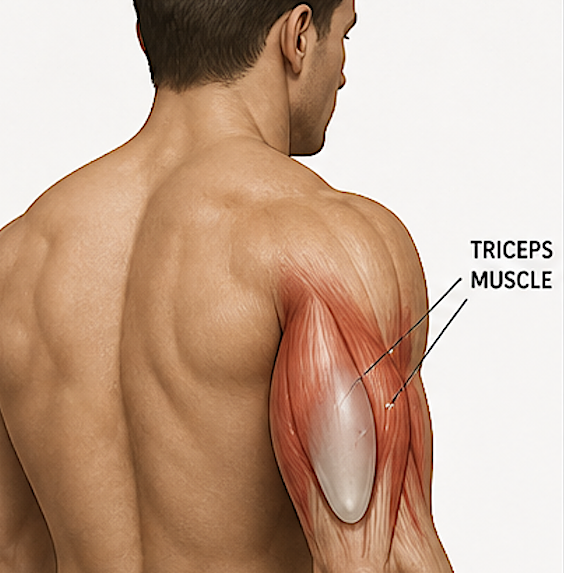
Tricep implants are a type of cosmetic surgery designed to enhance the size and definition of the triceps muscle (the back of the upper arm). They’re less common than bicep or calf implants but are used in similar situations—usually when someone wants more arm volume or definition that hasn’t responded to exercise.
What they are
- Solid silicone implants placed over or under the triceps muscle
- Designed to create a fuller, more defined posterior upper arm
- Often done for aesthetic reasons (body contouring) or sometimes reconstructive purposes
Who considers them
- People who feel their upper arms lack size despite training
- Bodybuilders or physique-focused individuals
- Patients with muscle asymmetry or atrophy
Procedure overview
- Typically performed under general anesthesia
- Incision placed in a hidden area (often near the armpit or back of the arm)
- Implant is inserted and positioned to mimic natural muscle contour
- Surgery usually takes 1–2 hours
Recovery
- Initial swelling and soreness for a few weeks
- Limited arm movement early on
- Return to light activity: ~2–3 weeks
- Full recovery / heavy lifting: ~6–8 weeks
Risks and considerations
- Infection
- Implant shifting or asymmetry
- Nerve irritation or stiffness
- Visible or palpable implant edges in very lean individuals
- Not a substitute for functional muscle strength
Important reality check
They can improve appearance, but they don’t increase actual muscle performance. The muscle will look bigger but will not be any stronger (nor will ot be any weaker either)
Case Example
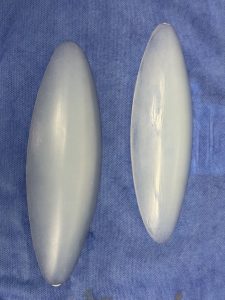 This young male desired augmentation of the upper back of his arms to achieve what exercise cold not. He opted for an implant as he wanted an assured and sustained volume effect. The tricep muscle length was 21cm on the back of his arms. The implangts chosen had a 21 cm length, 6.5cm width and 1.5cm height centrally with a taopered design that blended into small edges at its ends.
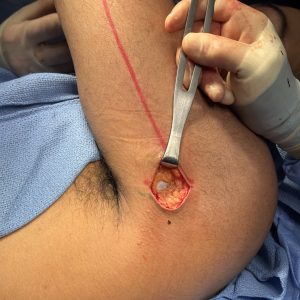
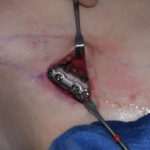
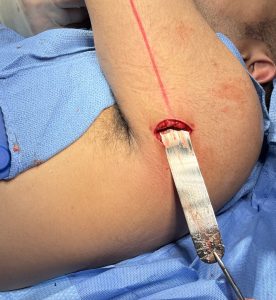 In the supine position a 3.5cm posterior axillary incision was made and dissection carried down to the muscle fascia The fascia was opened and a long flat retractor was used to create the subfascial pocket in a linear direction.
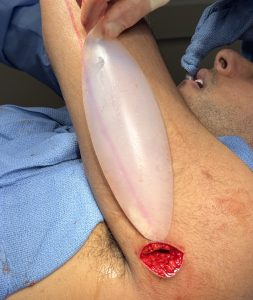
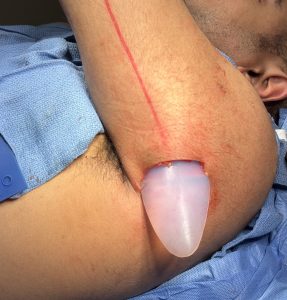 The subascial dissection was carried as long as that of the implant based on external measurmenys and it was inserted into the subfascal tunnel.
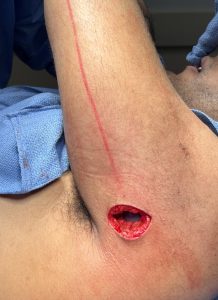
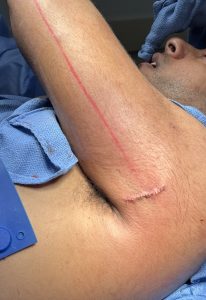 Once the implant was completely in the pocket the proximal end of the implamnt was tucked un the fascial edge to lock it into place. The incision was closed in multiple layers witn resorbable sutures. No drain or fascial closure was done.
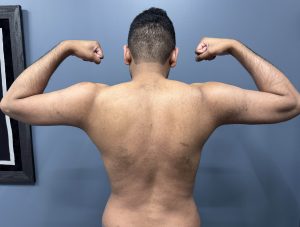
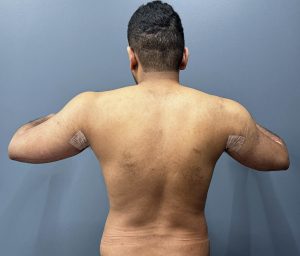 When seen the next day he back of the arm volume augmentation was visible as expected. His immediate postoperative lifting of his arms was limited due to short term muscle stiffness/discomfort.
Discussion
An implant provides the assured volume and shape of the tricep miuscle augymentation but some ask about whether fat grafting would be just as effective but with a less invasive surgery. As a result how do implants compare to fat transfer (natural alternative) Tricep implants and fat transfer (fat grafting) aim for a similar visual goal, but they behave very differently.
Big picture difference
- Implants = structure + predictable size
- Fat transfer = subtle, natural enhancement using your own tissue
1. Look & feel
Tricep implants
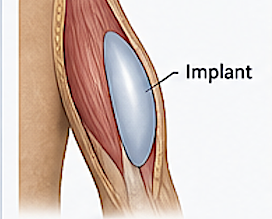
- Create a more defined, sculpted “muscle-like” shape
- Can look very impressive in lean individuals—but can also look too sharp or artificial if overdone
- Firm to the touch (like a flexed muscle, but constant)
Fat transfer
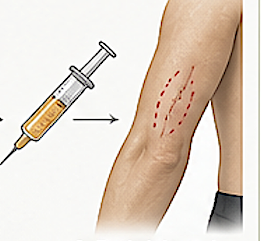
- Softer, more natural feel and movement
- Blends smoothly with surrounding tissue
- Better for subtle contouring, not dramatic muscle definition
? If you want a more signficvant vilume change” implants are better
? If you want “I just lwant to look natural with a low volume effect” fat injections is a viable option
2. Amount of volume
Implants
- Precise, guaranteed volume
- Can significantly increase arm size
Fat transfer
- Limited by how much fat survives (usually 50–70% retention)
- Often requires repeat sessions for bigger changes
- Not ideal if you’re very lean (not enough donor fat)
3. Risk profile
Implants
- Risks: infection, shifting, visible edges
Fat transfer
- Lower risk of foreign-body complications (it’s your own fat)
- Risks: uneven survival, lumps, partial loss of result
- Much lower chance of something looking “obviously surgical”
4. Recovery
Implants
- More restrictive recovery (protect the implant pocket)
- ~6–8 weeks before heavy lifting
Fat transfer
- Easier recovery for the arms
- BUT you also recover from liposuction areas
- Return to activity is often quicker overall
5. Longevity
Implants
- Long-lasting and stable
- May need revision if complications occur
Fat transfer
- Whatever fat survives is permanent
- But some volume loss is expected early on
6. Best candidates
Implants are better if you:
- Are very lean with little donor fat
- Want noticeable size increase and definition
- Are okay with a more “engineered” result
Fat transfer is better if you:
- Want natural contouring, not dramatic size
- Have available body fat
- Prefer avoiding implants/foreign materials
Dr Barry Eppley
Plastic Surgeon