

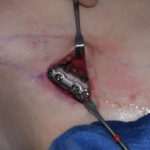
Custom designed implants for aesthetic skull augmentation and contouring is a very effective method that has replaced the limitations of traditional cranioplasty bone cements. But like any aesthetic implant patients may determine secondarily that they desire an enhanced augmentation effect. This could mean more projection than the current implant, increased surface area of augmentation coverage or both. This can be done with the exact dimensionsal knowledge of the first implant through either an Overlay or Extension desggn concept.
Custom Skull Implant Overlay
A custom skull implant overlay is a secondary, patient-specific implant designed to sit on top of an existing skull implant to add more projection or refine contour without removing and replacing the original implant. It haw also been described as a topper, stacked or add on skjull implant..
In practice, the first implant serves as the base footprint, and the overlay is added when the original augmentation was helpful but still left inadequate fullness, asymmetry, or contour irregularity. Such implant overlays are mainly used for revision contouring rather than first-time skull augmentation.
More broadly, custom skull implants are typically designed from a 3D CT-based planning process to aesthetically augment selected skull regions, and cranial implant manufacturers likewise describe patient-specific customization of implant thickness, contour, and edge fit.
Custom Skull Implant Overlay Case Example
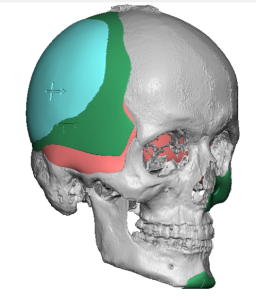
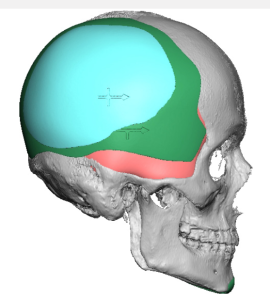 Large surface area coverage of a right occipital-parietal skull implant for plagiocephaly (green color). Secondarily the patient wanted some additional projection at the apex of the implant curve. An overlay implant was designed to add 4mms extra projection at the temporo-parietal curve (teal color)
Custom Skull Implant Extension
A custom skull implant extension refers to a patient-specific implant design that expands beyond the borders of an existing implant or previously augmented area to further increase skull contour, coverage, or projection.
It’s slightly different from an overlay:
- Overlay ? sits on top of an existing implant (adds thickness)
- Extension ? extends outward beyond the original implant’s footprint (adds surface area and shape change)
A custom extension is used when:
- The original implant is too small in surface coverage
- There’s a need to blend into adjacent skull regions
- The patient wants more global shape change, not just added thickness
- There are visible edges or transitions that need smoothing
Design Concept
- Built from 3D CT imaging
- Designed to interface seamlessly with the existing implant edge
- Can:
- Wrap further into temporal, parietal, or occipital regions
- Feather out edges for a natural transition
- Maintain or modify projection selectively
Surgical Considerations
- Usually placed through the same or slightly extended incision
- The existing implant may:
- Be left in place, with the extension added adjacent to it
- Or occasionally modified/repositioned for better integration
- Fixation ensures both pieces act as a single continuous contour
Custom Skull Implant Overlay Case Example
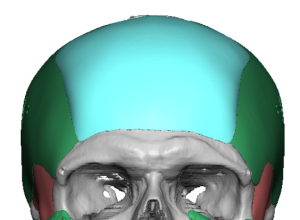
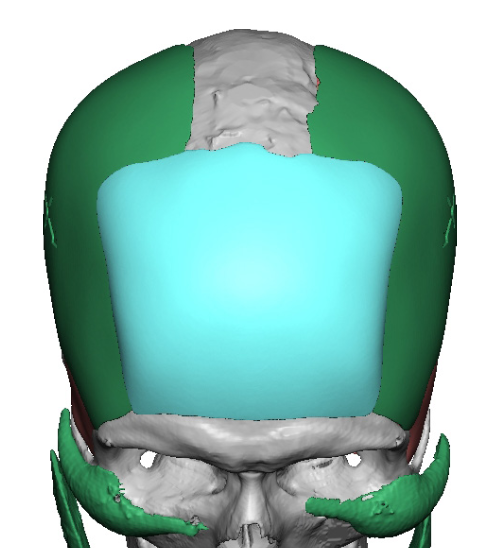
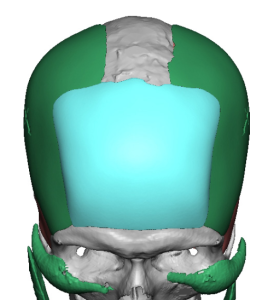 Bilateral custom extended temporal-forehead widening implants combined with custom bropw bone implants (green color) Decided secondarily to connect the existing implants with a one piece custom forehead-top of head implant (teal color).
When to Choose Extension vs Overlay
- Choose extension if the problem is shape coverage
- Choose overlay if the problem is not enough projection
With either secondary skull implant augmentation most of the time the combined implant volumes could not have been placed due to the limitations of scalp stretch to accommodate it.
Dr. Barry Eppley
Plastic Surgeon