
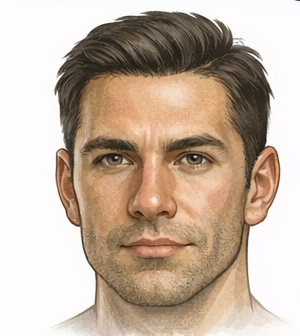
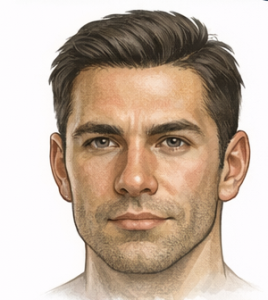
 While brow bone reduction surgery today is most commonly associated with forehead feminixation it also has a prior history in men as well. For the male with overly prominent brow bones suirgical reduction can reduce the hypermasculine or Neanderthal appearance. But not all male brow bone prominences are the same and matching the correct reduction technique to the probem assures the best outcome.
Male brow bossing generally appears in three common anatomical patterns. Recognizing the pattern is important because it determines how much reduction is possible and which surgical technique works best.
1. Central Bossing (Frontal Sinus Bossing)
Most common pattern
Description
- Prominence concentrated in the midline forehead above the nasal root
- Brow ridge forms a central bulge or bar
- Lateral orbital rims are relatively normal
Anatomy
- Usually caused by a large frontal sinus expanding forward
- The anterior sinus wall forms the visible brow ridge
Typical surgical approach
- Often requires frontal sinus setback
- Burring alone rarely produces enough change
Typical achievable reduction
- ~4–8 mm depending on sinus depth
Visual pattern
Top view

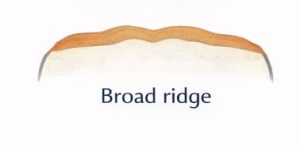
2. Diffuse Supraorbital Ridge
Broad, bar-like brow
Description
- A continuous horizontal ridge across both orbits
- Gives the forehead a sloping or heavy appearance
- Common in many male skulls
Anatomy
- Combination of:
- thick outer frontal bone
- moderate sinus projection
Typical surgical approach
- Often combined technique
- selective burring laterally
- sinus setback centrally
Typical achievable reduction
- ~3–6 mm
Visual pattern
Top view
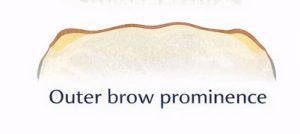
3. Lateral Orbital Bossing
Outer brow prominence
Description
- Prominence mainly over the outer supraorbital rims
- The central forehead may be relatively flat
- Creates a strong lateral brow shadow
Anatomy
- Usually solid bone rather than sinus
- Thick lateral orbital rim
Typical surgical approach
- Burring / contouring of the orbital rim
- Rarely requires sinus setback
Typical achievable reduction
- ~2–4 mm
Visual pattern
Top view
Important Clinical Reality
Most men actually have a combination pattern, such as:
- Central sinus bossing + lateral rim thickness
- Diffuse ridge with central sinus prominence
This is why many forehead contouring procedures involve:
- central frontal sinus setback
- lateral burring
- supraorbital rim reshaping
? Quick diagnostic rule surgeons often use
|
Appearance |
Likely anatomy |
|
Single central bulge |
Large frontal sinus |
|
Long horizontal bar |
Mixed sinus + bone |
|
Outer brow prominence |
Thick orbital rims |
Dr. Barry Eppley
Plastic Surgeon