
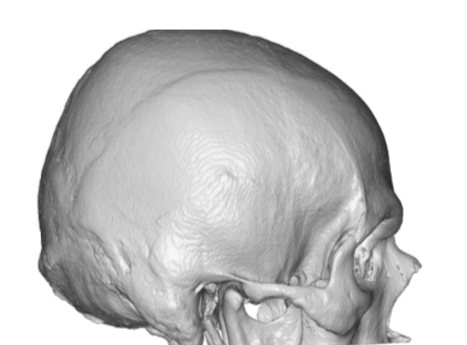

Occipital skull augmentation increases the projection of the flat back of the head. But how does projection translates visually in profile? This is the key concept most people don’t get until they see simulations…the eye reads curves, not millimeters.
Let’s break down how occipital projection actually shows up in profile.
The Profile Reference Line
 In side view a smooth curve from: forehead ? crown ? occiput ? neck is ideal. And it involves having adequate cranial lengths from the nasion all way back to the inion.…sometimes described as the golden ratio of the skull based on the lengths of nasion to bregma and bregma to inion and the ratios of their comparative lengths.
 With a flatter occiput, that curve and those cranial lengths are altered making the profile:
- Drops off too early
- Forms a straight or indented segment
- Makes the head look short or “cut off” in back
Augmentation works by pushing the curve backward smoothly extending thelength of the cranial curve , not by creating an isolated unnatural bump.
Visual effect by projection amount
 4–6 mm: curve restoration
- Removes the abrupt drop-off
- Softens the transition into the neck
- Profile looks finished instead of truncated
Visual impact:
Subtle, but the “flat” look largely disappears. Most patients would not find this augmentation change adequate.

 7–10 mm: profile balance
- Occipital point moves posteriorly
- Head appears longer and rounder
- Neck–head angle improves
- Hairline contour looks fuller
Visual impact:
Clear change in side photos — people can tell something looks better, but not what changed.
This range often makes the biggest perceived difference per mm.

 11–15 mm: silhouette change
- Back of head becomes a defining feature
- Curve is visibly fuller
- Can slightly change how hats, helmets, or hair sit
Visual impact:
Obvious in profile; must be well blended to avoid a “helmet” look.
 16+ mm: shape dominance
- Occiput becomes prominent
- Any design error is obvious
- Scalp tension and edge visibility matter a lot
Visual impact:
Reads as augmentation rather than anatomy if not perfectly designed by covering enoigh surrounding bone surface area to blend in..
Why smaller mm changes canlook big
A 5–8 mm increase:
- Alters a long arc of the skull
- Affects light reflection and shadow
- Changes where the head visually “ends”
So even single-digit mm can shift the perceived head length by centimeters.
That’s why patients are often surprised by how “enough” moderate augmentation looks.
The occipital point (critical concept)
 The maximum projection point is not the lowest point of the skull. It is usually located perpecdicular to the occipital plane often intersecting at its midpoint.
Good implants:
- Place max thickness at 90 degrees back from the occi0pital plane.
- Allow a smooth taper into the neck
- Avoid a shelf-like edge
This placement makes:
- 8 mm look like 12 mm
- 12 mm look natural instead of bulky
In profile:
- Hair follows the new curve
- Shadows soften
- The back of the head stops looking flat even when hair is short
That’s why people notice it more in photos than mirrors.
Common misconception
“I want it to stick out X mm.”
Better goal:
“I want the back of my head to look like it naturally curves.”
The best results look like you were born with a better occiput, not like something was added.
Dr. Barry Eppley