
Thigh implants are solid, medical-grade silicone implants designed to enhance the contour and muscular appearance of the thighs. They can add fullness to various quadriceps muscles including::
- Rectus Femoris
- Vastus Lateralis
- Vastus Medialis
Unlike fat transfer, implants create predictable and stable volume, especially for patients who are lean or who have difficulty gaining/thickening certain thigh areas.
Thigh implants may be appropriate if you:
- Want fuller, more sculpted thighs that can’t be achieved through workouts alone
- Have congenital leg asymmetry
- Lost thigh volume due to trauma or disease
- Have insufficient body fat for fat grafting procedures
- Prefer a permanent, non-resorbable volume option
Implant Options
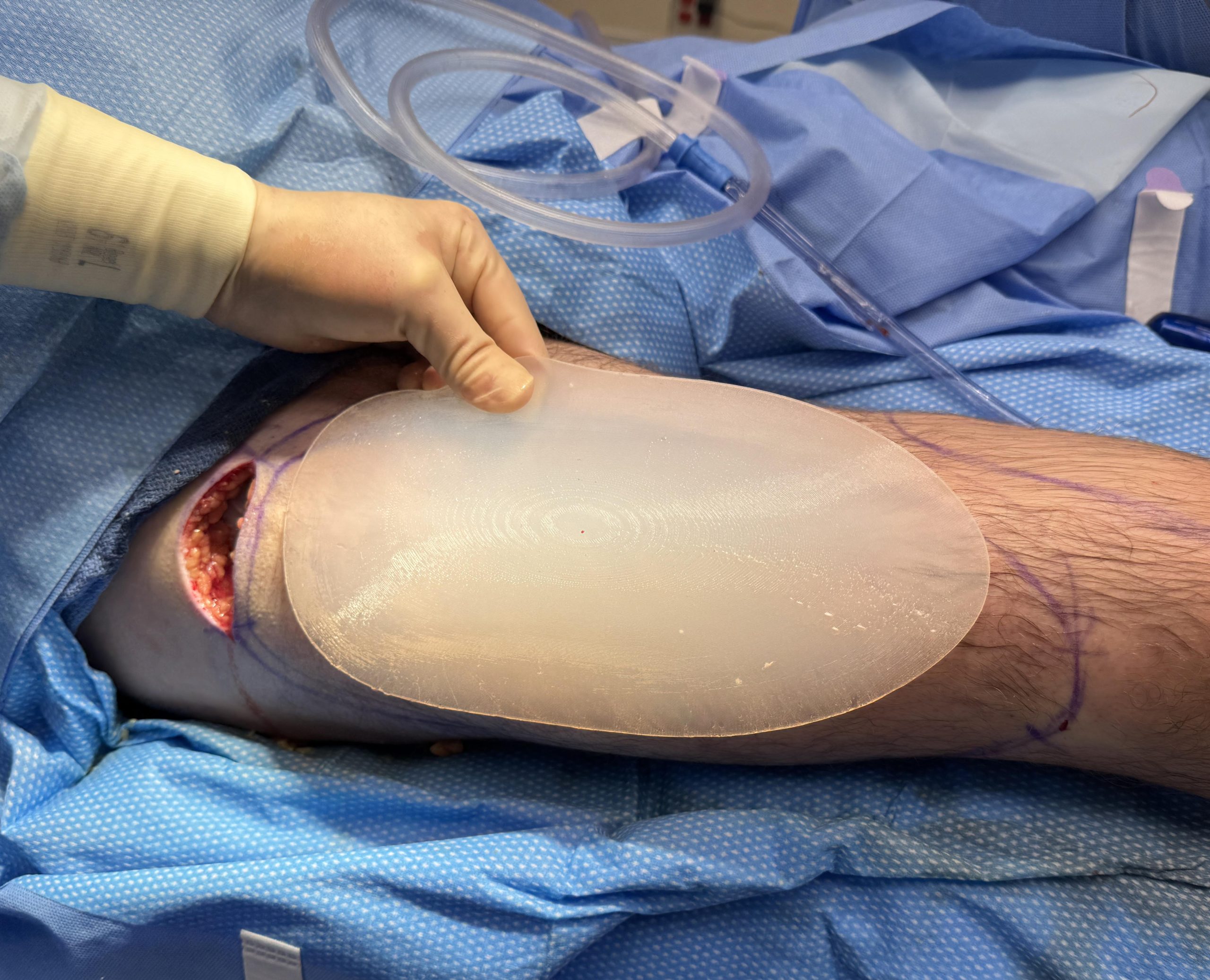
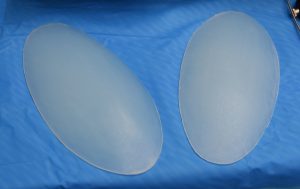 There are no standard thigh implants due to the low frequency of demand for them. Not are there any other body implants that remotely have the right shape for the larger anterolateral thigh or the rectus femoris -vastus laterals muscle area…which is the workhorse implant for the quads. As a result this type of thigh implant must be custom made based on measurements of the patient’s thigh area. They typically have a more elongated oval shape with typical lengths of 22 to 26 cos with widths of 12 to 14cms, Thickness can range from 1 to 3ms with the upper half of the plant being thicker than the bottom half.
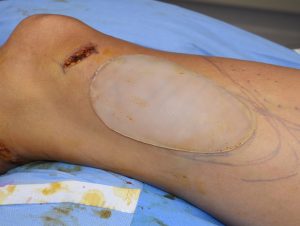 The smaller vastus medialis implant above the knee, however, can be successfully augmented using standard calf implants placed in an inverted orientation compared to how they are placed in the lower extremity.
Case Study
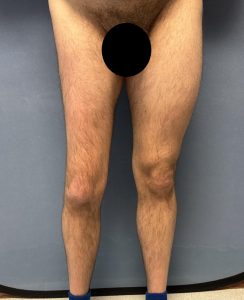 This male was born with right leg asymmetry with it being small than the left in length and exhibiting a much smaller thigh muscle mass. The cause of the leg asymmetry was unknown. He desired improved thigh fullness with the underestanding that the right thigh could never be the same size as that of the left due to soft tissue constraints.
Two implants were to be used to augment the larger rectus femoris-vastus lateralis area (custom design) and the smaller vastus medals muscle area above the inner knee (calf implant).
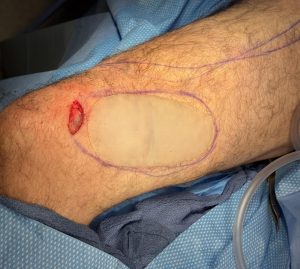 Under general anesthesia the vastus medialis implant was placed through a suprapatellar incision in the subfascial pocket location.
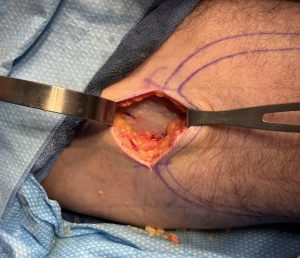
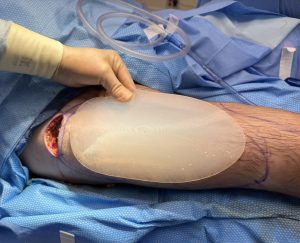 For the anterior thigh a anterolateral incision was made to expose the fascia. Rather than a subfascial pocket location due to the small muscle mass a pocket was developed on top of the fascia down towards the knee. The larger implant was placed into this suprafascialo pocket.
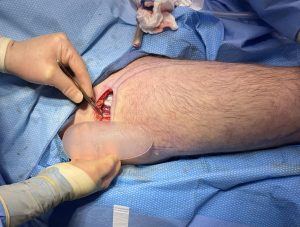 Because of the access to the fascia a subfascial pocket was developed right under the larger implant into which a small implant was placed for some added upper thigh augmentation.
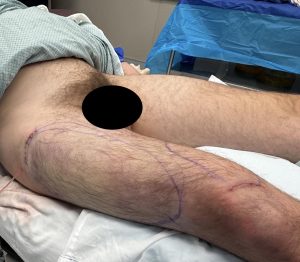 The thigh incisions were closed with multiple layers using resorbable sutures. For the larger upper thigh implant a drain was placed.

 The immediate effects of the implants showed improvement in the right thigh asymmetry albeit still not as large as the left thigh.
Discussion
Thigh implants when used for leg asymmetry improvement have some different considerations than when used for an increased size or muscular appearance. The congenitally smaller thigh with less muscle mass will have a very tight fascial lining which will only permit limited stretch…or only a small implant which may not make much of a difference in thigh size increase. As a result the implant is best placed on top of the thigh fascia where a much larger implant can be successfully inserted.
But regardless of the pocket location the recovery from thigh implants can be challenging given the large muscles involved. The recovery timeline is:
|
Stage |
What to Expect |
|
Days 1–3 |
Tightness, swelling, stiffness; short-distance walking only |
|
1–2 weeks |
Improved mobility; reduced soreness |
|
3–4 weeks |
Resume more normal activity; light exercise possible |
|
6+ weeks |
Full activity; quad workouts allowed |
|
2–3 months |
Final contour becomes natural-looking |
Key Points
- Congenital thigh asymmetry due to failure of adequate muscle development can only be improved by thigh implants.
- Due to the smaller muscle volume and tighter fascia in many thigh asymmetries the implants should be placed on top of the fascia so larger amounts of augmentation can be achieved.
- Most size implants will need to be custom made given the lack of commercially available implants of sizes and shapes that would be adequate.
Dr. Barry Eppley