
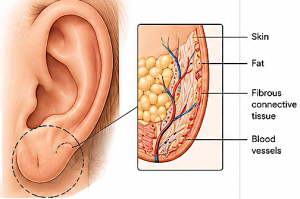
 The upper ear framework—the helix, antihelix, concha, tragus, and other structures—is supported by elastic cartilage that gives the ear its shape, stiffness, and recoil. The earlobe (lobule), however, is composed almost entirely of:
- Skin
- Fat
- Fibrous connective tissue
- Blood vessels
This structural difference explains several distinctive characteristics of the earlobe:
Soft and Flexible
Without cartilage, the earlobe feels soft, pliable, and mobile compared to the firmer upper ear.
More Susceptible to Stretching
Because it lacks structural support, the lobule stretches easily from:
- Heavy earrings
- Gauges
- Aging
- Gravity
Better Blood Supply
The earlobe has an excellent vascular supply, which is why:
- It heals very well
- Surgical procedures are predictable
- Tissue survival is excellent after reshaping or repair
Ages Differently
Cartilage maintains shape over time, but the soft tissue lobule elongates and thins with age due to loss of collagen and elastic support.
Embryologic Difference
Developmentally, the earlobe forms differently from much of the cartilaginous auricle, contributing to its unique anatomy and tissue composition.
Functional Difference
The cartilaginous ear helps:
- Funnel sound
- Maintain ear architecture
The earlobe has essentially no auditory function and is thought to be primarily:
- Vestigial
- Aesthetic
- Social/sexual signaling tissue in humans
This is also why the earlobe is ideal for:
- Piercing
- Tissue rearrangement
- Cosmetic reshaping procedures like reduction or repair
From a surgical standpoint, the absence of cartilage makes earlobe surgery technically simpler than reshaping the upper ear, since contour changes rely entirely on soft tissue excision and closure rather than cartilage sculpting.
Dr. Barry Eppley
Plastic Surgeon