Archive for the 'breast augmentation' Category


August 8, 2010

Case Study: Breast Augmentation in Hispanic Women

Author: barryeppley

Background: Breast augmentation is the most popular body plastic surgery procedure in women in the 18 to 35 year-old age group. The numbers of breasts implants placed has continued to increase every year. This is a testament to the success of the operation and is done across all ethnic groups. With the well known change in the immigration patterns in the U.S. over the past decade, Hispanic women are similarly seeking breast augmentation.

On the surface, breast enhancement in women of Hispanic heritage is no different than that of Caucasians or any other ethnic group. It is about making the breast larger and more full which is the goal of any woman having the procedure. But the thicker and increased skin pigment does make for different incision considerations. In addition, cultural considerations also help guide final breast size.

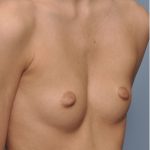
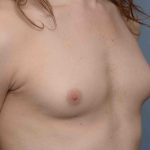
Case: This is an 18 year-old Hispanic female who came in for breast augmentation. She was motivated by her near complete lack of any breast tissue which made clothing options more limited. She got further motivation as her mother recently underwent the procedure as well. Besides her lack of much breast tissue development, her breasts were very widely spaced across a narrow and small chest wall.

In reviewing the choices of saline vs silicone gel breast implants, her primary concern was that she wanted no scar anywhere on her breasts. This comes from a known observation of hyperpigmentation in darker and thicker skin types. While inframammary or lower breast scars generally remain hidden in the skin crease, when breast augmentation is done in a completely flat breast that scar may not be as hidden.

While breast size is largely an individual choice, the American concept of a big breast is not shared by many other ethnic backgrounds. Hispanic women tend to prefer a smaller and very round breast that has a perky quality to it. In women with very narrow chest diameters, it is important to not get the breast implant too far to the side which is easy to do.

Widely spaced breasts pose limitations on what the final result can be. While most women want their breast to be as close as possible and create cleavage, the preoperative position of the nipple-areolar complex controls the final position of the implant on the chest wall. Such wide spacing can only create breast mounds that will be further apart that a patient will want.

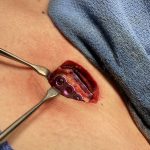
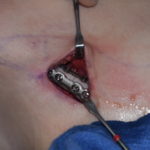
She underwent transaxillary saline breast augmentation using 300cc high profile implants. Going through a 1.5cm incision high up in the axilla, the pocket was made with long instruments and the deflated and rolled implant inserted under the pectoralis muscle. Saline was delivered by syringe through a long filler tube and pumped in 50cc at a time until 325cc was instilled. I like to overfill a saline implant by about 10% to 15% to decrease the potential for being able to feel rippling later.

Her recovery was quite rapid and she was off pain medication in just a few days. Her armpit scars, despite her darker skin, never hyperpigmented and became indistinct quickly.

Case Highlights:

1) Breast augmentation in Hispanic women must take into increased consideration the location of the scar and the general desire for not too large of a breast size.

2) The transaxillary incision must be kept small and done carefully to limit its potential for hyperpigmentation and increased visibility.

3) High profile implants are preferred to give the most round breast shape as possible.

Dr. Barry Eppley

http://www.eppleyplasticsurgery.com

Indianapolis Indiana


Background:  Breast augmentation continues to be one of, if not the most, reliable body contouring procedure. At the least, its popularity by number of breast implants placed annually has remained stable if not gradually increased. Having only two types of implants to choose from, saline vs. silicone gel, the options for breast enhancement seem fairly simple. Yet women have a plethora of pertinent questions besides implant type including implant size, projection, position, breast shape, and long-term effects. The answers to these questions are influenced significantly by the anatomy of one’s chest wall and breasts.

Many women ask…what is the best way to do breast augmentation…or what is the best breast implant? As the following case will illustrate, those answers must be individualized for each patient.

This is a case of a 30 year-old female, who while always being thin, lost whatever breast tissue she had after two childbirths. While some may think breast implants are for women who just want to enhance what they already have and is being done for sheer vanity, many women are like this patient with no breast tissue at all. This is a significant psychological problem for a woman’s sense of sexuality and self-image and does limit certain clothing options.

When one is very thin, the choice between saline and silicone gel implants is an important consideration. With little breast tissue between the skin and the implant on the bottom and sides of the breast (even in a submuscular position), the potential for palpable rippling with saline implants is almost assured. With silicone implants, rippling is far less likely and is usually very minor even if it occurs.

Is there a difference between how saline or silicone implants feel. In thin patients, the answer is yes. Silicone will feel more natural due to lack of any significant breast tissue. When more breast tissue exists, that difference in feel becomes more indistinguishable.

In younger patients (< 40 years of age), patients should realize that it is not a question if their implants will need to be replaced…but when. Failure of a breast implant is most dramatic with saline as the breast loses volume which is very obvious. (deflation) Failure of a silicone breast implants is much more subtle and often unknown since the gel is not absorbable. (silent rupture)

With these advantages for silicone in a young thin female with no breast tissue, she opted for saline implants. Why in the face of the superiority for silicone over saline in her case? The one advantage that saline has over silicone, all other issues aside, is economic. Saline breast augmentation is less expensive and is the right implant choice when it fits one’s budget.

She underwent placement of saline implants through a transaxillary (armpit) incision. Her desire was to be a C from an A. With a base size of 325cc inflated to 375cc, she got her desired size. When one has no breast tissue and fairly tight breast  skin, a more rounded breast shape will result.

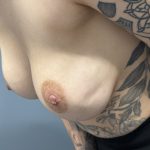
Saline breast implants can be placed through a remote incision off of the breast. Some refer to this as ’scarless breast augmentation’ but that is a bit of a deceiving term. These scars heal to a usual imperceptible line. These scars here are only four weeks from surgery.

Case Highlights:

1)      Breast augmentation poses multiple implant choices. Which implant is best for any patient may be different based on their breast anatomy and economics.

2)      The risk of rippling and spontaneous deflation are a normal part of saline breast implants. Rippling is expected in thin patients and will be better camouflaged for those women with some pre-existing breast tissue.

3)      No breast implant should be expected to last a lifetime. This point is of particular emphasis in younger patients.

Dr. Barry Eppley

http://www.eppleyplasticsurgery.com

http://www.ologyspa.com

Indianapolis


Breast implant surgery is known to produce many things. Always it makes for a better chest contour and clothing options. And most importantly, it improves the self-image and confidence of the woman who is the recipient of them. But sometimes it creates outcomes that are unexpected and even life changing. Such an uplifting story, no pun intended, was told to me today by one of my patients. (actually, by her mother)

I was seeing for a typical one week after surgery appointment a 30 year-old female who just had saline breast implants placed through a small armpit incision. She was still a little sore but had perfectly symmetric implant positions and looked as good as any patient after breast augmentation could look at this early time after surgery. She was well on her way to a great result and I knew she would ultimately have one of those ideal before and after results that every breast patient would love to have.

When talking with her I came to learn that she earned the money for the procedure by starting a home-based business. She decided some time ago that she was not take any saved money or money for other expenses out of the family budget. So she started making hairbows for babies and children…yes I said bows…and selling them. She had young children so she had a lot of inspiration and obvious talent to do it. Starting at the smallest level she sold them around the neighborhood, to friends, and even had the equivalent of ‘tupperware’ home parties. With a Facebook page and through the internet, her orders grew and so did her stash towards her breast augmentation. She eventually earned enough money for her surgery and grew to the point of no longer having to advertise for her hairbow business.. She has now grown to where this once tiny enterprise to earn breast implants has grown to a productive home-based business which will continue long after her recent surgery.

What once started out as a way to earn enough money for a cosmetic surgery procedure allowed one individual to do something in life they probably never thought possible. It is always amazing what motivation and a very specific goal can do. As the old saying goes ‘what you become in reaching for a goal is almost always greater than the goal itself’.

Breast implants can be a life-changing surgery and most of us would assume that change is in one’s appearance. But for some few patients that change can affect their work life as well…even becoming the impetus for a home-based business.

Dr. Barry Eppley

Indianapolis, Indiana


June 13, 2010

Considerations for Breast Augmentation in Bodybuilders

Author: barryeppley

Breast augmentation is not an uncommon request amongst women who are enthusiasts for bodybuilding and fitness activities. This extreme fitness activity can cause loss of any residual breast tissue as muscle mass is increased and body fat is lost. This is particularly relevant for those women who didn’t have much breast tissue naturally. When combined with a more pronounced pectoralis muscle outline and profile, the appearance of a defined breast can be completely lost or largely obscured.

Female bodybuilders have understandable concerns about breast augmentation since it is surgery on the pectoralis muscle. Common questions include where should the implant be placed, how soon can one return to working out, and will it ultimately affect muscle strength and development.

There are good arguments to be made for placing breast implants either above or below the muscle. In the day (pre-2007) when only saline implants were available, I would recommend placement under the pectoralis muscle. This was because the appearance of the implant was better due to less visible rippling. But now that silicone gel implants are available again, the issue of rippling when placed on top of the muscle is far less significant. There is a slight edge in benefits to an under the muscle position due to less risk of early implant infection and long-term capsular contracture. (hardening of the implant) But the recovery is quicker and the attachments of the pectoralis muscle are not disrupted if placed on top of the muscle.

The one aesthetic consideration in a body builder about an implant placed under the muscle is the bouncing of the implant or flattening of the breast mound when the pectoralis muscle is flexed. While this perfectly normal and causes no harm to the implant, it may be a visual issue in competitive events or just simply cosmetically disturbing.

One thing to realize is that a breast implant placed under the muscle…isn’t completely under the muscle. A proper implant position is largely centered under the nipple. That makes half of the implant under the pectoralis muscle, but the lower half is not covered by the muscle.  Keeping a breast implant completely under the pectoralis muscle would place the new breast mound (implant) too high on the chest wall.

Regardless of the position of the implant, there must be an incision somewhere to get it there. Generally, I use an incision in the inframammary fold under the breast for silicone implants and an armpit (axillary) incision for saline implants. In a bodybuilder, however, I have concerns about an armpit scar. Because of their frequent wear of sleeveless clothing, a scar in the armpit may be seen. While an armpit scar is small and heals quite well, this is always a concern in the bodybuilding patient.

Breast augmentation patients may return to cardio in one week after surgery and they can start lifting with light weights after two weeks. Chest exercises with heavy weights should be avoided for the first month. This will give the pectoralis muscle plenty of time to heal. In the first days to week after surgery, arm range of motion exercises (without weights) should be aggressively done. This will help one get back to normal faster and lessen the amount of discomfort that occurs. I have had a few bodybuilding patients tell me they were back to bench pressing in two weeks, and although I would not endorse it, does not surprise me given the conditioning of the pectoralis muscle they had before surgery. In addition, while a few of the lower attachments of the muscle to the sternum have been released, the insertion of the muscle is left largely undisturbed. This would also account for why there is no evidence that the ability to grow the muscle and increase its size and power is unaffected by submuscular breast implant surgery.

Dr. Barry Eppley

http://www.eppleyplasticsurgery.com

http://www.ologyspa.com

Indianapolis, Indiana


The risk of infection amongst any form of implantable medical device is one every patient who receives them takes on. Because medical devices are composed of a variety of synthetic materials, their surfaces can become colonized with bacteria which the body can have a very difficult time eradicating. Such bacterial inoculation may ultimately lead to a full-blown infection and require the implant to be removed.

Most bacterial contamination occurs at the time of surgical implantation. This is the most opportune time for skin bacteria, such as staph, to become accidentally attached to the implant. This probably occurs more than we realize in surgery but the use of IV and irrigation antibiotics helps considerably in washing off and killing bacteria before it becomes a problem.

But there is another potential bacterial exposure opportunity…and that occurs long after the implant has been surgically inserted. That is when bacteria are introduced into the bloodstream through secondary events, such as additional surgery, which may then attach themselves to a synthetic surface as they flow past it. While some implant infections months to years later have undoubtably been caused by such bacteremic events, they are not very common.

As it relates to plastic surgery, the most common medical device inserted is breast implants in women. And the most common event that can cause bacteremia is going to the dentist, particularly when one is having their teeth cleaned. Teeth cleaning, known as periodontal scaling, definitely causes bleeding as almost anyone can testify. This has lead to concerns amongst some breast augmentation patients about the need for oral antibiotics right before going to the dentist or whether should be taken afterwards.

The general consensus amongst plastic surgeons is that patients with breast implants do not need to take antibiotics before or after a dental procedure. But that question has been further answered by a January 2010 article in the Clinical Infectious Diseases journal. In this report, the authors asked that very question as it relates to hip replacements in orthopedic surgery. Their results showed that hip replacement patients were no more likely to develop implant site infections after dental treatments than those who had not undergo dental treatment over a similar postoperative time period.

Hip replacements are a good test for this potential association because these patients are much older than the typical breast augmentation patient and require more advanced or invasive dental procedures due to declining oral health. With no evidence of dental treatments leading to joint replacement problems in orthopedic surgery, it can be assumed that such findings translate to breast implants. With tens of millions of patients with breast implants and hundreds of millions of dental treatment exposures in this population, one would expect such events to become apparent even if they were few in number. But they have not been seen and the breast augmentation patient can now be definitely reassured. One will now have to find another reason to justify not visiting the dentist on a regular basis.

Dr. Barry Eppley 

http://www.eppleyplasticsurgery.com

http://www.ologyspa.com

Indianapolis, Indiana


April 13, 2010

Infection Risk and Management in Breast Augmentation

Author: barryeppley

 While there are numerous potential complications that can occur from cosmetic breast augmentation surgery, the most feared is undoubtably infection. All of the other potential risks, such as asymmetry, hematoma, capsular contracture, changes in nipple sensation, uneven nipple levels, and even implant rupture, they do not lead to the potential to remove the implant for an extended period of time. And when you may have one breast with an implant and the other breast without, even a day can be an extended period of time.

The risk of infection in breast augmentation is estimated to be around 1% which means it is relatively low. Infections will usually occur from days to weeks after surgery. It is possible that it could occur months later, but the inciting event is inadvertent contamination during implant placement. As a result, breast implants infections in cosmetic augmentations are not something that will likely occur many months to years later.

Breast implant infections will present as a warm, swollen and sore breast that appears different than the other. It is exceedingly rare to have both breasts simultaneously infected and I can’t say I have ever heard of it although it is theoretically possible. It will usually catch the patient’s attention as the swelling is going down and then it spontaneously gets swollen again in the involved breast days to weeks after surgery.

The historic thought is that the breast implant with the infection should be removed for resolution. While this would undoubtably solve it, no patients really wants to go to that immediate and drastic approach. Therefore, oral antibiotics are always resumed with a change to a broader spectrum antibiotic. Most of the time, the infectious bacteria is skin-related specifically a Gram-positive organism.

The interesting question is how effective is this approach and what to do if simple oral antibiotics do not provide a solution for the infected breast implant patient. In an excellent article in the April 2010 issue of Plastic and Reconstructive Surgery, Dr. Scott Spear reviews his experience with 87 breast implant infections or exposures over a 15 year period. While much of his patient population was in the more challenging breast reconstruction patient, there are some pearls and insights to be gleaned toward the less complicated breast augmentation patient.

The first key is to recognize infection early and start on broader spectrum oral antibiotics in adequate doses. One easily convert a cellulitis (surrounding soft tissue infection) from progressing to an infected fluid collection (seroma or abscess) in the space around the implant. Antibiotics should be continued for two or three weeks.

If this fails to completely eliminate the redness or it returns shortly after being off antibiotics, then a decision has to be made. Should one receive IV antibiotics at home or return to the operating room to washout the breast pocket and completely clean the implant of any biofilm layer. (replace the cleaned implant or to place a new one is, unfortunately an economic decision in elective cosmetic surgery) A thorough scrubbing and soaking of an existing implant in the early management of an infection will usually suffice. That is up to the judgment of the treating plastic surgeon.

Almost all of the time early and aggressive antibiotics, with surgical ‘cleaning’ will provide a relatively prompt solution. Greater long-term problems arise when everyone is in ‘denial’ about the need to be proactive. Allowing infections to progress to implant exposure or draining skin fistulas has far less satisfactory outcomes.

Dr. Barry Eppley

http://www.eppleyplasticsurgery.com

http://www.ologyspa.com

Indianapolis, Indiana


March 11, 2010

Memory Gel Breast Implant Referral Program

Author: barryeppley

The benefits of breast augmentation are many including a changed physical appearance, increased clothing options, and most importantly an improved self-image. But undergoing breast implants has recently added an additional benefit…the opportunity for some extra cash.

From the Mentor corporation, who has the largest share of the breast implant market in the United States, comes the Memory Gel referral program. Memory Gel is the tradename for their silicone gel breast implants. After having received a silicone (Memory Gel) breast augmentation procedure, the patient is given a Memory Gel Referral Program brochure from her plastic surgeon.

In the brochure the patient is referred to the manufacturer’s patient website, LoveYourLook. Once on the website, the patient fills out all the requested fields including her implant’s serial numbers. At this point, she can then enter the name and email address of a friend she would like sent information from the Referral Program.

An email from Mentor is then automatically sent to the friend whose name and email address was provided. If the friend goes on to have breast augmentation surgery (breast reconstruction does not count), a $50 American Express Gift card is sent to the patient who referred her. (for whatever reason, this offer is not available to patients in Texas and Florida)

While $50 may not seem much to someone who has spent $5,000 to $7,000 for breast surgery, it is a token gesture that speaks to an aspect of breast augmentation that few think of. Unlike any other medical device used in the United States, breast implants share many features similar to that of a retail product. First, breast implants are paid in cash directly from the patient and often financed to do so. That is clearly different than other implantable medical devices which are sold and paid for by the hospital, surgery center or physician, leaving the patient out of any financial involvement or burden. Secondly, breast implants carry warranties that provide some financial protection for the patient. Lifelong implant replacement for failures and actual cash reimbursement if these failures occur in the first 10 years after surgery. No other medical devices carry such financial patient protections. And now thirdly, the use of a referral incentive which is very common across the retail industry. By so doing, they are encouraging friends (who were likely going to have the surgery anyway) to use Mentor implants and not the competitors.

The business of breast augmentation is unique amongst medical devices.  It is a significant cash product that offers some financial assurance to the patients receiving them. Because the surgery is entirely elective and paid for out of pocket, confidence in the devices implanted is essential.


Dr. Barry Eppley

http://www.eppleyplasticsurgery.com

http://www.ologyspa.com

Indianapolis Indiana   


February 14, 2010

Cleavage after Breast Augmentation - Is It Possible?

Author: barryeppley

‘My breasts are sagging and I am a 36 B. I want to have breast augmentation to make them bigger. What worries is that my breasts are too spaced pretty far apart and I would like nice cleavage. How can I be sure that I will have good cleavage after my breast implant surgery?’

This is an incredibly common question and objective for many females considering breast enhancement. This patient has astutely observed her widely spaced breast ‘problem’ and is asking about it before surgery. Many patients, however, are unaware of their breast spacing but are equally expectant of good postoperative cleavage.

The amount of cleavage that can be present after breast augmentation will vary greatly depending upon the unique characteristics of each patient’s chest wall anatomy. Important variables include the width of the chest wall and rib cage, the prominence or lack thereof of one’s sternum, the natural separation of your breast mounds and nipples, the location of the nipples on the breast mounds and the amount of angulation or divergence of the breast mounds from the sternum. (sternal-rib angle)

To achieve the best and most natural look, breast implants need to be placed so that they are centered behind the nipple-areola complexes. The implants need to extend as much to the side of the chest wall as they do towards the sternum underneath the nipple. This implant location is more important than getting the implants close to the sternum for cleavage purposes. If  the implants were to lie closer together than the nipple position would allow, the nipples will end up pointing outward creating a ‘wall-eyed’ effect or look.

In widely spaced breasts, therefore, natural cleavage may be impossible. Cleavage may only be obtainable in significant breast separation with the use of very large implants, which may be disproportionate for one’s body frame. It is important for such patients to realize that few women have breasts that will have cleavage, without a bra, after augmentation.  ‘Synthetic’ cleavage (i.e., a bra) is needed by most women whether they have breast implants or not.

The spacing between your implants depends on the spacing you have naturally between your breasts before surgery. Some women have wide sternums or breast bones and some have narrow sternums. If the implants are placed too close together, an artificially-created cleavage will result. The skin over your sternum or breast bone is very thin and if the implants are placed too close, you will likely seem the edge of the implants.

Discuss your cleavage concerns with your plastic surgeon BEFORE your breast augmentation surgery. Find out what is realistic and what can be done given your anatomy and the location of your breast mounds. Good cleavage after breast augmentation, without a bra, is actually very uncommon.


Dr. Barry Eppley

http://www.eppleyplasticsurgery.com

http://www.ologyspa.com

Clarian North Medical Center, Carmel, Indiana

Clarian West Medical Center, Avon, Indiana

Indianapolis


1.      Which is a better breast implant, saline or silicone?


Neither of them is better than the other. Both are FDA-approved and millions of women have both types of breast implants. But they do have some property differences between them that patients should know. Understanding their differences can help one decide which is best for themselves.


Saline breast implants have the advantages of being able to be placed through the armpit (leaving no scar on the breast) and are lower in cost. Its disadvantages are that one may be able to feel, and sometimes see, implant rippling and a deflation can occur (flat breast) should a hole or small tear develop in the containment bag.


Silicone gel breast implants have the advantages of a more natural feel with less rippling and will not spontaneously deflate if a hole develops in it. Its disadvantages are that they are more expensive and need a larger incision in the lower breast crease in which to be inserted. 


2.      Should breast implants be placed above or below the chest muscle?


The history of breast augmentation has seen implants placed both above and below the pectoralis muscles. Successful results have been obtained both ways. Each location has certain advantages and disadvantages.

Placing a breast implant above the muscle (subglandular) causes less pain after surgery and fills out a breast better that has some amount of skin sag. It is associated with a higher long-term risk of hardening (capsular contracture)and the outline of the implant may be more noticeable. With the commercial return of silicone implants in 2006, subglandular techniques are becoming more commonly used again.


Implant placement under the muscle (subpectoral) causes more immediate discomfort but creates a more natural look in the upper part of the breast. This approach significantly reduces the long-term risk of capsular contracture and is the preferred location for saline implants due to their rippling concerns.


3.      Can implants help lift up sagging breasts?


As a general rule, no. This is a common misconception. Implants will not lift up significantly  a breast mound that is drooping nor will it make the nipple move up higher on the chest wall. If the nipple is even slightly pointing downward or sits at or below the lower breast crease, one needs to consider a lifting procedure with their augmentation.


Breast sagging, or ptosis, is a frequent issue in the post-pregnancy breast which exhibits a deflated and downward appearance. Careful consideration in this common breast condition of the trade-off between breast shape and scars is essential to avoid an unhappy breast augmentation result.


4.      Will my breast implants last my entire lifetime?


While this is possible, one should not expect it. The filler material in a breast implant is encased in a plastic (silicone) bag. This bag will eventually develop a crack or tear due to fatigue from motion and intermittent deformation from outside pressures. Given the relatively young age (under 40) of many breast augmentation patients, it is not realistic to expect an implant to hold up for several decades.


There does not appear to be differences in failure for saline vs silicone breast implants. The differences is in the awareness of failure between the two. Saline implant deflations will result in an obvious change in breast size. Silicone implants may not be detected for some time after failure as an obvious change in breast size does not occur.


Fortunately, all breast implant manufacturers have lifetime implant replacement warranties and monetary compensation should it occur in the first ten years after surgery.


5.      Will I have normal nipple sensation after surgery?


Most women maintain nipple sensation after breast implant surgery but there is a risk that it may be diminished or lost altogether. One of the major nerves to the nipple comes from the side of the chest wall at roughly the level of the nipple. This nerve’s path is very close to where the pocket must be developed for the implant. The nerve may be stretched or injured during the course of this dissection.


Fortunately, the likelihood of a completely numb nipple after surgery is low. More commonly, there may be some temporary changes in feeling which could be extra feeling (sensitivity) or some mild decrease. Recovery of complete feeling occurs within weeks to a month or two.


6.      Can I breastfeed after surgery?


Yes. A breast implant is well removed from the location of the ducts under the nipple. This is particularly true when the incisions are in the armpit or lower breast crease and the implant is placed under the muscle. If the nipple incision is used and the implant is placed above the muscle, some disruption of the ducts are possible but unlikely.


7.      How do I choose the right breast implant size?


Breast implant size is a personal choice and is  different for every patient. Show some pictures to your plastic surgeon and discuss what you think is appropriate for your body. There are, however, several anatomic considerations that can help one decide about the volume of the implant.


The size of the implant should not be more than your breast tissues can support over time. If it is too big, the implant will bottom out and drop down too low eventually. The thickness of your breast tissue and the tautness of your skin factors into this consideration.


The width (base diameter) of the implant should not be greater than the width of your own breast. This is a good simple measurement that can keep the implant’s size body proportionate. When the implant is wider than your breast width, it is not only likely too big but will also end up being too far to the side and may interfere with the swing of your arm.   


Dr. Barry Eppley

http://www.eppleyplasticsurgery.com

http://www.ologyspa.com

Clarian North Medical Center, Carmel, Indiana

Clarian West Medical Center, Avon, Indiana

Indianapolis


January 8, 2010

Case Study: Breast Augmentation in Asian Women

Author: barryeppley

Background: Breast augmentation in women of Asian ethnicity is far less common than that of Caucasians. But with changing fashion and clothing trends, more women of Asian descent are interested in having the procedure. The cultural concept of a smaller chest size and darker skin makes for some different considerations in breast enhancement surgery.

This is a case of a 42 year-old female of Chinese birth who had lost some of her breast tissue after having had two children. She was very petite (5’1” 103 lbs) and had a great concern about being ‘too big’ after surgery. Her breast skin had no stretch marks and her nipple was positioned well above the lower breast crease. Her breast base diameter was 12.5 cms.

One of the critical decisions for her  included what type of breast implant to use (saline vs silicone) and what size did she want to be. Given her lack of any breast tissue, the choice of silicone gel implant was chosen as she did not want any unnatural implant rippling. (whichi is likely to be apparent with so little natural breast tissue) As silicone gel breast implants must be placed through an incision on the breast, there is a scar concern given her darker skin complexion. The only way to completely avoid this issue is to use saline implants through a transaxillary (armpit) incision. Becuase of the risk of scar hyperpigmentation, I find that many Asian women will choose saline for this reason. But either way, it is a case of ‘picking your poison’…no scar on the breast and potential implant rippling vs. no implant rippling and a scar on the breast.

Like almost all women who undergo breast augmentation, a natural and not too large of a result is what they desire. This is particularly true in Asian women who rarely want to be disproportionate to their body and look obvious. This is inconsistent with much of their culture. One of the keys to breast implant size selection is the measurement of the diameter of the width of the natural breast. You do not want an implant size whose diameter is wider than your own breast base width, particularly if proportion and modesty is the goal. Given that her breast width was 12.5cms and being petite, a 300cc implant was more than adequate.

The operation was performed through a lower breast crease incision because she had chosen silicone gel implants. While placing that incision can sometimes require some  guesswork, in her case, it did not. She had a well established crease but, more importantly, her nipple was positioned nicely in the center of her small breast mound. This means you can use her existing crease for the incision and have perfect scar placement. This is ideal in the darker complexioned patient where a scar anywhere even slightly off the crease can be very noticeable.

She had an excellent result with just a few days of recovery. She was very pleased with her new size as it was very body proportionate and allowed her to pursue new clothing options.

For postoperative scar management, I put all my body contouring patients on topical Scarguard beginning three weeks after surgery. They continue this daily for up to three months after surgery. While her scar was not yet completely mature, its appearance at three months as seen here shows that it will not pose any long-term concerns.


Case Highlights:

1)      Asian breast augmentation patients desire very natural looking breasts with avoidance of scars on the breasts if possible. It has been my Indianapolis plastic surgery esperience that most of our Asian female patients are very private so natural looking breast implants are best.

2)      Keep the size of the breast implant, regardless of silicone or saline, to within the diameter of the natural breast base. Only go bigger if the patient shows you pictures of other brest augmentation results that clearly go beyond those dimensions.

3)      Incisions in the lower breast crease can be successfully used but perfect placement and topical postoperative scar management is necessary to ensure the most inconspicuous result.


Dr. Barry Eppley

http://www.eppleyplasticsurgery.com

http://www.ologyspa.com

Clarian North Medical Center, Carmel, Indiana

Clarian West Medical Center, Avon, Indiana

Indianapolis