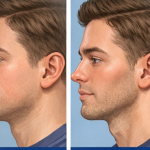
Not infrequently I get requests from patients for the desire to transform a round face into a more shapelier one. One cause of a round face is that the patient is overweight. A full neck, round cheeks, and a lot of subcutaneous fat throughout the face creates a generalized fullness that creates a fat and round face. These patients know full well that they are overweight and some liposuction of the neck and buccal lipectomies may make some difference. But weight loss will probably make the most difference in these cases. And these procedures should not be performed until some weight loss has been achieved.
But the overweight patient is not what usually makes up the ’round face’ patient. Most commonly these are younger patients that are not significantly overweight and are usually closer to being more height and weight porportionate. They may have some mild fullness in the cheeks and neck but often their bony prominences (cheeks, chin, or jaw angles) may be somewhat deficient. The approach to these patients must deal with both hard and soft tissues issues to be effective at improving the face’s angularity and definition.
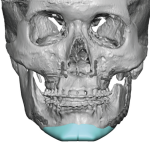
In addition to the fullness of the cheeks and neck, the next most important consideration in facial shape improvement should look at the chin. Often it may only be midly short in the horizontal dimension but the width of the chin is also important, particularly in the male patient. Chin implants today can provide more projection as well as width in many different sizes. Placed through a small incision under the chin bone, a chin implant can lend more definition and squareness to the lower face from subtle to dramatic results.
Upper facial fullness, more specifically midfacial fullness, can be achieved through cheek implants. Placed into position by incisions inside the mouth under the upper lip, cheek implants can provide good highlights through three-dimensional enhancement of the bone as it wraps around the area below the eye. An amazing aray of cheek and midface implants is available to provide a lot of enhancements around this important facial landmark. When paired cheek implants are combined with a chin implant, an upside down triangle of change is created that directly opposes a more round or oval facial shape.
Jaw angle implants are always a possibility but these are rarely needed in most really round faces. They can produce some lateral facial fullness but this is not usually helpful in ‘de-rounding’ the face.
The procedures of buccal lipectomies, neck and jowl liposuction, chin and cheel implants make up the usual plastic surgery tools for facial rehaping. Which one or combination of procedures is most helpful for improving facial definition is best determined by careful computer imaging study between the patient and their plastic surgeon.
Dr. Barry Eppley
http://www.eppleyplasticsurgery.com
http://www.ologyspa.com
Clarian North Medical Center, Carmel, Indiana
Clarian West Medical Center, Avon, Indiana
Indianapolis
I frequently see patients who desire greater facial definition. Usually these are younger men and women and much of their desire comes from having a fuller or fatter type face. Most of the time they have lost some weight but can’t lose it in the face. Others have never had a weight problem but want to have a more ‘chiseled’ facial appearance….this type of patient is almost exclusively a younger male patient. Regardless of their age, sex, and weight background, their objectives is to make their face appear less full with better accentuated facial features.
When looking at such patients, it is important to realize that their are only six facial landmarks which can be surgically altered to achieve these goals. They are (from top to bottom): cheeks, subcheeks (submalar), nose, chin, jaw angles, and neck. Four of these are more hard tissue (bone and hard tissue) and two of them are soft tissue or fat only. In the heavy or once heavy patient, the foundation of treatment is usually neck liposuction and buccal lipectomies. Reducing full areas by fat removal is always the first step and, for many, may be all that is really needed.They may benefit from cheek or chin augmentation as well and a good pre-surgical digital computer analysis and predictions will make this clear. A chin augmentation through an implant with fat removals in the cheek and neck is not an uncommon combination that can be highly successful.
In the ‘non-heavy’ or non-weight loss facial patient, fat removals may not be necessay at all. If needed, it is only in the buccal (cheek) areas only. This type of facial definition patient requires bony enhancement mainly. This may be chin, cheeks, or jaw angle implants and a computer analysis can tell which combination may be best. The order of facial implantation is chin implants are done the most, jaw angle implants next, and cheek implants the least. For the young male patient that is looking for what I call the ‘male model’ look, all three facial implants may be necessary.
I would be remiss in this discussion if the concept of rhinoplasty is not brought up as part of the surgical options. A broad, wide, or long nose can also be a source of facial disharmony. Rhinoplasty surgery helps put the nose into better balance with the rest of the face and a well-proptioned nose in some patients can make a dramatic difference. While it is not the most common facial change in facial definition surgery, it must always be considered in diagnosing what makes a patient’s face unbalanced.
Enhancing and redefining facial contours is a combination of fat removals and bony prominence enhancements. While none of these surgeries are difficult and all can be accomplished without facial scars, the most important part lies in the pre-surgical discussion and planning. These patients are highly self-conscious and, as a result, will be extremely critical of their surgical result. Thorough computer imaging and realistic goal-setting is the key in making the facial definition patient satisfied.
Dr. Barry Eppley
http://www.eppleyplasticsurgery.com
http://www.ologyspa.com
Clarian North Medical Center, Carmel, Indiana
Clarian West Medical Center, Avon, Indiana
Indianapolis
 Fullness in the midface, or a rounder area beneath the cheek bone, is partially the result of the prominent of the buccal fat pad. Most people do not realize that their is a large ball-like collection of fat under the cheek bone that in some patients can create lack of definition in the midface-cheek area.
The buccal fat pad has many ‘fingers’ that extend out from it to reach up to the temple area as well. Its exact role is not precisely clear and it appears to be similar to the appendix or your wisdom teeth….you can live just fine without it. Removing the buccal fat pad, a procedure known as a buccal lipectomy, is a very simple and uncomplicated procedure to perform. Through a very small incision just opposite the upper second molars, the buccal fat pad is teased out and removed. Portions of it or almost all of it can be removed. A single dissolvable stitch closes the incision. There is nothing special to do after surgery. One can eat or drink whatever and whenever one wants. There may be some mild swelling, and occasionally a small amount of bruising, but this completely clears within a week or so. It may take several weeks to see the results but some patients seek improvement even in the face of early swelling.
I often perform buccal lipectomies in younger patients in an effort to help change a rounder face and reduce cheek fullness. It may be performed alone but is usually done in combination with other adjunctive facial procedures such as neck liposuction, cheek implants, chin implants, or rhinoplasty. Buccal lipectomies create a subtle improvement and for this reason are not usually done alone….although it can be. When performed alone, I can do them in the office under local anesthesia if the patient desires.
The size of many buccal fat pads can be impressive and their removal can be quite substantial. One has to carefully look at the patient’s face and be certain that this procedure would really be helpful as it is easy to create the opposite problem (gaunt sunken-in look) which can develop over time in some patients. This is why I only usually use it in very full round faces with prominent cheeks. It is not a substitute for the patient who really needs a cheek augmentation instead. When done in the cheek-deficient patient, you are only flattening out the midface further.
Dr. Barry Eppley
http://www.eppleyplasticsurgery.com
http://www.ologyspa.com
Clarian North Medical Center, Carmel, Indiana
Clarian West Medical Center, Avon, Indiana
Indianapolis
THE BUCCAL FAD PAD IN FACIAL SURGERY
In select patients, removal of the buccal fat pad (which lies immediately under the
cheekbone and is about the size of a golfball in most patients) can help contour a fuller
face. I have performed this procedure, in conjunction with liposuction of the neck and
chin implants, many times in patients whose desire is to thin out their fuller faces.
In numerous anatomic studies, dissectors have detailed the known relationship
between the facial nerve, buccal fat pad and the parotid duct. Given the frequent
proximity to this area during many types during aesthetic and reconstructive facial
surgery, it is useful to have a better appreciation of this midfacial crossroads region.
Like most cadaveric studies, there are no absolutes for each person’s anatomy.
However, it is clear that several buccal branches of the facial nerve interlace with the
multi-lobed buccal fat pad. Most commonly, this is on the superficial (outer) aspect of
the buccal lobe, away from intraoral approaches of manipulation. For this reason,
aggressive buccal lipectomies may inadvertently damage these branches. I have never
observed facial nerve injury from a buccal lipectomy procedure but this attests to a more
limited resection. Complete removal is usually aesthetically undesireable but also places
these nerve branches at risk. Since the parotid duct shares a similar pattern
of proximity as that of the nerve, injury to it is also theoretically possible. However, it is a
much larger structure that is tethered by its attachment to the oral mucosa and, as such,
not as easily avulsed from its anatomic bed.
In performing buccal lipectomies, it is important to bear the anatomy of the facial nerve
branches in mind and adjust the amount of buccal fat resection accordingly.
Dr Barry Eppley
www.eppleyplasticsurgery.com
www.ologyspa.com
Clarian North Medical Center, Carmel, Indiana
Clarian West Medical Center, Avon, Indiana
Indianapolis