EXPLORE
Plastic Surgery
Dr. Barry Eppley

Explore the worlds of cosmetic
and plastic surgery with Indianapolis
Double Board-Certified Plastic
Surgeon Dr. Barry Eppley

Archive for the ‘facial reshaping’ Category

Jawline and Chin Narrowing by Tubercle Reduction

Sunday, November 13th, 2011

A square chin and jawline is considered desireable in a male but not so in a female. It is also deemed unattractive in certain ethnicities such as in the Asian face as well as in the male to female transgender face. Reduction of a square jawline is often perceived as that of the jaw angles. While jaw angle reduction surgery has a role to play in facial contouring, it only provides some narrowing in the posterior mandible or back part of the jaw. It has no slimming effect in the front part of the jawline in the chin area.


Narrowing of the chin or front part of the lower face can be done by several methods, all of which require bone reduction. If a chin osteotomy (osteoplastic genioplasty) is being done, the width of the chin will naturally narrow when the chin bone is brought forward and/or vertically lengthened. But not everyone needs horizontal or vertical chin lengthening so an osteotomy can be ineffective. The other approach is direct burring reduction of the chin or mandibular tubercles. By reducing the bony sides of the chin it can be narrowed in the frontal view.


When doing an osteotomy to create a chin narrowing effect, it is important to realize that the bone will not narrow behind the osteotomy cut. This also is where a step-off can be created at this junction which is most evident when horizontal advancements are done. As the bone edge of the downfractured chin segment moves forward, this step-off can be created. It can be a difficult area to reach for smoothing out this step-off and there is risk to the mental nerve which is very close by. This is why it is helpful to make that osteotomy cut back as far as possible to extend the natural narrowing effect of the advancing osteotomy and avoid a prominent step-off.


Reducing the sides of the chin can be done by either burring or saw reduction. Using a saw always removes more bone quickly with less risk of injury to the mental nerve. The more relevant question is whether it is done through an incision inside the mouth or from an external submental incision from below. Most of the time an intraoral approach is used if only the sides of the chin need to be reduced. But when an overall chin reduction is being done reducing height and/or projection, a submental approach is used so that the extra soft tissues can be managed by excision and redraping to prevent postoperative sagging or ptosis.


To achieve a more slim feminine lower face, reduction of the jawline must be considered as a whole. Changing the width of the chin from a more square to a tapered shape creates an essential change in the frontal view. Barring the need for horizontal or vertical lengthening of the chin, burring or saw reduction of the sides of the chin can be done from either an intraoral or submental approach.


Dr. Barry Eppley

www.eppleyplasticsurgery.com

Indianapolis, Indiana

Surgical Options for the Chubby Face (Fat Face)

Monday, February 15th, 2010

It is not uncommon to hear a patient’s concern about their chubby or ‘fat face’. For some of these patients their face matches their body habitus and some significant weight loss will do wonders for those concerns. But there are people who do have a chubby face that are not necessarily significantly overweight and they may seek a plastic surgery consult to see what their options are.

 The chubby face differs from other facial types in that the entire face appears full. From the cheeks down to the neck, the face assumes a definite round shape. Patients with a chubby face will often complain that the shape of their face makes them appear heavier than their body really is.

There are numerous non-surgical facial fat reduction methods that are marketed and sold. I can not comment on whether these work or are effective as they are not used in my Indianapolis plastic surgery practice. But should you try them and find them unsatisfactory, you can consider the following surgical options.

Almost all chubby face patients have thicker and elastic skin. This is a double-edged anatomic consideration. Such skin has the ability to shrink and contract (snapback if you will) which is good for getting better contours, particularly in the neck. Conversely, thick skin is also heavy and is prone to prolonged swelling.

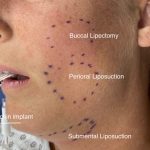
The strategy for the chubby face is not one of overall fat reduction through liposuction. This is not possible in the face contrary to the perception of many. Select or spot fat reduction must be done instead. This would include submental and neck liposuction and buccal (cheek) lipectomies. These are very consistent procedures that are effective but patients should not expect them alone to produce a dramatic facial change. Fat pockets around the eyes and excessive skin can also be helpful if they exist but these are complementary procedures, not a primary modification maneuver.

There are no other fat areas of the face that can be effectively reduced. While significant changes can be made, for example, through a superficial parotidectomy and submandibular gland removals, these are extreme procedures which are not justifiable for cosmetic changes. Attention must be turned to bringing out facial prominences to aesthetically work in the opposite direction.

The cheeks, chin and nose must be carefully look at to see if their accentuation would be beneficial. The chin is the easiest one to assess as a weak chin is readily seen. Chin augmentation, even if it is only a minor amount, can complement the contour pullback from the neck liposuction. Cheek augmentation is more difficult to determine its potential benefits as it is not a profile structure. Unlike the chin, cheek augmentation in some patients may actually make their face look fuller or heavier. A cheek implant to help make a face look thinner must be placed high on the cheekbone and not be overdone in amount and location of projection. Too much anterior or too much lateral projection creates undesired midfacial fullness.

A rhinoplasty with dorsal augmentation and tip narrowing can help make the face look thinner by an optical illusion effect. Thinning of the nose is the one procedure that affects the central face whose appearance is not based on how much fat is present. Patients with chubby faces rarely have a narrow nose or a nose with a high dorsum. Usually they have a broader dorsum with a wider tip to their noses.

To change the appearance of the chubby face, multiple soft and hard tissues procedures are needed. These can include neck and cheek fat removal, blepharoplasty, and facial bone prominence highlighting. Piecing together these procedures into an effective facial surgery plan is as much an art form as any definitive science.


Barry L. Eppley, M.D., D.M.D.

http://www.eppleyplasticsurgery.com

http://www.ologyspa.com

Clarian North Medical Center, Carmel, Indiana

Clarian West Medical Center, Avon, Indiana

Indianapolis

The Myth of Facial Liposuction

Saturday, November 28th, 2009

Liposuction is a very effective method of fat removal. While it can be used in almost any location of the body where there is fat, it does have limitations. And when applied to certain fat areas, it may even have the opposite effect of an undesired result.

The face is one such area where the concept of liposuction is largely more theoretical than practical. While the face does have fat below the skin, it is not easily removed like that in the trunk or extremities. Facial fat is more fibrous and has branches of the facial nerve lying deep to it. There are few very discrete collections which can easily be removed with the exception of the buccal fat pad and some of its numerous extensions.

Plastic surgeons frequently advertise and perform neck liposuction. And while the neck is part of the face, most patients do not think of the neck when they envision the concept of facial liposuction.

When you combine what is contained in the buccal space with the subcutaneous tissues in the neck, these are the only two facial areas where contouring can be done through fat removal. The neck can be liposuctioned while the buccal fat pad can be directly extracted through a small open incision. Removal of any other facial fat areas through liposuction  is not only ineffective but can cause a lot of tissue trauma and prolonged swelling.

When liposuction first became widely used in the 1980s and 90s, facial liposuction was both advocated and written about. It was used to try and reduce facial fullness in the lateral face and even reduce the prominent mound of tissue that develops above the nasolabial fold with aging. It was proven to be ineffective and has since become largely abandoned as a treatment for facial fullness.

For those seeking to reduce their ‘fat’ face or to deround their facial appearance, liposuction is not the answer. It simply can not do what can be done for the circumference of the thigh or the waistline. One cannot deflate the face so to speak.

Improving the shape of a very full and round face does include some fat removal which is accessible, the buccal and neck fat. But fat removal alone is inadequate as it can only change some of the contour. If a full neck is all that bothers someone, then liposuction alone is a good treatment. But for more total facial sculpting and definition creation,  it must be combined with other procedures that bring out or highlight facial prominences such as the chin, cheeks, or jaw angles. Using implants in these facial convexity areas can help bring shape to an otherwise amorphous face.         


Dr. Barry Eppley

http://www.eppleyplasticsurgery.com

http://www.ologyspa.com

Clarian North Medical Center, Carmel, Indiana

Clarian West Medical Center, Avon, Indiana

Indianapolis


Facial Reshaping Techniques In Plastic Surgery - Improving The Round Face

Thursday, July 10th, 2008

Not infrequently I get requests from patients for the desire to transform a round face into a more shapelier one. One cause of a round face is that the patient is overweight. A full neck, round cheeks, and a lot of subcutaneous fat throughout the face creates a generalized fullness that creates a fat and round face. These patients know full well that they are overweight and some liposuction of the neck and buccal lipectomies may make some difference. But weight loss will probably make the most difference in these cases. And these procedures should not be performed until some weight loss has been achieved.

 
But the overweight patient is not what usually makes up the ’round face’ patient. Most commonly these are younger patients that are not significantly overweight and are usually closer to being more height and weight porportionate. They may have some mild fullness in the cheeks and neck but often their bony prominences (cheeks, chin, or jaw angles) may be somewhat deficient. The approach to these patients must deal with both hard and soft tissues issues to be effective at improving the face’s angularity and definition.

 
In addition to the fullness of the cheeks and neck, the next most important consideration in facial shape improvement should look at the chin. Often it may only be midly short in the horizontal dimension but the width of the chin is also important, particularly in the male patient. Chin implants today can provide more projection as well as width in many different sizes. Placed through a small incision under the chin bone, a chin implant can lend more definition and squareness to the lower face from subtle to dramatic results.

 
Upper facial fullness, more specifically midfacial fullness, can be achieved through cheek implants. Placed into position by incisions inside the mouth under the upper lip, cheek implants can provide good highlights through three-dimensional enhancement of the bone as it wraps around the area below the eye. An amazing aray of cheek and midface implants is available to provide a lot of enhancements around this important facial landmark. When paired cheek implants are combined with a chin implant, an upside down triangle of change is created that directly opposes a more round or oval facial shape.

 
Jaw angle implants are always a possibility but these are rarely needed in most really round faces. They can produce some lateral facial fullness but this is not usually helpful in ‘de-rounding’ the face.
The procedures of buccal lipectomies, neck and jowl liposuction, chin and cheel implants make up the usual plastic surgery tools for facial rehaping. Which one or combination of procedures is most helpful for improving facial definition is best determined by careful computer imaging study between the patient and their plastic surgeon.


Dr. Barry Eppley
http://www.eppleyplasticsurgery.com
http://www.ologyspa.com
Clarian North Medical Center, Carmel, Indiana
Clarian West Medical Center, Avon, Indiana
Indianapolis


Dr. Barry EppleyDr. Barry Eppley

Dr. Barry Eppley is an extensively trained plastic and cosmetic surgeon with more than 20 years of surgical experience. He is both a licensed physician and dentist as well as double board-certified in both Plastic and Reconstructive Surgery and Oral and Maxillofacial Surgery. This training allows him to perform the most complex surgical procedures from cosmetic changes to the face and body to craniofacial surgery. Dr. Eppley has made extensive contributions to plastic surgery starting with the development of several advanced surgical techniques. He is a revered author, lecturer and educator in the field of plastic and cosmetic surgery.

Read More


Free Plastic Surgery Consultation

*required fields


Pricing

The cost of any type of elective plastic surgery plays a major role in the decision to undergo the procedure(s).

More Info


Military Discount

We offer discounts on plastic surgery to our United States Armed Forces.

More Info


Categories