EXPLORE
Plastic Surgery
Dr. Barry Eppley

Explore the worlds of cosmetic
and plastic surgery with Indianapolis
Double Board-Certified Plastic
Surgeon Dr. Barry Eppley

Archive for the ‘gynecomastia’ Category

Case Study: Correction of Supplement-Induced Gynecomastia in Athletes and Body Builders

Friday, March 2nd, 2012

Background: Gynecomastia, or male breast growth, has numerous causes. When occurring in very young males going through puberty the cause is a natural one over which one has not control. Fortunately, many puberty-induced gynecomastias are self-resolving. But when occurring in non-teenage males there is almost always a specific exogenous influence.

Gynecomastia is well known to be the result of certain drug uses. Precriptions drugs such as Prilosec, Tagamet, Zantac and Propecia are some recent examples. They exert their adverse effect by stimulating estrogen production. Anabolic steroids, which are generally used in non-prescription or illegal fashion in the body building industry, causes an equal if not greater number of gynecomastia cases through their aromatization effect and subsequent conversion to estradiol. Certain supplements in muscle building can also cause gynecomastia although which ones are a bit controversial.

Drug or supplement-induced gynecomastia almost always presents as firm glandular enlargement underneath the nipple-areolar complex. It makes the nipple protrude outward with a very discrete palpable mass. Because of the good muscular definition and lean body mass of most amateur and professional body builders, the protrusion caused by the breast lump is aesthetically obvious.

Case Study: This 22 year-old male from Bloomington Indiana had developed nipple protrusion over a one year period. He never had it before age 20 when he started to lift weights regularly. He purchased and took a muscle-building supplement purchased over the internet to help get bigger more quickly as part of his program. After a year, he had developed hard masses under his nipples. He stopped taking the supplement but the nipple lumps failed to go away. After six months of no improvement, he sought a surgical solution to his small ‘man boobs’.

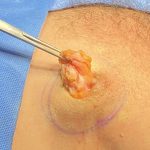
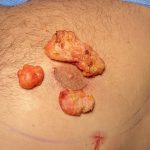
Under general anesthesia, the breast lumps were approached through a lower areolar half-moon incision. A large amount of hard glandular breast tissue was cut out and removed. The removal was done until more normal soft chest fat was left. While getting every bit of abnormal gland tissue removed is important, some fat on the underside of the nipple and on the pectoralis fascia if possible should be preserved to prevent the risk of a sunken-in nipple later. Drains were placed and the incisions closed. A chest compression wrap was placed. This was performed as an outpatient procedure that took one hour to complete.

He wore a chest compression wrap for two weeks after surgery. By three weeks after surgery, all bruising and swelling had resolved. His chest was completely flat with a smooth nipple-areolar complex contour. He returned to exercise and weight lifting, without supplements, one month after surgery.

Most cases of steroid or supplement-induced gynecomastia in athletes and body builders present as discrete firm masses just under the nipple. The rest of the chest rarely has enlargement or needs contour reduction. This type of gynecomastia can usually be cured satisfactorily in a single procedure with a low risk of the need for revisional surgery. But it is important that no working out, specifically chest exercises, be done within the first month after surgery. Doing so will cause a fluid collection or seroma which will require drainage and may induce scar formation. Such scar formation may result in a mass that is just as big as the breast tissue that was removed.

Case Highlights:

1) Gynecomastia can be caused by any drug or supplement which has a stimulatory effect on breast tissue. This is a well known effect of numerous supplements used in body builders.

2) Supplement or drug-induced gynecomastia is glandular in nature and usually requires direct excision with or without contouring liposuction

3) Direct glandular breast excision is done through a lower areolar excision and must be done carefully to avoid a concave contour deformity. It is a completely curable gynecomastia problem.

Dr. Barry Eppley

Indianapolis, Indiana

Case Study: Gynecomastia Reduction with Smartlipo

Wednesday, February 22nd, 2012

Background:  Enlargement of the breast tissue in a teenage or adult male, well known as gynecomastia, is a challenging aesthetic chest problem. It is comprised of several components including the amount of breast tissue, the size of the areola, and the position of the nipple-areolar complex on the anterior chest wall. Much of the focus of gynecomastia surgery, understandably, is on the reduction of the size of the breast mound whether it is throughout the whole chest or just limited to around the nipple-areolar complex.

Reduction of the breast tissue in gynecomastia can be done by either liposuction, direct excision through a lower areolar incision or both. Which of these approaches is best is determined by the size and quality of the breast tissue. Male breast tissue can be simplistically divided into ‘soft’ and ‘hard’ types. Hard breast tissue is known as glandular tissue and is very firm, lump-like and largely relegated to underneath and around the nipple-areolar complex. Soft breast tissue is largely comprised of fat with some fibrous tissue, known as fibrofatty tissue. It can occupy the entire chest or be an extension beyond the zone of glandular tissue underneath the nipple.

As a general rule, hard gynecomastia responds best to direct excision as it needs to be cut out. Soft gynecomastia can be extracted without excision by liposuction. Many gynecomastia conditions require both methods given the mixed hard and soft tissue make-up. If glandular tissue is not recognized before surgery, residual lumps or areolar fullness may be left behind by liposuction.

Case Study: This 35 year-old male from Indianapolis had developed increasing chest fullness which started when he was a teenager. It continued to grow as he got older and gained some weight. Exercise did not make it get smaller. He finally resolved to himself that he had to get rid of his ‘man boobs’ by surgery. Examination showed that he had generalized breast mound fullness of which all of the tissue was soft and non-glandular. Even under the nipple-areolar complexes no lumps or firm tissue could be felt.

Under general anesthesia, the chest was first infiltrated with a Hunstad solution. Then through small stab incisions at the side of the chest wall, each breast mound was first treated by a Smartlipo probe to heat all of the fatty tissues. Suction aspiration then removed a total of 1300cc of aspirate from both sides of the chest, a large amount by gynecomastia standards. The chest areas became flat and well contoured on both sides without any residual lumps of breast tissue under the nipples.

He wore a chest compression wrap for two weeks after surgery. By three weeks after surgery, all bruising and most of the swelling had resolved. By six weeks after surgery, the chest had a completely flat appearance and the chest skin and underlying tissues felt soft again.

Most cases of gynecomastia surgery require excision if small and a combined excision and liposuction approach when larger. It is not common to find a gynecomastia patient in which a completely flat chest can be obtained in one surgery by liposuction alone. In either case, Smartlipo provides a good method of liquefying the fatty breast tissue in gynecomastia.

Case Highlights:

1)      Male gynecomastia responds to different treatment approaches based on the type of breast tissue and the size and position of the nipple-areolar complex.

2)      In ‘soft’ forms of gynecomastia without significant glandular tissue, liposuction can be very effective at chest contouring/reduction.

3)      Liposuction of gynecomastia, specifically using Smartlipo, can be done with very small incisions and without the need for drains.

Dr. Barry Eppley

Indianapolis, Indiana

Gynecomastia Reduction Surgery in Male Athletes and Body Builders

Wednesday, October 26th, 2011

Gynecomastia, or male breast enlargement, is a well known condition that affects both teenagers and adult men. While the majority of gynecomastia occurs in teenage boys, most of which can go away on its own, those that require surgery are more common in adult men over the age of eighteen. I do far more gynecomastia reduction surgery in men than in teenage boys.

While most people assume that gynecomastia surgery involves the reduction of large amounts of breast tissue, these types of male breast enlargements do not make up the majority of cases today. Men requesting gynecomastia reduction today are just as likely to come in for a relatively small amount of breast tissue that may just be underneath the nipple (areolar gynecomastia) or limited to just around it. The enlarged nipple-areolar complex is just as aesthetically distracting for many men as is a completely enlarged breast mound. This is also reflection of contemporary body styles and cultural standards of male beauty.

One very specific type of contemporary male breast concern that I see is ‘athletic gynecomastia’. This is seen in athletes, usually body builders, and often is the result of steroids and other muscle building supplements. The specific use of steroids or testosterone has the side effect of making the female hormone estrogen which stimulates breast tissue development. This creates a very firm breast tissue nodule which is easily felt right under the nipple. It is visually evident in a normal stance but protrudes out much further when lifting or posing as the flexed pectoralis muscle pushes it forward.

In the surgical treatment of this type of gynecomastia, liposuction will not usually work well alone. The breast tissue is too firm to be broken down and removed by cannula extraction. When looking at the three zones of breast tissue, the two zones outside of the nipple (between the nipple and the sternum and between the nipple and the armpit) can be treated by liposuction as it always much softer than what lies under the nipple. Direct excision through a nipple incision is needed to remove the subareolar firm mass. The size and firmness of the areolar mass can be quite impressive and is always much bigger than the diameter of the areola.

The approach to this type of gynecomastia is always through the lower half of the areola. This places the incision in the transition zone between the areola and the skin which makes for a well concealed scar. The scar will run between the 9 and 3 o’clock position. This will allow adequate access for directly excising the breast mass by electrocautery and doing liposuction to the two outside breast tissue zones. There is no need for any additional breast incisions. The wide undermining created by the liposuction also allows the skin surrounding the areola to shrink and adapt better.

Drains are almost always used for up to a week after surgery to prevent a fluid collection which can easily turn into hard scar tissue, creating minimal improvement afterwards. The use of a chest wrap is also important for the same reason and is worn for up to several weeks after surgery.

While there are the typical risks of gynecomastia surgery, such as hematoma, seroma, prominent areolar scar and nipple and chest irregularities, these are not the ones I emphasize to these types of gynecomastia patients.

The real risk of this athletic gynecomastia reduction surgery is the need for a revisional procedure. Despite the fact that this gynecomastia is small in size compared to other gynecomastia surgeries, and thus would seem to be more easily solved, the need for revisional surgery is actually higher in my experience. This is because this type of male patient is very particular in the final cosmetic result and even the smallest amount of residual tissue or irregularity will be seen as a cosmetic distraction. When you look at the type of body on which this small gynecomastia occurs, one realizes the high aesthetic goal one has to reach for complete satisfaction.

Dr. Barry Eppley

www.eppleyplasticsurgery.com

Indianapolis, Indiana

Case Study: SmartLipo For Gynecomastia in the Older Male

Sunday, June 12th, 2011

Background: Gynecomastia is a well known condition that largely affects the teenage and younger male. Male breast enlargement is most likely to be affected during the hormonal changes that occur during and after puberty. On the opposite side of puberty, the andropause era of men may cause gynecomastia as testosterone levels drop and numerous drugs for medical conditions may cause it. This is sometimes unflatteringly referred to as ‘senile gynecomastia’. But this is an inaccurate term and is better referred to as older gynecomastia to differentiate it from juvenile gynecomastia.

Older gynecomastia is different than that which appears in younger men in numerous ways. The amount of breast enlargement is often less and more diffuse in consistency. But the biggest difference is in the shape and amount of chest skin. The chest skin is more loose and sags and the nipple position is much lower than normal. Often the nipple may be close to or at the level of the inframammary fold. The skin also has lost much of its native elasticity. The lax skin and the droopy shape of the chest is often far more significant than the volume of breast tissue.

Because of differing tissue characteristics, the older gynecomastia male patient requires greater consideration of the extra skin problem and the position of the nipple. Ideally procedures such as horizontal excision of overhanging skin and free nipple grafting or liposuction with periareolar nipple lifts may be needed. But many men do not want the scars that result from these procedures and prefer liposuction alone to avoid this concern.

Case Study: This 68 year-old male wanted chest reshaping as his favorite activity in the summer was to be out on the beach at his lake. He was embarrassed because of the way his chest looked, particularly when contrasted to the chest of many younger men. In revewing his options, I initially recommended a periareolar mastopexy with liposuction. But he did not want the risk of any visible scar around his nipples and opted for liposuction alone.

Under general anesthesia, he underwent liposuction of both sides of his chest. A Smartlipo (laser liposuction) technique was done for optimal skin retraction. A fiberoptic laser probe was initially inserted and 20,000 joules of energy was delivered, raising the internal subcutaneous tissue temperature to 48 degrees C. Then 600cc of tissue was aspirated from each side of his chest up into the armpit area. He wore a chest compression garment for one week after surgery. It took another six weeks until all swelling and bruising subsided to appreciate the final result.

His final result showed significant chest contour improvement. But the outcome was not ideal due to only a limited amount of skin retraction. He desired no further efforts as he still did not want any chest scars.

Smartlipo offers an effective treatment for gynecomastias in older men but the amount of skin retraction is limited. It does not always result in an ideal chest result from a skin redraping standpoint but that is the trade-off for avoiding visible scars.

Case Highlights:

1) Gynecomastia in older men is different than in younger men and teenagers. The primary problem is soft tissue sagging that has lost much of its elasticity. The amount of breast enlargement is usually less significant than the size of the overlying skin problem.

2) Ideal older male chest contouring addresses the sagging skin through nipple repositioning and skin tightening/lifts. The scars that result from these procedures, however, may be unappealing to some men.

3) Liposuction of older gynecomastia provides improvement but not an ideal result as there is too much skin. Smartlipo aids the skin retraction process and is helpful in this form of gynecomastia treatment.

Dr. Barry Eppley

http://www.eppleyplasticsurgery.com

Indianapolis, Indiana

Case Study: Revision of Gynecomastia Reduction Deformities

Thursday, October 7th, 2010

Background:  The treatment of certain types of gynecomastias employs the use of direct excision. Direct excision may be combined with liposuction but the dense tissue of some gynecomastias does not respond well to liposuction alone. Unlike liposuction, however, directly cutting out male breast tissue underneath the nipple  can easily be overdone and too much can be removed. There is an experience and art form to know just what is the right amount to remove to have a good result but not enough to cause a secondary contour deformity.

Over resection of gynecomastia is often not immediately apparent and only appears when the swelling has gone down. As healing sets in, the nipple may be pulled downward with scar contracture. This results not only in nipple inversion but the nipple may be distorted with certain arm movements due to the scar bands between the nipple and the deeper tissues.

Revision of over resected gynecomastia is different than underresected gynecomastia. It illustrates that it is always easier to remove tissue than it is to add tissue. Nipple inversion from gynecomastia requires a release and tissue fill. The question is what material is best to fill in the defect.

Case: This is a 28 year-old male who previously had a nipple gynecomastia removed by direct excision through a lower nipple incision by a general surgeon. Postoperatively he developed  a severe nipple and chest contour deformity on the right side that was treated by the placement of a multiple layers of Gore-tex sheeting. While this provided some contour restoration, it soon became hard and contracted. The photos here do not do justice to how hard and abnormal it felt. The nipple, while better, still had a contracture deformity to it.

The best tissue fill for many soft tissue contour problems, including gynecomastia, is a dermal-fat graft. It is soft, supple and is composed of one’s own natural fat tissue. Its only negative is that it requires a harvest site with associated temporary pain and a scar. He underwent a revision procedure consisting of an initial removal of the synthetic grafts through his old nipple incision. Then a dermal-fat graft was harvested from his lower buttock crease which matched the dimensions of the synthetic grafts removed. The dermal-fat graft was sutured to the muscle from underlying the nipple upward to the top of the defect. No drain was used. He only had to wear a chest wrap for 10 days. While there was no discomfort from the chest site, the harvest site had predictable discomfort.

He went on heal without any problems and was seen back three months later. His nipple contour was much improved and his chest felt soft without any deforming scar contractures. There was a slight hint of the graft contour externally but that will disappear as the fat graft continues to heal and settle down.

Case Highlights:

1)      Over resection of gynecomastia causes a chest wall deformity consisting of nipple inversion and scar contracture.


2)      Revision of a gynecomastia inverted deformity requires some form of tissue fill. This is best done with a dermal-fat graft or an allogeneic dermal graft. Synthetic materials, while having initial good results, will ultimately develop contracture and unnatural hardness.


3)      Dermal-fat grafts can be harvested from most abdominal scar sites or along the lower buttock crease.


Dr. Barry Eppley

www.eppleyplasticsurgery.com

Indianapolis Indiana

Case Study: Plastic Surgery Correction of Areolar Gynecomastia

Sunday, August 15th, 2010

Background: Gynecomastia is a well-known male condition of breast enlargement. Most envision gynecomastia as that of a significant breast mound that may be fairly small to that of a mound more similar to that seen in the more mature female breast. But smaller size gynecomastia exist in equal numbers which can be just as bothersome to the younger male.

Breast enlargement relegated to just around the nipple area can be defined as areolar gynecomastia. Appearing as a ‘puffy nipple’, the development of a small areolar mass pushes it out beyond the plane of the surrounding chest skin. While minor compared to much larger gynecomastias, it can be of cosmetic concern as it can appear through t-shirts and is not consistent with our modern-age culture of the ‘Abercrombie Fitch’ male. A completely flat chest is what younger males desire today. In the aesthetically conscious young male, any degree of nipple protrusion can be bothersome.

Case: This is a 21 year-old male who came in for treatment of his puffy nipples. On first glance, one may not see anything abnormal. But closer examination showed some nipple elevation on both sides of his chest. His overall chest appearance was not muscular but smooth and thin. In the perspective of the shape of his chest, one could appreciate why this small amount of areolar mass would be bothersome. His medical history was significant in that he had been treated with long-term low dose steroids due to congenital adrenal hyperplasia. This may have been the cause of his small gynecomastia. Also, he previously had liposuction surgery which did not significantly improve his chest concerns.

The treatment choices for any small form of gynecomastia is between liposuction versus open excision, or some combination of the two. Which choice is best depends on how the gynecomastia feels. If it is soft, liposuction (particularly laser liposuction or Smartlipo) can do a good job. If it feels hard or has a ‘mass-like’ feel, open excision will be more effective. It is tempting to think that one can beat up the hard areolar mass by liposuction cannulaes or laser probes and suction it out, but this approach will often be disappointing.

During his gynecomastic surgery, an open approach was done using a lower or inferior areolar incision. A very dense mass of tissue was encountered on each nipple and removed. The key to removing these areolar masses is to not overdo it. It is very easy to remove too much tissue and end up with a reverse problem, the inverted or indented nipple. At least 10 millimeters of tissue must be left on the underside of the nipple-areolar complex. And it is best not to completely expose the pectoralis fascia. Resection will usually go wider than the diameter of the areola. The incision is closed with dissolveable sutures under the skin, taped, and a compression chest wrap worn for a week. A small drain may or may not be used depending upon the size of the residual resection cavity.

When seen at one week after surgery, the tapes were removed. His areolas were nice and flat and he had no fluid build-up despite not having a drain used. The nipples will almost have deflated appearance compared to that before surgery. The incisions are inconspicuous even just one week after surgery.

Case Highlights:

1) Areolar gynecomastias are small nipple protrusions that can be cosmetically disturbing, particularly in the younger male.

2) Despite their small size, they are usually not best reduced by liposuction due to their firm consistency. Open excision is more effective for getting out these silver-dollar sized masses.

3) The use of open excision for areolar gynecomastias creates no significant scarring and is no more invasive than liposuction. Overzealous tissue resection can result in nipple indentations and inversion.

Dr. Barry Eppley

http://www.eppleyplasticsurgery.com

Indianapolis Indiana

Open Excision of Areolar Gynecomastia in the Younger Male

Thursday, July 15th, 2010

Gynecomastia is defined succinctly as male breast enlargement. While this description is accurate, it is overly simplistic. Gynecomastia is a wide spectrum of male breast problems caused by the growth of excess male breast tissue. This can range from the smaller areolar gynecomastias (puffy nipple), up to a size that resembles a large droopy female breast (giant gynecomastia), to a deflated sac of skin and sagging nipple. (elder gynecomastia) The quest for younger males is a completely flat chest with no nipple protrusion.

One of the unique types of gynecomastia that is rarely discussed is that seen in the younger male which may be small but is very firm. Generally seen in men between late teens and mid-thirties, it presents as a discrete swelling under and around the nipple. It is very firm and nodular. These male patients will usually have a history of some drug use in the past, whether it be steroids, growth hormone, or other anabolic supplements. They can be patients who were treated for a medical condition in the past, such as congenital adrenal hyperplasia, or may be bodybuilders or very athletic.

In presentation, this type of gynecomastia is not large and is fairly small. The actual firm mass underlying the areola is not large and it is fairly discrete, although bothersome to the patient. Many men may not be that bothered by it but young body-conscious males are very aware of it. This is particularly relevant in today’s male culture where a very flat chest contour is desired. Even a slightly puffy nipple stands out by these standards. For bodybuilders, this nipple mass is accentuated on flexing and in certain poses.

It is important to appreciate that although this areolar mass is small, it is not able to be removed adequately by liposuction. It is tempting to do so and I have tried because it seems like it should be easy to extract. I have not been successful even with laser liposuction. (Smartlipo) It can be reduced but not flattened sufficiently to the satisfaction of these male patients.

The firm consistency of the young male areolar gynecomastia requires that it be removed by an open excision technique. Through a lower areolar incision, the mass can be easily excised in a circumferential manner around the base of the areola. The firm dense consistency of the mass can be quite surprising. While it is important to remove as much as possible, one must be careful to not remove too much, ending up after healing with a nipple indentation. Some tissue must be left on the underside of the nipple to prevent this potential complication. Depending on the size of the excision cavity, a small drain may be used for several days after surgery. If the underlying space is not too large, the ‘dead space’ can be tacked down and reduced so a drain is not necessary. The areolar incision is closed with internal dissolveable sutures and taped. A circumferential chest wrap is worn for several weeks after surgery.

Dense areolar gynecomastia is best approached by doing open excision. Liposuction is tempting but will not be successful as the consistency of the mass is too dense.  

Dr. Barry Eppley

http://www.eppleyplasticsurgery.com

http://www.ologyspa.com

Indianapolis, Indiana

Common Questions About Gynecomastia Surgery

Sunday, January 3rd, 2010

1.      What is the difference between teenage and adult gynecomastia?


Gynecomastia, or male breast enlargement, can occur at any age. It is most commonly seen in teenage males after undergoing puberty. The breast tissue often responds by becoming larger and more noticeable. While many teen age gynecomastias do go away and the chest gets flatter again, this does not occur in all male teenagers. If the enlarged breast tissue has not gone down by age 15 or 16, it is not likely to go away. A parent should consult with their pediatrician first to be sure that there is not a treatable cause. (endocrine disorder)


Adult male gynecomastia is different in numerous ways. Breast masses, particularly if they are just on one side and painful, should be evaluated to rule breast cancer. (about 1% of all breast cancers do occur in men) Older men can develop gynecomastia  as a result of the medications that they take for prostate enlargement and in the treatment of some cancers. Older men also develop chest sagging or drooping as well as some breast enlargement as their testosterone levels fall.


2.      At what age should a teenager undergo surgery to correct their breast enlargement?


My personal approach is to treat the gynecomastia when it is psychologically disruptive to the teenager. I don’t think it is necessary to wait until they are 17 or 18 to see if it goes away. While age 12 or 13 is too young, if the breast enlargement has not changed by age 15 or 16, then a plastic surgery consultation is in order. If the breast enlargement is going to really go away on its own, a substantial change will be apparent by that age. From a psychological perspective, I have seen numerous teenage boys that have suffered too long and could have had surgical correction earlier. 


3.      Will my insurance cover the costs of gynecomastia surgery?


Insurance coverage for gynecomastia  requires an insurance pre-determination process. After an initial consultation, your plastic surgeon will write a letter complete with photographs to them. They will use that information to either approve or deny coverage. My experience is that the success rate for insurance coverage is in less than half of the cases. Some insurance companies even specifically exclude gynecomastia surgery from their policies. Adolescent or teenage gynecomastia has a much better success rate than that of adult men.


4.      What is the best method to treat gynecomastia, liposuction or open excision?


Liposuction and open excision are two methods to treat gynecomastia. Sometimes they are done alone and in others both are used in a single surgery. Which one is used will depend on the size of the gynecomastia and how firm or soft the breast tissue feels. For small breast tissue enlargement that is just around the nipple, a simple open approach with an incision around the lower half of the nipple is used to cut it out. If the gynecomastia is larger and soft, then liposuction alone may be sufficient. In gynecomastias that have sufficient size but have a harder feel under gthe nipple, then a combination of liposuction and excision is done.


In very large male breast enlargements (where an actual breast mound exists), another issue to consider is what to do with the extra skin. Some form of skin reduction needs to be done to lift the nipple, make it smaller, and tighten the chest skin as well. Because skin reduction causes scars, reduction of breast mound skin is usually done by keeping the incision and cut-out around the nipple. Older gynecomastia techniques used more traditional female breast reduction scars which should be avoided due to poor and very noticeable scarring.


5.      When can I return to exercise and working out after surgery?


That will depend upon what type of gynecomastia surgery one has. If liposuction alone is used, one could return to working out within 10 to 14 days. If any form of open excision  with or without skin reductio, is used, one should wait a full month after surgery before stressing the chest tissues. This will help prevent any build-up of fluids (seroma)that could occur.


6.      What is the difference between gynecomastia and  ‘man boobs’?


There is no difference. Man boobs is a slang or urban term for gynecomastia. It is used very unflatteringly across the internet with numerous so-named websites dedicated to mocking this unfortunate and embarrassing male condition.


7.      Will I need drains after my surgery?


In cases where open excision is used, yes. The drains will stay in for 3 to 5 days after surgery. When liposuction alone is used, drains are not necessary.

Dr. Barry Eppley

http://www.eppleyplasticsurgery.com

http://www.ologyspa.com

Clarian North Medical Center, Carmel, Indiana

Clarian West Medical Center, Avon, Indiana

Indianapolis

Man Boob (Gynecomastia) Reduction in the Young Male

Saturday, December 26th, 2009

The condition known as ‘Man Boobs’ is getting a lot of attention in the media recently. Known medically as gynecomastia, any enlargement or expansion of an otherwise flat chest in a man is being given this unflattering name. The man boob problem is a wide spectrum of chest wall deformities that are just as variable in appearance as breasts are in women. While being overweight is certainly associated with excess chest tissue, I have seen many patients in my Indianapolis plastic surgery practice that have ‘man boobs’ and are not overweight or significantly out of shape.

Numerous websites and e-articles tout that gynecomastia can be treated with weight loss or pectoral or chest exercises. While this approach may have some benefit in the overweight male, it will not get rid off excess breast tissue in an otherwise weight-appropriate body frame. While diet and exercise can reduce overall body fat, it is much more challenging to try and achieve spot reduction on the chest wall. The type of fat that is on the chest is of a different consistency than that of the abdomen, for example. It is more of a fibrofatty tissue particularly around the nipple-areolar complex. Such tissue type is more resistant to typical metabolic fat reduction approaches.

 Gynecomastia in the younger male can be classified into four types. Types 1 and 2 are when the breast tissue enlargement is limited to just underneath the nipple (1) or fans out to within four and 5 cms from the nipple. (2) Types 3 and 4 are much larger and become more mound-like as is characteristic of a female breast. An important determinant of the proper treatment approach is how this breast tissue feels. Is it soft and squishy or does it feel like a harder lump or mass?

Two plastic surgery operations exist to treat these younger forms of gynecomastia. The first is the exclusive use of liposuction. This is a very effective approach when the breast tissue is soft, regardless of its size. Through a small incision (3 to 4mms) on the side of the chest wall, the equipment to do liposuction can be introduced. No incision is needed around the nipple. While there are advocates for different types of liposuction, I find the Smartlipo (laser-assisted liposuction) is ideal for the fibrofatty tissue of the male chest. By first liquefying the tissue site and getting the internal temperature to just under 50 degrees C, significant tissue can be removed. While this tissue was always more difficult to remove adequately with traditional liposuction, Smartlipo makes the process more effective. The heating of the underside of the skin allows for some contraction, particularly of the areola which is often enlarged from the breast tissue expansion.

When the breast tissue is more firm or a specific lump can be felt, open excision needs to be part of the surgery. Through an incision on the lower half of the areola, breast tissue can be directly removed. Sometimes this may be all that is needed in Type 1 gynecomastia. But in type 2, the open excision must be combined with liposuction to feather the edges of the excised area out for a smooth chest contour. In some uncommon Type 2 cases, the areola may be excessively enlarged in diameter. When this exists, the open excision can be combined with an areolar reduction through a ‘donut’  excisional technique.

Smaller amounts of gynecomastia in the young male can not usually be reduced with any form of exercise or dieting, particularly if one is not overweight. Laser liposuction and scar-friendly excision can solve these gynecomastias with one hour of surgery. Recovery is fairly quick with the need to only wear a narrow chest wrap for a week or two. One can resume running in two weeks and weight lifting in three weeks.


Barry L. Eppley, M.D., D.M.D.

http://www.eppleyplasticsurgery.com

http://www.ologyspa.com

Clarian North Medical Center, Carmel, Indiana

Clarian West Medical Center, Avon, Indiana

Indianapolis

Scarless Male Breast Reduction with Smartlipo

Wednesday, October 14th, 2009

Gynecomastia is a much more common condition than many men realize. While it is manifest by developing excess tissue in the breast. it also has varying degrees of nipple and chest skin deformities. Often the amount of chest skin and nipple position determines the quality of a gynecomastia reduction result. In any case, it is an  embarrassing condition for both teenagers and older men alike.


For gynecomastia that consists mainly of fat or breast tissue deposits, liposuction would be the appropriate treatment. Because of the density and increased fibrous tissue of male breast tissue, traditional liposuction is effective but not ideal. It can take a far amount of trauma to maximally loosen up the tissue to be aspirated. At the least, this results in significant bruising and discomfort…as well as the risk of not removing enough breast tissue.


Densed fat is better removed with a method liposuction that relies on other mechanims to break up the tissue than just mechanical trauma alone.  Such a technology is Smartlipo. Using directed heat and the concept of heating tissue zones to a set temperature, more breast tissue can be removed in a less traumatic fashion. There may also be some heating benefit on the skin resulting in some shrinkage and tightening, although never enough to be a substitute for chest skin tightening through skin removal.


In those men that have breasts which contain a combination of fat and glandular tissue which is particularly dense under the nipple, many surgeons feel that liposuction alone is not adequate. The use of open incisions around the nipple is often used to remove this glandular tissue, often causing unsightly scarring or inversion of the edge of the nipple from scar contracture.


Having worked with Smartlipo in my Indianapolis plastic surgery practice for a while now, I have found that open excision of subareolar glandular tissue can be avoided with its use in some cases. Some have dubbed this scarless male breast reduction.

By using Smartlipo only, it is possible to now break up hard glandular tissue and remove it through the suction cannula used to perform liposuction. This procedure takes about an hour or so to do. Depending upon the patient, their age, and transportation issues, it can be done with either a local,twilight anesthesia or general anesthesia  on an outpatient basis. Most scarless male breast reduction patients can return to a sit down job within days or a more strenuous one in several weeks. There certainly will be some discomfort but the heat from the laser makes it less than what I have seen with traditional liposuction. There is no question in my experience that the pain and bruising is definitely less.

The concept of scarless male breast reduction refers to avoiding any incisions around the areola. There does have to be some small entrance sites for the laser probe but these are at the sides of the chest wall. These incisions are left open to drain after surgery which is different than traditional liposuction. They will drain for 24 to 48 hours and consists of liquified fat (oil) and some blood. This drainage is actually a good (but potentially messy) thing as otherwise it would have to be absorbed by the body which would prolong swelling and bruising. Under the applied chest wrap at the ene of the surgery are absorbent pads to catch this drainage. These small scars close down quickly and actually heal the same later as if they has been sutured.


Dr. Barry Eppley

http://www.eppleyplasticsurgery.com

http://www.ologyspa.com

Clarian North Medical Center, Carmel, Indiana

Clarian West Medical Center, Avon, Indiana

Indianapolis


Dr. Barry EppleyDr. Barry Eppley

Dr. Barry Eppley is an extensively trained plastic and cosmetic surgeon with more than 20 years of surgical experience. He is both a licensed physician and dentist as well as double board-certified in both Plastic and Reconstructive Surgery and Oral and Maxillofacial Surgery. This training allows him to perform the most complex surgical procedures from cosmetic changes to the face and body to craniofacial surgery. Dr. Eppley has made extensive contributions to plastic surgery starting with the development of several advanced surgical techniques. He is a revered author, lecturer and educator in the field of plastic and cosmetic surgery.

Read More


Free Plastic Surgery Consultation

*required fields


Pricing

The cost of any type of elective plastic surgery plays a major role in the decision to undergo the procedure(s).

More Info


Military Discount

We offer discounts on plastic surgery to our United States Armed Forces.

More Info


Categories