Archive for the 'lip advancement' Category
The upper and lower lips are one of the five main facial features that makes up and helps define the most recognizeable central third of the face. In today’s society, full lips are viewed as healthy and sensual, thin or wrinkled lips cast the opposite image. While the lips are paired, they are not identical due to their embryological origins. The upper lip is uniquely different than the lower as it has a central cupid’s bow or two-peak wave form which differentiates it from the smooth and continuous lower lip. That is a key aesthetic difference and very important consideration in any form of lip augmentation.
While injectable fillers are the most common form of lip augmentation, they are not for everyone and every form of injectable filler is not for lips. Patients who have thin lips can not be injected and end up with full pouty lips. The pink part of the lip will only stretch so much before it begins to look distorted, too full, and unnatural. Results like this are evident everywhere on TV and in the movies. Injections will not make a well-defined cupid’s bow nor make the height of the lip bigger either. While it acceptable to try a small amount of injectable filler in a thin lipped patient, and I frequently do, it is best to not overdo it. Let the patient decide whether the result is worth it. I always place injectable fillers in layers and ask the patient to give me their opinion with each new layer. Enough is when they tell me so. Surprisingly, no injectable filler is formally approved by the FDA for injection into the lip even though it is common practice. Only the hyaluron-based fillers such as JuvaDerm, Restylane or Perlane should be used in the lip as they flow in smoothly and have little risk of a foreign-body reaction….and they are completely reversible with time. The particulated fillers such as Radiesse and ArteFill should not be used in the lip as they do have risks of lumpiness and potential reaction to their particle component. As for silicone oil…be very wary. Not only is it not FDA-approved for any injectable application at this time, its track history from the 1960s and early 70s is not reassuring. (even if this is a newer more purified form)
For those thin-lipped patients, some consideration may be given to lip lifts and advancements if careful thought is given to the permanent scar. While these are powerful lip procedures and can do wonders in increasing the size of the pink part and in making a well-defined cupid’s bow, they do produce a fine line scar at the junction of the pink lip and skin. If the patient is certain they can live with that trade-off and has a high lipstick use frequency, this may be the procedure for them. That decision becomes a little easier in the older female where the thinning of the lips and the development of vertical wrinkles on the lip requires more than a simple lip fill with an injectacble can do. If the procedure is done well, it can look fairly natural. If the lip is advanced too much or the peaks of the cupid’s bow made too sharp, it can look very unnatural.
Often patients who have had temporary lip injections desire a more permanent fix. Options include fat injections and synthetic implants. Since fat has to be harvested from the patient in a sterile fashion, I always do this procedure in the operating room and is a strong consideration when the patient is going to be there for other plastic surgery procedures anyway. There really is very little to lose by doing it in that setting. While the take of fat grafts is definitely variable, some patients will do well with it. The test is what it looks like at three months after surgery, not in the first few weeks. If fat takes well, it will last longer than any synthetic injectable but it may not last forever as the lip does continue to age. Therefore, further fat inejctions may eventually be necessary. Permanent lip implants (Advanta) have been around for over a decade and in the right ‘qualified’ patient can do well. Qualifying a patient is one who has had lip injections and is really ready to accept a permanent implant over a temporary filler. My experience with Advanta, a soft spongy tube, has been quite good even though all patients will definitely be able to feel it.
Two of the most important things in creating natural lip results is that they must not be too big or have treatments which result in them ending up stiff or irregular. We touch the lip area very frequently so we are quite attuned to how it feels And the lips need to be soft and flexible to support easy and painless movement.
A good artistic sense in shaping the lips (they enhance the face but should be the focal point), consideration of the many lip treatment options, and preservation of soft flexible lips are needed to get the most natural lip augmentation results.
Dr. Barry Eppley
http://www.eppleyplasticsurgery.com
http:.//www.ologyspa.com
Clarian North Medical Center, Carmel, Indiana
Clarian West Medical Center, Avon, Indiana
Indianapolis
Lip Enhancement in Indianapolis by Dr Barry Eppley
Improving the size and shape of the lips is a frequent cosmetic request and a very commonly performed aesthetic procedure done in the office. While the vast majority of lip enhancements are done by injectable fillers, and most patients are only aware of this approach, there are other less common but equally effective options.
Injectable fillers are the most common lip enhancement method and the hyalurons such as Restylane and Juvaderm are usually used. The longevity of hyaluron fillers, while touted differently amongst manufacturers, is in the range of 4 to 6 months. While longer-lasting injectable fillers exist, such as Radiesse and Aretfill, these contain particles which may be prone to lumpiness and foreign-body reactions. Because of their predictability and safety, with very few complications, hyaluron lip enhancement is the current gold standard.
There other other types of non-injectable lip fillers. Over the years, many collagen-based implants have been tried, such as Alloderm and Fascian. Unfortunately, while conceptually appealing, their longevity has not been shown to be any greater than the hyaluron fillers. But they are more expensive and cause much more lip trauma to place. As a result, they have fallen into disuse.
Despite the frequent touting of your own fat as an injectable filler, and reports of great longevity and possible permanency, most plastic surgeons have not had that experience. Fat in the lip is simply unpredictable. I will still use it…..when I am performing other procedures in the operating room where the use of fat is ‘easier’ than in the office and there is little to lose by doing so. I suspect that repeat fat injections over time do consistently work but that is fairly traumatic for a patient to go through.
Permanent lip augmentation can be done by synthetic implants known as Advanta. These very soft implants are threaded into the lips, corner to corner, by a metal trocar under local anesthesia. They are non-resorbable, fairly soft, and the volume added is permanent. They can definitely be felt in the lips but I have not had a patient yet who has reported that as a problem. I use Advanta when the patient is ‘qualified’, meaning they have tried injectable fillers first and want to move on to something permanent.
More surgical lip enhancement is known as vermilion advancements or subnasal lip lifts. While these are highly effective are making the lip bigger, they have a trade-off of permanent scars. A patient must be very willing to make this trade-off and accepting of fine-line scars. I use these in patients that have very thin lips and a very flat cupid’s bow and have ‘failed’ lip enhancement by fillers. (meaning it does not look good or do what the patient expected. Lip lifts are often most effective in the older patient whose lips (which were not big to start with) have shrunken with age.
As you can see, lip enhancement has lots of options. All work well at achieving larger lips….but not every enhancement procedure is for every patient.
Dr Barry Eppley
http://www.eppleyplasticsurgery.com
http://www.ologyspa.com
Clarian North Medical Center, Carmel, Indiana
Clarian West Medical Center, Avon, Indiana
Indianapolis
Lip Enhancement by Lifts and Advancements by Dr Barry Eppley of Indianapolis
By far, the most popular form of lip enhancement or rejuvenation is by injecting any of the commercially-available forms of hyaluronic acid gels (e.g., Restylane or JuvaDerm) By injecting into the body of the lip or along the white roll, good results can be consistently obtained in the vast majority of patients. However, there are some patients with very thin lips in which injecion treatments do not produce a good result. And by good result, I am referring to a natural lip that is both bigger and aesthetically pleasing. When the amount of vermilion (pink) show is small, injections may make the lip bigger primarily by making it stick out. This is not very aesthetically pleasing and usually makes the patient standout as ’someone who has had their lips injected’. A look that not a one of my patients would ever want.
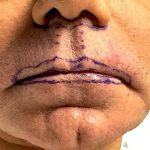
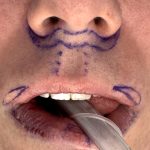
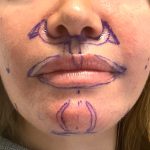
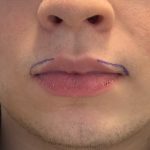
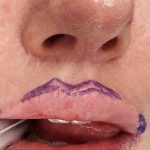
In this atypical cases, it is usually an older woman who has lost much of her upper lip with age (because she had a small one to begin with) or, rarely, a younger patient who simply has very little upper lip and a poorly-defined (flat) cupid’s bow. The surgical procedures of vermilion advancement or subnsasal lip lift are better for these thin lip patients. With the vermilion advancement, a strip of skin along the white roll is removed and the vermilion ‘advanced’ upward and sutured into place. This is a powerful procedure that can make an upper lip fuller….forever. But at the price of a fine line scar along the border of the vermilion and the upper lip skin. The cupid’s bow can be highlighted and better defined with this procedure as well. For those patients who cannot accept an upper lip scar and, only want the cupid’s bow area enhanced, then the subnasal lip lift is an option. Skin is cutout along the base of the nose and the entire middle-third of the upper lip is lifted as it is sewn into place. It is important to remember that the subnasal lip lift will do nothing for the sides of the upper lip which lie beyond the nostrils which is the tail of the cutout. This results in a more lip scar in a better location but the effect is not as great as the vermilion advancement procedure.
In eitehr case, It is extremely important to use these procedures as a ‘last measure’ for a thin lip problem. I always have the patient go through a trial of lip injecions first, even if I think it will not work well. They may very well make the patient happy….and that is the ultimate goal. If not, then they have qualified themselves to be willing to make the trade-off of a lip scar for a significant change in their lip appearance.
Lastly, remember the vermilion advancement procedure can be used on the lower lip as well. When both lips are done together, the effect can be quite dramatic.
Dr Barry Eppley
http://www.eppleyplasticsurgery.com
Clarian North Medical Center, Carmel, Indiana
Clarian West Medical Center, Avon, Indiana
Indianapolis