Archive for the 'rhinoplasty' Category
Cartilage grafting in rhinoplasty today is often an essential component of the procedure. Improving structural support of the nasal tip and internal nasal valves may require mechanical support through the use of cartilage grafts. In some patients, particularly revisional rhinoplasty patients, cartilage donor sites may have been previously used and the patient is now ‘graft-depleted’. In reality, graft depletion is usually relegated to the septum as ear and rib cartilage donor sites are always available but the plastic surgeon or patient may want to have a seconday donor site harvest.
A most recent article in Plastic and Reconstructive Surgery by British plastic surgeons James and Kelly writes on their successful use of polydioxanone foil in rhinoplasty surgery. Polydioxanone is one of the many biodegradable polymers that exists and has been used for many years in orbital floor fracture repair. It maintains its integrity for about 6 months and is flexible and adaptable. It comes in various thicknesses, usually .25 or .5mm is used. They performed 58 rhinoplasties in which it was implanted. (37 primary, 21 secondary rhinoplasty) It was used primarily as a columellar strut. Two complications with its use was seen (3%), one infection and the other exposure. Both resolved by non-surgical management.
This artilce brings to my mind my historic use with LactoSorb in some select rhinoplasties. LactoSorb is a well-known biodegradable polymer with a fifteen-year history of extensive use in craniomaxillofacial surgery primarily as resorbable plates and screws. I have used it in the past in rhinoplasty as well for septal support, columellar struts and spreader grafts in cleft and trauma patients. If one is careful to have good soft tissue coverage, the complication rate will be very low and one can avoid the need for cartilage harvesting. Since I am very comfortable with cartilage harvesting from all donor sites, I have not really used it in the purely aesthetic rhinoplasty patient. But this article has given me the impetus to press forward with its use more in aesthetic rhinoplasty. It would be particularly helpful as a spreader graft and columellar strut, both areas where one should almost always get cartilage and good soft tissue coverage. While complications rates for any material will never be as low as autogenous cartilage (which is essentially zero), an acceptabel rate of 1 - 3% may be a good trade-off for potential donor site concerns.
Dr. Barry Eppley
http://www.eppleyplasticsurgery.com
http://www.ologyspa.com
Clarian North Medical Center, Carmel, Indiana
Clarian West Medical Center, Avon, Indiana
Indianapolis
I frequently see patients who desire greater facial definition. Usually these are younger men and women and much of their desire comes from having a fuller or fatter type face. Most of the time they have lost some weight but can’t lose it in the face. Others have never had a weight problem but want to have a more ‘chiseled’ facial appearance….this type of patient is almost exclusively a younger male patient. Regardless of their age, sex, and weight background, their objectives is to make their face appear less full with better accentuated facial features.
When looking at such patients, it is important to realize that their are only six facial landmarks which can be surgically altered to achieve these goals. They are (from top to bottom): cheeks, subcheeks (submalar), nose, chin, jaw angles, and neck. Four of these are more hard tissue (bone and hard tissue) and two of them are soft tissue or fat only. In the heavy or once heavy patient, the foundation of treatment is usually neck liposuction and buccal lipectomies. Reducing full areas by fat removal is always the first step and, for many, may be all that is really needed.They may benefit from cheek or chin augmentation as well and a good pre-surgical digital computer analysis and predictions will make this clear. A chin augmentation through an implant with fat removals in the cheek and neck is not an uncommon combination that can be highly successful.
In the ‘non-heavy’ or non-weight loss facial patient, fat removals may not be necessay at all. If needed, it is only in the buccal (cheek) areas only. This type of facial definition patient requires bony enhancement mainly. This may be chin, cheeks, or jaw angle implants and a computer analysis can tell which combination may be best. The order of facial implantation is chin implants are done the most, jaw angle implants next, and cheek implants the least. For the young male patient that is looking for what I call the ‘male model’ look, all three facial implants may be necessary.
I would be remiss in this discussion if the concept of rhinoplasty is not brought up as part of the surgical options. A broad, wide, or long nose can also be a source of facial disharmony. Rhinoplasty surgery helps put the nose into better balance with the rest of the face and a well-proptioned nose in some patients can make a dramatic difference. While it is not the most common facial change in facial definition surgery, it must always be considered in diagnosing what makes a patient’s face unbalanced.
Enhancing and redefining facial contours is a combination of fat removals and bony prominence enhancements. While none of these surgeries are difficult and all can be accomplished without facial scars, the most important part lies in the pre-surgical discussion and planning. These patients are highly self-conscious and, as a result, will be extremely critical of their surgical result. Thorough computer imaging and realistic goal-setting is the key in making the facial definition patient satisfied.
Dr. Barry Eppley
http://www.eppleyplasticsurgery.com
http://www.ologyspa.com
Clarian North Medical Center, Carmel, Indiana
Clarian West Medical Center, Avon, Indiana
Indianapolis
By far, the most challenging aspect of rhinoplasty surgery is in the nasal tip. As the nasal tip is probably the greatest variable in appearance amongst individuals and one of the most defining parts of the nose, precision in nasal tip changes during rhinoplasty is of critical importance. Therefore, good access to provide adequate visualization and workability of the nasal tip cartilages is key.
Rhinoplasty, by its history, has been traditionally done through a closed or endonasal delivery technique. By this approach, the nasal tip cartilages are delivered without using a skin incision at the columella. In the ‘right’ nose, I personally prefer this technique as it is simple, produces consistent results, and has a low rate of the need for revisional surgery. It also offers the bonus of less prolonged swelling of the nasal tip after rhinoplasty. Good patients are those that have fairly thin nasal skin, strong stiffer cartilages, and have never had rhinoplasty surgery before. The only problem with the closed approach to rhinoplasty is that it requires more finesse in delivering and suturing the cartilages than an open approach.
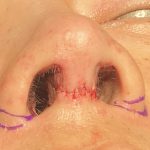
Open structure rhinoplasty, where the entire nasal tip is widely exposed, is done by making a incision across the columella (skin between the nostrils) and lifting the skin off of the nasal tip. With such exposure, manipulation of the nasal tip cartilages is much easier and symmetry between the sides better appreciated. For this reason, open rhinoplasty is the most common way rhinoplasty surgery is done today and, in most surgeon’s hands, produces more reliable results. It certainly is the way to go in revisional rhinoplasty (of the tip area) and in primary rhinoplasty where the patient has thick skin, nasal tip asymmetries, or weak cartilages. The fear over a columellar scar is largely unfounded as they heal nearly imperceptably. The biggest problem with gloving the nasal skin through an open approach is that some patients will have some prolonged swelling of the nasal tip, particularly those with really thick skin.
The debate between open vs. closed rhinoplasty isn’t really a debate anymore. It is more about what type of nose does a patient have and the plastic surgeon’s experience with each rhinoplasty technique.
Dr. Barry Eppley
http://www.eppleyplasticsurgery.com
http://www.ologyspa.com
Clarian North Medical Center, Carmel, Indiana
Clarian West Medical Center, Avon, Indiana
Indianapolis
Ethnicity is very intertwined with rhinoplasty surgery. For this reason, there are different considerations for each major ethnic group. The key to successful ethnic rhinoplasties is to refine the nose but not try and eliminate the beautiful features of one’s ethnicity. It is not a realistic patient goal or a surgical objective to make a nose that is racially incongruous with the rest of the face. The Middle Eastern nose is no different. They have a number of features which can be improved to put the nose in better balance. These often include a nasal hump to some degree, wide nasal bones with a broad bridge, a long nose from which the tip droops downward, and a wide and ill-defined nasal tip. Compounding this appearance and limiting what surgical result can be achieved is a coevrage of overlying thick skin. Understand that I am speaking here about an ‘average’ Middle Eastern nose, I have certainly seen some females that actually have a narrow nose with thinner skin but with a large hump and a plunging tip.
All of these type of noses need to be done through an open approach in my hands. Middle Eastern rhinoplasty is as much about rebuilding as it is about reshaping, with the frequent need to add cartilage for support. An open approach provides the best exposure for this challenge for me. Much work needs to be done in the tip area to narrow and re-rotate the tip upward. Cartilage grafts via columellar strut grafts and tip grafts are usually used to help provide better tip definition and position. Sometimes tip rotation may need to be helped by dividing the lateral crus and allowing the more medial segment to slide over the lateral segment and then stabilizing this overlay method with sutures. This manuever may also help reduce the amount of alar and nostril flare that is present. The think overlying skin prevents any evidence of the cartilage step-off which results. The nostril flare may also be helped with the removal of wedges of skin.
Nasal hump reduction is almost always needed and the goal here is to have a smooth dorsal line, not a scooped-out upper nasal appearance. A high dorsal line is much more congruous with the Middle Eastern face than a low dorsal profile. When manipulating the dorsal line, it is not usually possible to create a noticeable supratip break without cartilage over-resection. But that is still satisfactory as its presence is not an ethnic nasal characteristic.
Middle Eastern rhinoplasty is challenging but if one stays within the boundaries of racial harmony, good results can be consistently achieved.
Dr. Barry Eppley
http://www.eppleyplasticsurgery.com
http://www.ologyspa.com
Clarian North Medical Center, Carmel, Indiana
Clarian West Medical Center, Avon, Indiana
Indianapolis
Infrequently, I will get a request for a ‘non-surgical rhinoplasty’, otherwise known as the use of injectable fillers to plump up certain areas of the nose. Injection of any of the commerically-available fillers such as Restylane, Juvaderm, Radiesse, or Artefill into a low-lying bridge area of the nose can certainly be done. This treatment approach would be for that one nose problem in which the nasal profile is benefited by elevation of a depressed area of the nasal bridge. Such an isolated nose problem is uncommon and, therefore, the indications for the use of injectable fillers into the nose is quite limited. Injectable fillers should never be placed into the nasal tip!
I am usually reticent to do this procedure because of three specific issues. First and foremost, the use of injectable fillers (none of them) is approved for injection into the nose area. Therefore, this practice is off label and is not FDA-approved. Secondly, the effects created by the injectable fillers is temporary. Over time, the cost of injectable fillers will eventually exceed the cost of a rhinoplasty. If one is looking for a quick fix, this approach may be alright but in the long-term, it is a poor value. Thirdly and most importantly, there are other better long-term surgical solutions that are more reliable and can address the nose as a whole, rather than one specific area. The implantation of crushed cartilage (from the septum or ear) or the use of off-the-shelf dermal products offers reliable and permanent correction that will naturally become part of your body. Even if this the nasal bridge is the only area of concern, this approach is a better long-term value that will withstand the test of time and is worth the price of rhinoplasty surgery.
Dr. Barry Eppley
http://www.eppleyplasticsurgery.com
http://www.ologyspa.com
Clarian North Medical Center, Carmel, Indiana
Clarian West Medical Center, Avon, Indiana
Indianapolis
One of the most frequently confusing issues for patients is the cost of rhinoplasty. Rhinoplasty, external nose reshaping, which is frequently a cosmetic procedure (although not always) is often confused with Functional Nasal Airway Surgery whose onjective is to improve breathing and is often covered by medical insurance.
Th confusion comes in as many patients believe that if they have a breathing problem with their nose that they then can get their reshaping rhinoplasty done under insurance reimbursement. This belief is both inaccurate and fraudulent. Medical insurance may pay for functional nasal airway surgery such as septoplasty, turbinate reduction and repair of nasal vestibular stenosis with cartilage grafts. All of these procedures aim to provide a functional improvement by making one breathe through their nose better. None of these procedures will make any significant difference in the outward appearance of your nose As soon as any procedure is done to change the appearance of your nose, such as hump reduction or tip lifting or narrowing, this enters the realm of a cosmetic rhinoplasty which has no impact on breathing improvement. The only time that any external changes to the nose is covered by medical insurance is if the abnormal appearance of the nose is due to a birth defect (such as cleft lip or palate or other craniofacial deformity) or an accident. (if it is due to an accident, this event must be documented with medical records that substantiate the injury…just saying it happened won’t cut it)
One of the frequent motivations for nasal breathing surgery is to have the nose reshaped at the same time. This is perfectly understandable, achieve two goals at the same time and is commonly done. The rub comes in from a money standpoint. Some patients believe, however, that ‘once you are there doing one thing, you can just the other thing…how does insurance know what you are doing?’ Trust me, they do. The hospital/surgery center knows and I know. It is fraudulent to have your medical insurance carrier ‘pay’ for the cosmetic portion of your nose surgery. In today’s world, the hospital or surgery center knows what is going on in any nose procedure and will ask for payment up front. Any responsible plastic surgeon will as well.
Dr Barry Eppley
http://www.eppleyplasticsurgery.com
Clarian North Medical Center, Carmel, Indiana
Clarian West Medical Center, Avon, Indiana
Indianapolis
Rhinoplasty, nose-shaping surgery, is one of the most common plastic surgery procedures of the face. It can have a dramatic effect on one’s facial appearance due to the prominent position of the nose on the face. While rhinoplasty surgery has been performed for over 100 years, modern rhinoplasty techniques create noses that are more natural and can hold their shape over time.
Historically, rhinoplasty surgery was associated with after surgery appearances which were ‘overdone’. This type of reductive rhinoplasty produced noses that were short with up-turned tips(pugnose appearance) and with low bridges. Even if the nose did not appear this way immediately after surgery, this appearance developed months or years later. This nasal appearance was the result of removing too much of the natural structures of the nose. Taking the bridge of the nose down too low (bone and cartilage) or shortening the tip of the nose excessively (all cartilage), while immediately looking good, weakens the support of the nasal framework. Over time, as scar forms and tissues heal and contract, the nose gradually ‘falls’ and assumes an unnatural appearance. It may look too small, too upturned, or too narow and pinched at the tip.
The importance of maintaining as much of the support of the nose is better appreciated today. The nose is like a house, the framework must be maintained to keep the roofline intact. Contemporary rhinoplasty is more of a rearrangement of the framework structures with only small removals of cartilage or bone. In this way, the nasal dorsum (line along the bridge to the tip) remains smooth but at a good height, the end of the nose is lifted but not too high, and and the nasal tip is narrowed but is not made into a single point.
Besides less cartilage and bone removal, the natural rhinoplasty makes use of adding support through cartilage grafts as necessary. Supporting the nasal tip through columellar strut grafts, small hand-carved grafts for better tip definition, spreader cartilage grafts to the middle vault to improve breathing, and adding height at the very top of the nose where it joins the forehead (radix) with small crushed cartilage grafts are some of the ways to help build and strengthen the framework of the nose. These cartilage grafts are usually acquired from the septum of the nose (which may be simultaneously straightened) or from the back of the ear.
Natural rhinoplasty techniques are a combination of preserving critical nasal tissues, skillfully rearranging the different zones of the nose, and the three-dimensional eye to visualize how to get to the final nasal result. It is usually best done through an ‘open approach’ with a resultant indetectable scar across the columella. (strip of skin between the nostrils) Natural noses fit each patient’s face more proportionately and never have that ‘operated’ appearance. While tedious to perform, I find the long-term results rewarding and the need for secondary revisional surgery reduced.
Dr Barry Eppley
http://www.eppleyplasticsurgery.com
http://www.ologyspa.com
Clarian North Medical Center, Carmel, Indiana
Clarian West Medical Center, Avon, Indiana
Indianapolis
I came across an interesting blog from Rodeo Drive Plastic Surgery in Beverly Hills California on Google’s blogspot on rhinoplasty. They had entitled their version of a rhinoplasty as ‘Breathe Easy’. This obviously relates to the concern of some patients (although most patients are not aware of this possibility) that breathing through their nose after a cosmetic rhinoplasty may be worse after such a procedure. It is possible that even if you had not problems breathing through your nose prior to a rhinoplasty, you may have some difficulty breathing through it after.
Such potential breathing difficulty after a rhinoplasty is possible because the inside of your nose may be actually smaller after surgery is some cases. When the nose is reduced in size through either a hump reduction or shortening and/or narrowing a wide and long tip, the internal nasal valve angle (one of the most important structures inside the nose that determines who easy or hard it is for you to breathe) may be narrowed or pinched on with these nose changes. A reduction in the opening of this valve angle can have a dramatic effect on your nose breathing.
Fortunately, most of the time, nose breathing is not affected after rhinoplasty. Certain types of patients are very prone to developing this problem, such as a long and narrow nose or when a very broad nose is narrowed. When these types of patients are identified, some changes can be done during the procedure to try and prevent breathing problems after surgery. Cartilages grafts can be done to open up the internal nasal valve angle as a preventative manuever. This is exactly the type of surgical manuever that is done when the purpose of the operation os to treat a breathing problem in which one of the culprits is collapse of the internal nasal valve angle.
While all potential breathing problems can not be 100% prevented or every patient at risk for breathing problems identified prior to surgery, patients can ‘breathe easier’ knowing that such risks have been reduced wh today’s modern rhinoplasty techniques.
Dr Barry Eppley
http://www.eppleyplasticsurgery.com
http://www.eppleyrhinoplasty.com
Clarian North Medical Center, Carmel, Indiana
Clarian West Medical Center, Avon, Indiana
Indianapolis
One of the greatest fears of many patients who are considering rhinoplasty surgery is that their nose will be packed during surgery, subsequently requiring removal sometime after surgery. That thought is one of significant uncomfortability at best and outright pain at the worst. I have found that many potential rhinoplasty patients often ask….are you going to pack my nose?
The good news is that the need for packing a rhinoplasty surgery patient is very infrequent. If you are having a cosmetic rhinoplasty, where only the external nose is being operated on (hence the concept of a cosmetic rhinoplasty), then there is absolutely no reason to have to pack the nose after surgery. If you having a ‘rhinoplasty’ for breathing purposes only, other wise known as functional nasal airway surgery or septoplasty and/or turbinate surgery, then that possibility exists but it is still in my practice a very low likelihood.
The purpose of nasal packing is only two-fold, to stop bleeding and to help adapt the lining of the nose back in its place against the cartilage or bone so no bleeding occurs underneath it. Whe performing septal straightening, a very important component of airway surgery, you must first lift the lining off of both sides before strsightening it. Once straightened, the lining must be put back in its original place. Historically, packing the nose with gauze squeezed this lining back in place. The use of packing has been replaced by many surgeons with sewing it back into place through a sewing technique known as quilting. This has virtually replaced the need for packing, much to the applause of patients and plastic surgeons alike. Only in cases where there is too much bleeding at the end of surgery will packing be sued to control it, much like the way it is used to stop difficult nose bleeds.
So to those patients considering most forms of rhinoplasty surgery, this is one issue that you need not concern yourself with!
Dr Barry Eppley
http://www.eppleyplasticsurgery.com
http://www.ologyspa.com
Clarian North Medical Center, Carmel, Indiana
Clarian West Medical Center, Avon, Indiana
Indianapolis
Rhinoplasty (nose surgery) is one of the top ten procedures performed around the world in plastic surgery for men and women. Due to the tremendous complexity of nasal anatomy, the many different components of bone and cartilage which overlap and interdigitate, and the potential unpredictable forces of healing and scar contractures, rhinoplasty surgery results are rarely perfect. Like all plastic surgery procedures, it carries with it the risk of undesired aesthetic outcomes and the possible need or desire for revisional surgery in the future.
Historically, high revision rates particularly if one looked at very long-term results existed in rhinoplasty when the closed approach was exclusively used. Due to the now widespread practice of open approaches in rhinoplasty in the past 15 years, I am certain that the need for revisional surgery in rhinoplasty has dropped. With better visualization of nasal anatomy, an improved focus on conservative bone and cartilage removal, and improved suturing techniques with or without the use of cartilage grafts, rhinoplasty outcomes have become more predictable.
However, despite these newer techniques, the potential risk of the need for revisional rhinoplasty is not eliminated. As a general rule, I do not like to undertake revisional rhinoplasty until 6 to 12 months after surgery. While this is much longer than most patients would like to wait, it is important that you are operating on a ’stable target’. Meaning…let all the swelling and changes take place so you know what it really looks like. The initial problems that were seen may have become less of a visible or psychological concern or the problem may actually have gotten more noticeable or more of a concern. Either way, more time allows the decision for revisional rhinoplasty surgery to become self-evident. Unless it is a major problem that a patient simply can’t tolerate, I would prefer to be on the longer side of this issue, closer to one full year after surgery. The skin over the nose is also much softer at this point and the tissues are closer to normal in their handling, although they will never be completely unscarred and always more difficult to handle than the first time.
While the need for secondary rhinoplasty is probably around 10% or less in most plastic surgeon’s experiences, the need for ‘revision of a revision’, otherwise known as tertiary rhinoplasty, is probably much higher than 10%. Fixing a previous problem, particularly if it is not a very minor one, is not easy and esults are more unpredictable than when the rhinoplasty was first done.
Dr. Barry Eppley
http://www.eppleyplasticsurgery.com
Indianapolis