EXPLORE
Plastic Surgery
Dr. Barry Eppley

Explore the worlds of cosmetic
and plastic surgery with Indianapolis
Double Board-Certified Plastic
Surgeon Dr. Barry Eppley

Archive for the ‘scar revision’ Category

Plastic Surgery’s Did You Know? Z-Plasty Scar Revision

Sunday, May 13th, 2012

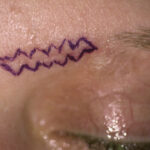
There are many techniques for scar revision in plastic surgery but one of the most well known is that of a Z-plasty. It is a technique for either improving the appearance of a scar (by changing the line of tension) or improving its function by contracture release. (elongating the scar) It is based on the use of two triangular skin flaps cut along a central portion of the scar. Based on the angles that the Z limbs are cut determines how much scar lengthening occurs. It was first described in 1856 and was initially used for scar problems around the eyelids and mouth, for which it is still useful today. While the geometry of a Z-plasty has a lot of appeal, it is an infrequent scar revision technique that is useful only for specific type scars. There are many other scar revision methods that are more widely used.  

Combined Fractional Laser and Topical Steriods Hold Promise For Wide Hypertrophic Scar Improvement

Saturday, January 21st, 2012

Scar therapy consists of a wide variety of possible treatments from injections, lasers and light devices and surgical excision. There is no one type of scar treatment which is uniformly effective for all scars. There are simply too many types of scars and differing skin types and body locations for any uniform approach to improving the appearance of scars.


While scar revision by excision still remains a mainstay for many scar patients that I see, it is not effective for scars that involve large surface areas. Broad hypertrophic scars, particularly from burns and other forms of trauma, pose unique challenges for improvement. While in some cases complete excision and skin grafting may be useful, patients may either not want that approach or want to try non-surgical methods first.


One non-excisional treatment approach, and the only that I find effective for established scars, is that of combined laser resurfacing and topical steroids. When referring to laser resurfacing, I am not talking about a uniform ablative approach but specifically that of fractional CO2 ablation. This ablative CO2 laser creates channels from 400 to 600 microns or more deep into the dermis/scar. Such channels provide many points of entry for topical agents such as steroids. The early introduction of intradermal steroids helps to control the inflammation that the laser causes as well as suppresses collagen synthesis to reduce scar thickness  


This scar treatment approach can be done under either topical or local anesthetic. Usually topical is better because wide hypertrophic scars are typically hard to inject under and get good pain relief. Numerous topical anesthetic creams are available but ones that contain a combination of benzocaine, lidocaine and tetracaine penetrate and work the best. Once adequately anesthetized, the broad scar is treated by the fractional CO2 laser to create intradermal pores. Thereafter, the steroid triamcinolone acetonide suspension (kenalog) is applied over the laser-treated area. Different concentrations of the steroid can be used from prepared concentrates of 10, 20 and 40mg/cc. In some cases, intralesional steroid injections may be given as well if the scar is very thick. The topical steroid suspension is held into place over the scar treated area by a clear adhesive dressing for 24 hours.


Few wide hypertrophic scars respond well to a single treatment and a series of fractional laser resurfacing and topical steroids is needed to get the best result. Typically it requires three or four sessions spaced four to six weeks apart.


This combined laser and steroid treatment is fairly novel but makes biologic sense with its multimodality approach. The synergism of these two treatments  strives to create a flatter scar that is more supple, not necessarily complete scar removal. Breaking down existing scar tissue, without creating a lot more, is the only realistic goal for this type of hypertrophic scar.


Dr. Barry Eppley

Indianapolis, Indiana 


Facial Disfigurements and Their Impact On Job Interviews

Sunday, December 4th, 2011

Plastic surgeons have the opportunity to see a lot of patients with a variety of facial disfigurements. Ranging from traumatic injuries to birth defects to defects caused by a variety of neoplastic pathologies, people so afflicted are understandably concerned about their appearance and want to be as whole as possible. They feel, justified or not, that these facial differences have a negative impact on many different types of social interactions.

New psychological research has now shown that such facial deformities can also result in being rated lower in job interviews compared to those with unaffected faces. A report published on the online Journal of Applied Psychology from two Texas universities looked at how people with facial disfigurements were viewed in job interviews. The research looked at two studies, one using eye-tracking technology that looked at the interviewer’s focus and the other having interviewers evaluate the applicant’s based on face-to-face interviews.

In the first study, nearly 200 participants viewed a computer-mediated interview of applicants who did or did not have facial disfigurements. Using eye-tracking techniques, the amount of time they spent looking at the facial deformity and how they recalled and rated the applicant. Results show that the more time participants spent looking at the facial disfigurement, the less they could recall about the actual details of the applicants interview. This led directly to lower rating for the applicant.

In the second study, nearly 40 managers enrolled in post-graduate business courses interviewed applicants who either did or did not have a facial deformity. Their impression and ratings of the applicants showed that those with facial deformities were less well remembered and received lower ratings as suitable hires.

These studies confirm what many patients with facial deformities feel…that they are viewed as less worthy than if they did not have the facial problem. A more normal face or unaltered face is felt to have a better chance of success in life both socially and vocationally. While this is no surprise and has been shown by many studies before, the current report shows why it happens. The facial deformity directs one’s memory away from the actual content of the interview and more towards what is visually seen.

Interestingly, this study does not factor in how significant the facial deformity has to be to create this discriminatory effect. It would be logical to assume that the greater the facial problem, the more pronounced the effect is. The interviewee’s demeanor and mannerisms may also play a role in creating this effect as they may unconsciously direct attention to their facial problems.

This research illustrates why it is important that people seek improvements through plastic surgery if possible. While no plastic surgery technique can completely normalize most facial deformities, particularly that of scarring, significant improvements are often possible. Scar revision is a typical example where the concept of reduction or improvement exists but complete elimination or removal is almost never possible. Even small amounts of facial improvement, however, may make a big difference in how those afflicted feel and are perceived.

Dr. Barry Eppley

www.eppleyplasticsurgery.com

Indianapolis, Indiana

Prevention Of Dogbite Injuries To The Face In Children

Sunday, May 22nd, 2011

Dogbites are an unfortunate risk to which all children are potentially exposed. Beyond the trauma of the experience, permanent scarring almost always occur which can leave lifelong marks to be seen by all if it occurs on the face. With millions of dog bites occurring per year, plastic surgeons are involved in a lot of repairs particularly when it has occurred on the face. Plastic surgery involvement is so significant that last week was Dogbite Prevention Week sponsored by the American Society of Plastic Surgery.

Having done many hundreds of facial dogbite repairs and secondary reconstruction, there are some very common trends. A disproportionate number occur in children from ages five to nine, the biting dog is rarely an unknown one, and many such injuries turn into legal and insurance issues. The common age of patient injury is a reflection of the naïve and innocent nature of that age and their view that dogs are playful and fun. Most dogbites occur in a family, neighbor or relative’s dog where the familiarity promotes unintentional behaviors that are predisposed to evoke their protective natures. Because many dogbites occur on the owner’s home, insurance battles are certain to ensue that frequently involve lawyers. It is not uncommon for me to see referrals from attorneys to evaluate dogbite scars and get an estimate on the cost of scar revision.

That being said, prevention of dogbite injuries can avoid many of these problems. These are the most significant ways to avoid a dogbite injury to a child. These are based on many of the reasons or circumstances I have heard that were given for what was going on when the injury happened.

1) Don’t play aggressive games with a dog. They may not see it as a game.

2) Don’t mess with a dog while eating or play keep away games with food. They are very protective of food and aggressive about getting it.

3) Do not jump on a sleeping dog or surprise it from behind. Give it plenty of warning that you are around.

4) Do not attempt to kiss a dog, particularly face-to-face. Dogs tend to strike defensively when confronted directly.

5) Do not hug, squeeze, or ‘pin’ a dog in any way. This is likely not to be interpreted as play to them.

6) Keep away from a dog with puppies or do not attempt to take a puppy away or get between a mother and her puppy.

7) Do not attempt to pet a dog, particularly an unfamiliar one, unless you let them sniff you first.

While some dogbites can just not be prevented or occur for no discernible reason, these behaviors which are common in children can unintentionally cause a defensive maneuver by a dog. Defensive maneuvers in dogs are usually a biting response and their nature is to go for the face and neck.

Dr. Barry Eppley

www.eppleyplasticsurgery.com

Indianapolis, Indiana

The Concept and Benefits of Geometric Scar Revision

Wednesday, October 13th, 2010

When topical therapies fail and the scar is unfavorable, resorting to scar revision is necessary. There is a lot to be said about time for scar maturation, but scars that are depressed, raised or excessively wide do not substantially improve as they heal in many cases. Many scars do not need an elaborate revision procedure and often simple linear excision and closure will suffice. This is particularly true for many scars on the trunk and the extremities.

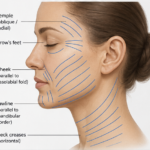
But many facial scars are not improved by simple linear scar revision. The visibility of the face has a lot to do with the need for heightened scar revision outcomes as well as the location of the variable patterns of the relaxed skin lines of the face. For these reasons, better scar camouflage can be obtained through what is known as geometric, or non-linear, scar rearrangement. (GSR) A variety of GSR methods are known and they carry names that start with a letter followed by –plasty. Whether it be the classic Z-plasty or W-plasty or other combinations of the alphabet, the concept is to convert a straight line scar to a non-linear or irregular one.

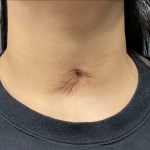
The Z-plasty is a well known scar revision method that is easy to visualize. With a Z pattern in the middle of the scar, it is easy for patients to understand. The beauty of the Z-plasty is that it not only makes the scar irregular but also makes it longer. This is of great value in scars that have created skin tethers or contractures as they cross moving surfaces and concavities. Examples would be vertical scars of the upper eyelid, the inner area of the eye near the nose, the nostril rim, and the armpit. This lengthening benefit is also useful for contracted scars along the upper lip philtrum and the corner of the mouth. Scars around an orifice can also be helped with z-plasties including the oval nostril, a tracheostomy stoma scar, or those scars around or in the umbilicus.

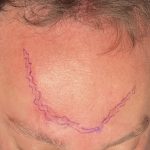
The W-plasty scar revision turns the whole scar into an irregular ‘pinking shear’ pattern. Instead of a one or two areas with a Z pattern in a scar, the W-plasty turns the entire scar into a continuous zigzag pattern. The scar essentially becomes a series of alternating triangles. The theory is that an irregular line is harder for the eye to follow than a straight line. This is of great value in facial scars of the cheek, side of the face, or forehead in which there is no discrete skin fold or wrinkle in which to ‘hide’ the scar. While this does break up a linear scar, it also creates a regular pattern which may work against the concept of decreased visibility by making a regular pattern for the eye to follow, even if it is irregular.

For this reason, w-plasties are rarely done alone or throughout the entire scar. They are usually combined other patterns in what is a more sophisticated scar revision method known as geometric broken line closure. (GBLC) This method employs the W-plasty but with the addition of other shapes besides just triangular flaps of the W-plasty. The different shapes may be Ms or other shapes interspersed between the Ws. This makes the closure irregularly irregular and offers the best potential for maximal scar camouflage.The resulting scar is “irregularly irregular,” with the maximum potential for camouflage. This scar closure pattern, combined with sanding or dermabrasion later (no sooner than 2 to 3 months after), is the best bet for many scars that are in difficult or unfavorable facial locations.

Dr. Barry Eppley

www.eppleyplasticsurgery.com

Indianapolis, Indiana

What Is Your Scar Type - Making The Correct Scar Diagnosis

Sunday, August 8th, 2010

Any interruption of the skin, whether from a fall on the ground, an accident on the job, or from the surgeon’s knife, prompts the complicated and not yet fully understood process of healing, the end result of which is a scar. However, the word “scar” often invokes the image of an unwanted deviation of the healing process, that which is a physical derangement from the smooth and non-discolored appearance of skin that it replaces.

As do the injuries from which they result, the appearance of scars can vary tremendously. Differing scar appearances are because the scars are different from each other. Different scar types are treated differently! Like all of medicine, successful treatment is based on establishing the diagnosis first. The wrong treatment method on a scar results in not only no beneficial effect but a waste of your time and money.

Hypertrophic scars appear as raised, wide, firm, and red to purple-colored scars that

remain within the physical boundaries of the original skin injury. They are more likely to

occur in wounds that cross natural lines of skin tension or an original open wound that

healed on its own. These can cause some itching and discomfort to the touch but may

improve with time.

Keloids are also raised, reddish-purple, nodular scars that are usually firmer than

hypertrophic scars. Keloids are the result of uncontrolled scar healing that the body does

not stop once the wound is healed. The difference between keloids and hypertrophic scars

is that keloids extend beyond the boundaries of the original injury site, encroaching upon

surrounding uninvolved healthy tissue. Keloids can result from seemingly innocuous

activities such as ear piercing and tattoos and unlike hypertrophic scars, keloids do not

regress over time. While keloids can occur in all skin types, they are generally more

common in darker skin.

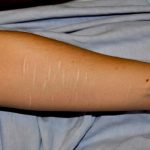
Stretch Marks are linear bands of wrinkled skin that most frequently result from rapid

weight loss or weight gain, for example following pregnancy, and tend to appear in areas

like the abdomen, breasts, thighs, and hips. Initially, they tend to be red or purple, but

often fade to white over time. They are essentially ‘partial tears’ on the underside of the

kin from overextension.

Depressed Scars (atrophy) are due to the irreversible damage of the skin from the injury

where the amount of scar formed is less thick than that of the surrounding normal skin.

The level of the scar (thickness) is less than that of the surrounding skin. They can occur

from a multitude of inciting events such as acne lesions, burns, or skin avulsive injuries

from trauma. Trying to apply makeup to conceal depressed scars actually worsens their

appearance as makeup enhances the textural variations.

Acne scars are a variety of depressed scars that have occurred due to loss of skin

thickness from the body’s inflammatory response to a plugged sebaceous follicle. The

inflammatory reaction (infection) results in thinning of the skin even though scar tissue

has formed. Acne scars appear in a variety of shapes, which are important to distinguish,

as they are often treated differently.

Icepick scars are usually narrow, sharply demarcated tracts that are wider at the

surface and taper as they extend through the skin.

Rolling scars are more superficial, wider, and produce an uneven appearance in

The skin.

Boxcar scars are round- to oval-shaped skin dimples with sharp margins and are

wider than icepick scars. Most tend to have diameters from 2.0 - 4.0 mm.

Burn Scars are unique in that they have a very thin and atrophic underlying dermis. They

are quite stiff and inflexible and do not heal well when cut and sutured. The fat layer

underneath them is frequently gone or thinned due to the initial heat of the original injury.

The burn scar can appear smooth and almost ‘glass-like’.

Scar diagnosis is critical to selecting the proper scar revision approach. These simple

descriptions may help one better describe and identify their scar problem.

Dr. Barry Eppley

www.eppleyplasticsurgery.com

Indianapolis, Indiana

Case Study: Surgical Revision of Extensive Facial Scars

Wednesday, June 9th, 2010

Background:  Scars are a common patient concern, whether they be slight or significantly disfiguring. While scar treatments and therapies abound, significant scarring requires some form of surgical scar revision. Lacerations and traumatic wounds are particularly prone to hypertrophic scar formation, the most common type of raised and disfiguring scars. While less commonly seen on the face, hypertrophic scars can develop under two healing situations. One is when a laceration crosses a facial transition zone, such as the jaw line. The other is when an open facial wound is allowed to or can only heal by secondary intention. Abrasions, burns and other partial thickness wounds are particularly prone to abnormal scar formation

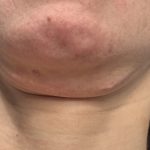
This is a 22 year-old female who was originally involved in a motor vehicle accident in which she was thrown from the car. She sustained multiple long facial lacerations including a deep abrasion from the left side of her face down into the neck. Her original care was unclear although she may have received suturing of some of her facial wounds. She went on to heal and came in for scar revision 18 months after the accident. Besides the numerous persistent red and prominent scars, she had a large scar contracture across the left jaw line. It was painful and tight and limited her from turning her head to the right.

She underwent revision of all of her scars in a single operation. Some basic plastic surgery scar principles were used. Scar revision of most facial scars is best done by changing the line or orientation of the scars. While you can’t change the direction of scars, you can make them more narrow and not a perfectly straight line. This is the principle of the running w-plasty, it changes a straight line into more of a pinking shears pattern. This is useful if the scar runs obliquely or perpendicular to the natural lines of skin tension. This is known as geometric scar rearrangement. Z-plasties are done when the scar is contracted and needs lengthening. This is of particular need in many scars that cross the jaw line, a transition zone between the face and the neck which differs in both skin thickness and exposure to stretching.

Over 500 skin sutures were placed in doing these comprehensive facial scar revisions. They were removed one week later and replaced with topical glue to allow further healing. She was lost to follow-up  but reappeared nearly two years later. Her scars had adequately faded and the final results of the initial scar efforts could be seen. While I thought some further scar improvements could be obtained, she declined any further scar work.

Case Highlights:

1)      Traumatic facial lacerations and wounds are prone to develop hypertrophic scars. Such scars can only be improved by surgical treatment.


 2)      The use of a combination of straight line closure and geometric rearrangement for facial scar revision is used based on scar orientation to the relaxed skin tension lines.

3)      Most facial scar revisions will require some form of touch-up which can include laser resurfacing and/or treatment of persistent redness. Such considerations should wait at least six months after the initial scar revision.


Dr. Barry Eppley

http://www.eppleyplasticsurgery.com

http://www.ologyspa.com

Indianapolis

Scar Revision of Hair Transplant Donor Scars

Monday, April 19th, 2010

Most grafts for hair restoration come from the back of the head or the occipital region. This is most commonly done with a horizontally-oriented excision, resulting in a straight-line closure from one side of the occiput to the other. Most hair transplant donor scars have a width of just a few millimeters, but wide donor scars do occur in a few patients leaving a new visible bald area that can be easily seen from behind.

Wide occipital scalp scars can be difficult to treat. They are the result of either too wide of a donor strip removed, poor laxity of the donor site due to prior harvest(s), or poor skin closure techniques.  Widened scars can be improved in only two ways. They can be re-excised and closed to make the scar more narrow or the scar itself can under hair transplants to make it less visible.


Scar excision should be the first approach (provided that it hasn’t already been tried) but the method of skin closure needs to be different. The key lies in the manipulation of the deeper tissues. Adequate superior underlining needs to be done in the subgaleal plane as the upper scalp area is the most likely to be adequately mobilized. Once adequate scalp is loosened, tension needs to be reduced on the upcoming skin closure through galeal or fascial closure. The tension needs to be placed in this deeper layer, not on the skin. In some cases, the galea needs to have relaxing incisions in it for adequate movement. The goal is to get the scalp hair-bearing skin edges to lie loosely together. If the skin has to be pulled together tightly to get it closed, there is a good change the scar will re-widen significantly.


Once good mobilization and galeal closure is done, the skin can be either put together as a straight line again or changes to an interdigitating w-plasty pattern. That is a matter of intraoperative judgment. Geometric skin closures can not only help reduce skin tension but they change an easily followed straight line into a less obvious scar pattern.


The skin closure can also be done using a classic trichophytic technique. This is a common plastic surgery method that has long been used in facial procedures done near the hairline such as facelifts and browlifts. A small piece of one wound edge, as well as the corresponding hair, is removed. (but not the hair follicles) When the wound heals, the buried and partially cut hair shafts will end up growing through the scar. This will take several months to see the new hair growing up through the scar.


Hair transplants are an ironic approach to improvement of the wide donor scar, but it can be effective. The question is where can the hair grafts be satisfactorily harvested? A large number are not needed, usually 25 to 50. Some have advocated other scalp donor areas around the scar and a few use chest hair through a 1mm punch method. Transplants, in my opinion, should be reserved only as a last-ditch method as scar revision will usually suffice for adequate improvement.

Dr. Barry Eppley

http://www.eppleyplasticsurgery.com

http://www.ologyspa.com

Indianapolis, Indiana


Common Questions about Scar Revision

Monday, January 18th, 2010

1.      I recently had a car accident and have a very ugly scar on my forehead. Will scar revision help me? The revision of scars  is rarely done prior to 6 months following an injury. This is simply because  it is too early to intervene as the tissues have not sufficiently softened to handle being surgically manipulated. Another reason is that scar revision prior to nine to twelve months following your injury can also be too early is because scars change in appearance over time.. A scar that initially looked terrible can almost completely fade as it matures and settles down.

In some scars that appear to be healing poorly (wide, irregular, misaligned skin edges), scar revision before six months may be done. It is the progress of a scar over time that determines whether early or delayed scar revision may be beneficial.

Today’s plastic surgery techniques also allow for scar manipulation to be done as it progressively heals. It is wise, therefore, to see a plastic surgeon and have your scra followed as it heals. Certain methods may help a scar heal better along the way. For example, if the scar thickens, it can be treated with injectable steroids to reduce any unwanted hardness or fullness. If the scar stays red for too long, it can be treated with pulsed light therapy to lessen the undesirable redness. If the scar becomes darker due to  sun exposure or your natural darker skin color,topical bleaching products may help the darker color fade.


  1. Does Cocoa Butter or Vitamin E really work to improve scars? There is no doubt that these two topical creams or oils have a historic belief that they are helpful for scar reduction. I have seen many patients over the years in my Indianapolis plastic surgery practice that have recounted stories of their relatives or even themselves that have seen the benefits of using them on scars and stretch marks.


Despite these long-held beliefs, scientific studies have shown that they are largely urban myths. While good scientific studies in scar revision are largely  lacking, a few scientific studies that have been done have shown that these treatments provide no improvement at all in an incision or scar. In fact, Vitamin E oil has been shown that it may actually slow wound healing. (this doesn’t mean that it makes scars worse, just that it does not make them better) Therefore, the use of these topical creams is mainly psychotherapeutic, not clinically effective.

3.      What causes scarring and why is it noticeable? A scar is the result of the natural process of wound healing. The body does not always heal a wound with exactly the tissue that was cut or lost. Rather it mends and replaces injured tissue with on-specific collagen tissue to bind it back together. Whether the amount of scar tissue that is formed is a little or a lot depends on a lot of factors, such as the size of wound, how close the skin edges where as it heals, and the mechanism of injury. (e.g., incision, burn etc.) How much and what type of scar tissue that forms will have a significant impact on how much the scar is seen.

There are other factors, beyond how the wound has healed, that also influences how a scar looks. A scar can be noticeable because it is a straight line that your eye can easily follow. Another reason a scar is visible is that the scar is darker or lighter than the surrounding skin color. Dark color may fade over time. A white scar, however, will not change color and is a permanent visible contrast to your surrounding pigmented skin. A scar may be visible because it is at a different level to that of the surrounding, It may be raised or indented, causing a visible contour deformity. Lastly, a scar may be adhered (scarred to) a nearby structure which causes it to move abnormally or be tethered as it tries to move. This causes visible distortion of both the scar and the normal structure during movement.

4.      How can scar revision surgery make it look better? Scar revision is a surgical approach to scar improvement. Fundamentally, it is about cutting out the scar and putting it back together. How it is put back together is different based on the type of scar and its location on the body.

Straight Line Repair. For some scars, it is as simple as cutting it out and putting it back together in the line or orientation that it lays. This can be very effective for scars that already lie along the relaxed skin tension lines of their locations. Some scars are simply too wide or depressed and need to be made thinner and more even with the surrounding skin. This is often how scars on the body (below the neck) are done.

Geometric Broken Line Repair.  (GBLR) The concept of GBLR is to cut out a scar and put it back together in an irregular pattern, not a straight line. By doing so, it makes it harder for the eye  to follow the scar line thus making it less noticeable. Using precise and randomly alternating squares, rectangles, triangles, and trapezoids that measure between 3 to 5 mm and that interlock with one another, the scar is transformed from a straight line into a very difficult to follow  zig-zag appearance. In some cases, a superficial skin resurfacing treatment (laser or mechanical dermabrasion) is done several months later.

Z-plasty Repair  A z-plasty involves changing the scar from a straight line into a z-pattern. This accomplishes several scar benefits. It redirects the forces of tension and also lengthens a contracted or shortened scar. By irregularizing a straight line, it also serves to make it more difficult to see the scar and thereby camouflage it.

W-plasty Repair. The w-plasty serves to irregularize a straight line and creates a ‘pinking shears’ effect. It breaks up the entire straight line of a scar.


5.      Is there any way to make scars look better without cutting them out? For scars that have some minor contour deformities, ‘sanding’ is one approach. This can be done using mechanical dermabrasion or laser resurfacing. For scars that have some minor amounts of depression or indentation, injectable fillers can be used to raise the scar. Unfortunately, no currently available filler is permanent.


6.      What is the difference between a keloid and a hypertrophic scar? These two types of scars are commonly confused. I have seen lots of scar patients who thought they had a keloid when they did not. A keloid is a scar that grows beyond the boundaries of the original margins of the scar. A hypertrophic scar, on the other hand, is a very thick or widened scar but it stays within the edges of the scar.

 As a general rule, keloids rarely form on the face. The face is defined as the area in front of the ears and not involving the scalp and the neck. The areas where keloids are often distributed include the earlobes after ear piercing, the neck after shaving, and the back of the head after hair trimming and most often are found in African-Americans or darker complected races. Keloids manifest and may continue to grow after a very minor insult like an ingrown hair or after shaving. Hypertrophic scars usually arise from a real injury of some kind and tend not to continue to grow.

This distinction is very important as the treatment for these two scar types can be quite different. Keloids are well known to be difficult to treat and often require multiple treatments and surgeries for improvement.


Dr. Barry Eppley

http://www.eppleyplasticsurgery.com

http://www.ologyspa.com

Clarian North Medical Center, Carmel, Indiana

Clarian West Medical Center, Avon, Indiana

Indianapolis

Combination Laser Treatments for Difficult Burn and Acne Scar Problems

Saturday, November 7th, 2009

On the Today Show yesterday, many may have seen the burned triplets who had their scars treated with a ’new’ laser technique. This is a very interesting story from both the perspectives of the girls themselves as well as the form of laser scar treatments that had been done on them. 


The Berns triplets were just 17 months old when they were trapped in a house fire in Texas that took the life of their mother. With burns that covered up to 30% of their body, they underwent a long initial hospitalization with multiple burn debridements and skin grafts. Fortunately they recovered and healed and have gone on to have a relatively normal life. Like most children with disfigurements, they were not overly focused on their scars until they passed puberty and were in high school. As is unfortunately common, others then pointed out their scars and they began to suffer the ridicule that such differences can bring.


Like all burn victims, the scars that result fall into two categories. Hypertrophic scars, which are thick and raised scars, from burned skin which has healed but did not necessarily need skin grafting. And scarring from areas that had been skin grafted, which looks like pebbly thickened skin, which creates a very uneven skin texture. Either way, the healing of burned skin (unless it is a very superficial burn) does not result in skin that looks or feels remotely normal. To the surprise of many, skin grafting in general and in burns in particular (due to the need to mesh it to allow it to expand to get more surface coverage out of it) does not make for a normal appearance. The primary goal of skin grafting is to get a healed wound…which they do well. The secondary goals of a normal appearance and function…they do rather poorly.


These triplets, like many thousands of burn victims, have to live with these burn scars forever. Over the years, numerous non-surgical methods to improve burn scars have been tried, including laser resurfacing. Significant improvements in their appearance have yet to be consistently obtained.


The triplets were showcased on TV because they were treated with a variation of fractional laser resurfacing. While touted as a medical miracle and a new laser innovation, this is a significant overstatement. Fractional laser resurfacing as well as more traditional out surface laser skin removal is not new. The fractional or fractionated laser approach to skin treatments has been around for several years now. It is based on the concept of punching holes into and through the skin over just a portion or fraction of the treated area. By going deeper into the skin, its deeper layers or dermis is stimulated to heal by creating more collagen. This is in contrast to superficial laser resurfacing where 100% of the skin that is treated undergoes more superficial layer removal.


The one innovation, from a laser design standpoint, that these triplet scar treatments represent is that the manufacturer has combined both types of laser treatments into a single laser device and treatment. But their combined use is certainly not new. I have used this combination superficial and partial deeper approach in my Indianapolis plastic surgery practice now since early this year. I am certain that the recognition of the skin benefits to treating both depths simultaneously is recognized by many other plastic surgeons as well. My current approach is to use a needle roller of up to 2mms to get the ‘aeration’ of the scarred area and then do a more superficial (up to 50 micron) total laser resurfacing of the scarred area. Whether fractionating the skin (cutting these deeper holes) with a hot method (laser) or cold method (needle) is better, or any different, is as of yet unknown.


By attacking both the deeper and superficial levels of difficult scars, the scope of the scar problem is more thoroughly treated. In my opinion, this is clearly a better biologic approach than anything that has been done before. This approach in my experience is particularly helpful for refractory scar problems such as acne and burn scars. Two points should be emphasized however. First, we are talking about improvement in the scar appearance, not complete elimination. Secondly, multiple sessions or a series of laser treatments are required to obtain a significant level of improvement in the appearance of these scars.

I think these dual laser treatment approach offers an improvement over traditional scar treatment methods. But I would stop short of calling it a medical miracle.  


Dr. Barry Eppley

http://www.eppleyplasticsurgery.com

http://www.ologyspa.com

Clarian North Medical Center, Carmel, Indiana

Clarian West Medical Center, Avon, Indiana

Indianapolis


Dr. Barry EppleyDr. Barry Eppley

Dr. Barry Eppley is an extensively trained plastic and cosmetic surgeon with more than 20 years of surgical experience. He is both a licensed physician and dentist as well as double board-certified in both Plastic and Reconstructive Surgery and Oral and Maxillofacial Surgery. This training allows him to perform the most complex surgical procedures from cosmetic changes to the face and body to craniofacial surgery. Dr. Eppley has made extensive contributions to plastic surgery starting with the development of several advanced surgical techniques. He is a revered author, lecturer and educator in the field of plastic and cosmetic surgery.

Read More


Free Plastic Surgery Consultation

*required fields


Pricing

The cost of any type of elective plastic surgery plays a major role in the decision to undergo the procedure(s).

More Info


Military Discount

We offer discounts on plastic surgery to our United States Armed Forces.

More Info


Categories