Archive for the 'tummy tuck' Category
Case Study: Tummy Tuck Surgery and the Potential Need for Revision
Author: barryeppleyBackground: A tummy tuck, or abdominoplasty, is one of the best and most reliable body contouring procedures. For many women after childbirth or for men and women after extreme weight loss, a classic tummy tuck procedure can make a world of difference. But unlike the many marketing ads and images, the sheer size of the procedure and the tissues removed does not give everyone a perfect waistline or result. For some patients after surgery, and for all patients considering it, the reality is that revisional surgery or touch-ups may be desired or needed.
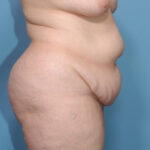
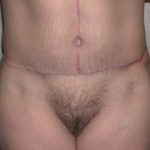
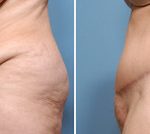
This 48 year-old female was tired of her full and hanging belly. While she was not a diet or exercising fiend, she felt that she was never going to get rid of this problem. As a result, she inquired about a tummy tuck or abdominoplasty. With the amount of skin and fat that she had, and that it hung down over her pubic region, a full or complete tummy tuck was the best option. She was ore than willing to accept a long horizontal scar as a trade-off. (as well as a scar around her new belly button)
She underwent the full abdominoplasty procedure with successful results, giving her a tighter and more narrow waistline. Over two years after the procedure, she inquired about making some minor improvements to the result. Specifically, she wanted the fullness of the pubic region reduced. A protruding pubic area after a tummy tuck is quite common. This is because the tightness of the scar around the waistline above the pubis makes its fullness stand out. While it was always that full, it only became apparent when it was lifted and juxtaposed against a tighter waistline scar. Also, the central tummy tuck scar remained wider and more red than the rest of the scar. This is commonly seen as the middle of the scar was originally exposed to more tension during the tummy tuck closure than the sides of the wound.
One other common tummy tuck sequelae is that the pubic hairline will be right up against the tummy tuck scar. This is unavoidable and will exist in all tummy tuck procedures. The only way to make a hair-free zone between the scar and the pubic hairline is to undergo laser hair treatments.
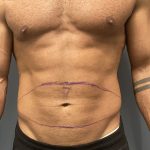
She underwent a simple revisional procedure consisting of pubic liposuction and central scar excision to optimize her result. The marks in the presurgical photo for her revision show the area of horizontal scar excision and the oblique markings for the area of pubic liposuction.
Case Highlights:
- Tummy tuck surgery can make a dramatic difference in one’s waistline shape and frontal trunk contour. But it can not solve every minor detail of the abdominal problem and there are almost always residual minor issues of scar and tissue redundancies.
- Revision of tummy tucks are not rare and can be done as early as three to six months after the original surgery depending upon the type of concern.
- Scar revision (scar narrowing), excision of dog ears at the sides of the tummy tuck scar, belly button adjustment, and pubic and abdominal liposuction are secondary tummy tuck options for obtaining an optimal result.
Dr. Barry Eppley
http://www.eppleyplasticsurgery.com
http://www.ologyspa.com
Indianapolis, Indiana
Background: A tummy tuck, or abdominoplasty, is one of the great plastic surgery body contouring procedures. It can do for many patients what no diet and exercise program can…get rid of loose skin and fat along the waistline. While there is always the trade-off of a scar (and a significant recovery), the results usually justify those significant trade-offs.
Like most every other plastic surgery procedure, a tummy tuck can be done multiple ways. The amount of loose skin and fat removed can be adjusted through either a more limited resection of tissues (limited or mini-tummy tuck) and a more complete or full tummy tuck. What differentiates these two variations is the amount or length of horizontal scar that is needed to complete the tissue resection. Mini-tummy tucks remove tissues below the belly button and result in a shorter horizontal scar and no scar around the belly button. A full tummy tuck includes a resection of abdominal tissues that extends to just above the belly button, ultimately resulting in a longer low horizontal scar and a scar around the new belly button.
This 32 year-old female, who is serving in the military, wanted improvement in her abdominal region. After the delivery of her twins a year ago, she has been unable to get her tummy back in any reasonable shape. She had a very large amount of abdominal muscle looseness (laxity) which accounted for a significant amount of her tummy protrusion. She also had loose skin with an extreme number of stretch marks around her belly button and throughout her entire lower abdomen.
In discussing her tummy tuck options, she was what I call in my Indianapolis plastic surgery practice a ‘tweaner’. This means she could have either a smaller or a larger procedure, in this case being either a mini- vs. a full tummy tuck. She had enough loose skin and stretch marks to justify a full tummy tuck to get all of them out. But by doing so, she would have a scar that went past her hips. With a mini-tummy tuck, her scar would be less but a significant portion of her stretch marks would remain. With her tummy tuck option, her abdominal muscles would be sutured back together. Which one is best for her? As you can see, her approach will make a big improvement but each one has trade-offs.
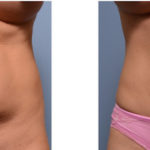
Because she did not want a longer scar, she was willing to accept much of stretch marks to remain. She opted for the mini-tummy tuck which included liposuction through the entire abdomen and into the flank (back) areas. She had a drain for a week and wore a binder for two weeks. She returned to her service duties in three weeks and exercise four weeks after surgery.
1) The decision between the two tummy tuck options in the ‘tweaner patient’ is a
balance between much scar one can tolerate vs the amount of improvement that
one expects.
2) Scars are always a consideration in a tummy tuck procedure. Once they are
placed, there is no way to remove them. A long tummy tuck scar is not a
choice if it would bother someone as much as the original abdominal problem.
3) While the scar may be different between a mini- vs. a full tummy tuck, the
recovery is not much different. The concern about recovery should be the least
consideration when making a decision between the tummy tuck options.
Dr. Barry Eppley
http://www.eppleyplasticsurgery.com
Indianapolis, Indiana
The Use of Drains in Seroma Prevention in Body Contouring Plastic Surgery
Author: barryeppley
The use of drains is a routinue part of many procedures in plastic surgery. From procedures such as facelifts, breast reductions and tummy tucks, drains play an important role in the prevention of postoperative complications. While patients have to tolerate a tube(s) sticking out of their body and go through the process of emptying and recording its output, they happily await the day when it can finally be removed. The removal of a surgical drain often signals the end of the first phase of recovery.
The importance of a surgical drain is just as important after it has been removed than when it was in. This is particularly true in most body contouring operations, particularly tummy tucks, abdominal panniculectomies and circumferential body lifts. But most patients understandably don’t appreciate the biology of their use and this often leads to the one complication that are used to prevent…seroma or fluid accumulation.
When large open cavities are left behind and underneath a closed incision, this unhealed space will fill with fluid. This fluid is largely a lymphatic leak with some intial blood that is leaking from the raw surfaces of the cut tissues. The larger the unhealed space (such as a tummy tuck), the greater in amount and longer in time this fluid will leak into this space. This collection of fluid prevents the raw surfaces of the cavity tissues from healing together and also serves as a perfect culture medium for bacterial growth.
Drains pull off this fluid, accomplishing a reduction in the fluid interface between the raw surfaces. Like the edges of a surgical incision, keeping the raw surfaces of the cavity close together helps them heal to each other. Once this happens the cavity is obliterated and no more fluid will accumulate since the space is gone The time it takes for wound edges to heal often coincides with the slowing down of the fluid leak from the tissues as the cut ends of the lymphatic vessels seal themselves off.
While ideally a surgical drain should stay in as long as the lymphatic leak is occurring, it is impossible to know precisely when the fluid leak is over. The longer drains stay in the better but there does come a point of patient tolerance and often drains become loose. Sometimes they fall or get pulled out and often become sore and painful where they exit through the skin. In tummy tucks, for example, this point is often reached around 10 days or so.
When drains come out, however, the fluid leak may still not be over. While the body can absorb a certain amount of fluid in a cavity, too much fluid leak will create a collection known as a seroma. Once the drains are out, the patient can do two things that can help prevent this problem. The wearing of a circumferential compression binder helps push the sides of the cavity together to help encourage sticking and healing together. Keeping one’s activities limited (no exercise or extensive walking) also decreases fluid leak. More activity acts as a pressure pump, releasing more fluid into the surgical area. Just because a surgical drain is out is not a license to become more active. One should limit their activity for at least two weeks after a drain is out to prevent the likelihood of a seroma build-up.
While seromas can be treated by tapping (needle aspiration in the office), prevention is always better. In my Indianapolis plastic surgery experience, about 30% of tummy tucks for example will develop a seroma that needs to be treated. Limiting one’s activity after drain removal and wearing a binder can help keep one in the more favorable majority.
Dr. Barry Eppley
http://www.eppleyplasticsurgery.com
Indianapolis, Indiana
1. How can one minimize the risk of complications associated with a tummy tuck?
The most common complication after any form of a tummy tuck is a fluid build-up or a seroma. Most tummy tucks use drains for a period of time after surgery. While newer techniques are being developed that can either decrease the time a drain is in or perhaps eliminate it completely, most plastic surgeons still use drains. The risk of a seroma build-up occurs after the drain is removed. This occurs because the body is still weeping fluid inside from the unhealed raw surfaces and it is too much to be absorbed. Such fluid build-up is ‘promoted’ by too much activity in the first few weeks after the drain is removed. Not getting too active too early and wearing your circumferential binder (which helps push the underside of the skin flap which heals it to heal back together)as much as possible are two things a patient can do to help prevent the development of a seroma.
The other more significant complication is healing problems of the incision which could be as extensive as skin necrosis and opening of portions of the healing incision. This is a real risk in patients who smoke. Even smoking just a ‘cigarette or two a day’ can cause this problem. It is extremely important to stop smoking three weeks before surgery and at least three weeks after. This is necessary to clear out and keep out any agents, such as nicotine and carbon monoxide, which cause vasoconstriction and impair the delivery of oxygen to healing tissues that are starving for it. If you smoke and can not absolutely adhere to these guidelines, you should not have a tummy tuck.
2. What is the difference between abdominal liposuction and a tummy tuck?
While both are surgical methods of abdominal contouring, they are substantially different and are used for anatomically different abdominal problems. Liposuction removes fat and has only a very mild effect at having skin shrink or contract. It is best used when the overlying skin quality is good, there is no loose abdominal skin, and it is clear that the accumulation of fat is the primary problem.
Tummy tucks are excisional procedures that remove a certain amount of fat AND skin. As a result, it produces better results in the patients who has excess fat and loose or overhanging abdominal skin. It also allows for the central abdominal muscles to be tightened. Treating all three anatomic problems is a more extensive surgery but it also results in a better and flatter abdominal result. Often times, liposuction is also used particularly at the sides of the waistline and into the back area to create more of a near circumferential result.
3. What is the difference between a mini- and a full tummy tuck?
Conceptually, the difference between the two relates to how much skin is removed and where. A mini-tummy tuck is a more limited operation and removes skin and fat from below the belly button. This keeps the final scar well inside the front bony edges of the hips. A full tummy tuck removes skin and fat going above the belly button. This creates a longer horizontal scar that goes from one hip to the other. This also creates a scar around the belly button as it is re-created in a position on the pulled down abdominal skin.
Choosing between a mini- and a full tummy tuck is determined by how much excess skin you have and how long of a scar you can tolerate.
4. How painful is a tummy tuck?
Certainly, tummy tucks are not pain-free. But they are not excruciatingly painful either. Most of the discomfort comes from the manipulation of the muscle. If this is not done, and s it is not done in every tummy tuck, then it can be more comfortable than you thought. But when muscle manipulation is done, it creates a feeling of tightness and difficulty in standing up straight in some cases It takes a few days to adjust to this feeling at which point it becomes more tolerable. And yes…pain medications are provided and necessary.
5. How bad is the scar from a tummy tuck?
The vast majority of tummy tuck scars look quite good. Despite the fact that the incision is closed under tension, which can be a real cause of scar widening, the orientation of a tummy tuck scar accounts for much of its good long-term outcome. The low horizontal lie of the scar places it parallel to the relaxed skin tension lines (RSTL) of the body which are circumferential in the trunk. It is well known that scars that run parallel to the RSTLs produce better scars than those that are perpendicular or run obliquely to it.
The techniques that plastic surgeons use also contribute to more narrow scars. One of the more recent methods is the use of internal barbed sutures that hold the incision together underneath the skin for a long period of time before it resorbs.
6. Can I have children after having had a tummy tuck?
While I would advise that one should wait until they are done having children (so that the result is not partially or completely lost), I have known more than a few patients who have gotten pregnant after tummy tuck surgery. Because pregnancy is a slow expansion process, the scar and muscle tightening from a tummy tuck is gradually stretched out without a problem.
7. Are tummy tucks covered by insurance?
Unfortunately, no. Unless one has a very large pannus (skin overhang onto the thighs), the abdominal concern is not viewed as a medical problem. In days long gone by, the separated muscles (rectus diastasis) was used as a medical reason for coverage. But the muscle problem is no longer viewed as causing medical symptoms worthy of health insurance coverage unless there is a hernia associated with it.
http://www.eppleyplasticsurgery.com
Clarian North Medical Center, Carmel, Indiana
Clarian West Medical Center, Avon, Indiana
Indianapolis
Abdominoplasty or tummy tuck is one of the top five cosmetic procedures for women but is performed much less frequently in men. Because men do not get pregnant, their abdominal skin does not suffer as much loss of elasticity and can ‘snap’ back better after weight loss. Men are also less tolerant of a low abdominal scar than women who may already have had a c-section.
Even though it is far less than women, more men are considering or undergoing tummy tuck surgery than ever before. Some of this is fueled by the large increase in bariatric surgeries which has equal distributions between men and women. Another mitigating factor is that men are increasingly concerned about their appearance and are willing to go to greater lengths to get the best body shape as possible.
There are some significant differences between a male and a female tummy tuck that affects recovery from the procedure. Most importantly, muscle plication is rarely done or needed. In my Indianapolis plastic surgery practice, I have never done muscle tightening in a man. Men do not suffer from rectus diastasis, again due to never being pregnant. As a result, there is no cosmetic or functional advantage to sewing the rectus muscles tighter.
Because the rectus muscles don’t need tightening, undermining of an abdominal skin flap to do so is not needed. This enables just the overhanging loose skin and fat to be removed in a direct cut out fashion. The need for prolonged use of drains is reduced because there is less undermined skin space.
The avoidance of muscle manipulation also impacts one very important aspect of recovery…a significant reduction in pain after surgery. Sewing muscle is the single main contributor to postoperative tummy tuck pain and the restriction in standing up straight right afterwards. The removal of skin and fat causes surprisingly little pain for most people. At best it gives some incisional discomfort but not severe or restrictive pain.
The length of the incision line in men is determined by how much loose skin exists and how far back it goes from the hips…if it does at all. Unlike women, most male tummy tucks require skin and fat removal at least between the front edge of the hips. (anterior superior iliac crests) Most men wouldn’t undergo a tummy tuck if the amount of skin removal would be less than that amount. In some cases, the skin removed may go into the back area of significant weight loss has occurred.
Men should not fear a tummy tuck because of how they perceive it to be done in women. The male tummy tuck is simpler to do and less involved. The lack of a need to tighten the abdominal muscles makes for less pain after surgery and a reduced need for prolonged drain use.
Dr. Barry Eppley
http://www.eppleyplasticsurgery.com
Clarian North Medical Center, Carmel, Indiana
Clarian West Medical Center, Avon, Indiana
Indianapolis
Sagging and fullness of the pubic area, also known as the Mount of Venus, is a very common problem in mature woman. This condition is often observed in patients who have been suffering abrupt weight loss, pregnancies or simply because of aging. The falling down (known in plastic surgery as ptosis) of the pubic area happens due to flabbiness and looseness of the skin in the frontal pelvic area.
Even in the face of a lack of a lot of excess skin, a woman may have fat deposits in her pubic region which causes an unsightly bulge in her clothes. This deposit may have been present since birth or acquired with weight gain. It is also a common development after a tummy tuck where the scar line and above is quite flat and the pubic fullness bulges out from below.
An isolated pubic bulge can be eliminated by liposuction, particularly when there is not a loose skin issue. When aging or weight gain has caused the pubic and vaginal regions to descend, rejuvenation can be done by excising excess skin above the pubic hair and removing excess fat in the pubic region. The pubic liposuction and pubic lift procedure are often a part of tummy tuck procedure. Even if not done as part of a tummy tuck, it can be done as a secondary procedure using the existing tummy tuck scar.
Improvement of the pubic region through lifting and/or liposuction is often referred to as genital rejuvenation or mons pubis rejuvenation. The mons pubis is the hair-bearing area of the pubis. Both women and men can have this problem, although most men acquire it through significant amounts of weight loss.
Whenever I do an abdominoplasty in my Indianapolis plastic surgery practice, an evaluation of the appearance of the pubis is done to determine whether or not the pubic area needs to be lifted. All tummy tucks will cause a certain amount of pubic lift. But the design of the tummy tuck can be done to cause a greater amount of pubic lift if needed. In all cases, the top of the pubic hairline will reach to the scar line which will also raise the level of the hairline as well. Patients often undergo laser hair removal later to create a ‘hair-free’ buffer between the scar and the pubic hair line. A few patients have also reported that the amount of pubic lift has resulted in the clitoris becomes more exposed, allowing for improved stimulation.
When a pure pubic lift is done, a caesarian type scar just above the pubic hair is used as the approach for lifting the pubis. This scar heals well as a horizontal scar just above the pubis. It is also combined with liposuction as well. Unlike a tummy tuck, this is a fairly simple procedure that does not require a drain and can be completed in less than an hour.
Barry L. Eppley, M.D., D.M.D.
http://www.eppleyplasticsurgery.com
Clarian North Medical Center, Carmel, Indiana
Clarian West Medical Center, Avon, Indiana
Indianapolis
The traditional tummy tuck (abdominoplasty) is primarily what I call a frontal approach where skin and fat is removed from the lower abdomen. The skin cutout is done horizontally in the shape of a football. Often times, liposuction is also performed on the sides around the waistline to get more of a 270 degree result. When the skin excess is not large, this is a perfectly fine approach and will immensely satisfy the vast majority of people who seek abdominal contouring.
When the amount of abdominal skin increases, however, the dimensions of the skin problem change. Redundant skin and fat is present not only in the horizontal direction but in the vertical dimension as well. Such abdominal problems exist in the larger abdominal pannus patient (skin overhang onto the thighs) and in the extreme weight loss patient. (greater than 100 lbs.)
If this additional dimension is not taken into consideration during the planning, patients may be disappointed with the result at the sides of the waistline. They may wonder why the side of the waistline does look as flat or as contoured as the front. Herein enters the concept of the extended tummy tuck, also known as the anchor tummy tuck or the fleur-de-lis tummy tuck.
The extended tummy tuck adds a upper vertical cutout of skin along with the lower horizontally oriented skin removal. By so doing, the skin closure pulls in on the sides of the waistline as well as pulling down in the front. This effectively helps narrow the waistline as well and helps reduce the amount of redundant skin in that area. By adding this ‘third’ dimension to the tummy tuck, the length of the operation is increased but it does not result in any significant increase in the risk of postoperative problems.
The extended tummy tuck does result in an additional scar that runs vertically from below the sternum down to the pubis. This creates the anchor scar result. Whether this extra scar is worth the trade-off for the improvement in the waistline is a personal choice. That choice is an easy one if an existing midline abdominal scar is already present. If no such midline scar exists, then one has to decide which ‘negative’ they can live with the best….loose skin on the sides or a vertical scar.
In my Indianapolis plastic surgery practice, I have noted that most patients with a lot of excess abdominal skin opt for the most skin removal and the best abdominal contour result. My general approach to the consideration of incisional scarring in non-hidden areas is…if you have to think about whether the scar is worth it…don’t do it. If the answer is an immediate yes and one could care less about the scar (compared to the existing problem), then the scar is not very likely to be a regrettable concern after surgery.
Dr. Barry Eppley
Http://www.eppleyplasticsurgery.com
Clarian North Medical Center, Carmel, Indiana
Clarian West Medical Center, Avon, Indiana
Indianapolis
If dieting, sit-ups and walking and running leave you still far from your goal of a flatter belly, then a tummy tuck could be the only surgical solution. Everyone recognizes what a tummy tuck is, the removal of extra skin and fat from the abdominal area and tightening of the abdominal muscles all at the same time. But in my Indianapolis plastic surgery practice, this plastic surgery procedure is not a “one size fits all” operation. It must be customized to some degree for each patient’s needs and thier own unique anatomy.
Tummy tucks actually come in a variety of variations, depending upon the anatomy of one’s problems. When looking at an undesired loose, saggy, or fat stomach, the question is how much is skin, fat, and/or loose muscle. Everyone has differing ratios of these anatomical issues and knowing what the problems are determines the type of tummy tuck that one needs.
If one has good quality skin that is not loose, then excess fat may be the main make-up of the abdominal fullness. If so, liposuction without a tummy tuck may produce an acceptable result, sparing one a scar. With the emergence of Smartlipo, or laser liposuction, good results with liposuction alone may be able to be achieved even when one’s skin is little but loose. (but not too loose) The heat from the laser has the capability of doing some skin tightening.
When loose skin and fat is present, the question is how much should be removed. If the loose skin and fat is mainly below the belly button, then a mini- or limited tummy tuck may suffice. If there are rolls or wrinkles of skin above or around the belly button, a mini-tummy tuck can include a repositioning of the inside stalk of the belly button lower, helping work out this extra skin. Mini-tummy tucks can include no muscle tightening, muscle tightening from the belly button down, or full muscle tightening from the ribcage on down, depending upon how and where it is loose.
If you can grab more than a handful of loose skin and fat, or loose tissue is evident above the belly button, then it is likely that a full tummy tuck is needed. Almost all full tummy tucks get the vertical rectus muscles tightened.
These cut outs of skin and fat, above or below the belly button, determine the length of the resulting low horizontal scar. Mini-tummy tucks have shorter scars, just longer than that of a C-section. Full tummy tuck scars run from one hip point to the other. A longer scar means more skin and fat have been removed.
Which type of tummy tuck is best for any patient is a mixture of how much skin and fat one has and how long a scar one is willing to accept. In my Indianapolis plastic surgery practice, I like to go over all the advantages and disadvantages of each type for every patient so they can make the best decision for themselves. For some patients, they could go either way. For others, one or the other is fairly clear from the beginning.
A tummy tuck does not magically endow you with perfectly sculpted washboard abs. It does, however, give you a more contoured and tauter waistline than before. The improvements are often dramatic, and people who have had tummy tucks are some of my most happy patients.
Dr. Barry Eppley
http://www.eppleyplasticsurgery.com
Clarian North Medical Center, Carmel, Indiana
Clarian West Medical Center, Avon, Indiana
Indianapolis
Tummy tuck surgery remains as one of the most sought after elective plastic surgery procedures. To the person struggling with a loose or unsightly stomach area that has not changed with diet and exercise (and it almost never does), tummy tuck surgery offers a result that is otherwise unobtainable. But tummy tuck surgery has evolved over the years into an increasingly more sophisticated operation. No longer is it just the simple removal of some loose skin and fat. Recognizing that this area is aesthetically more complex than just be a flatter surface, newer techniques are being incorporated into the old traditional tummy tuck.
Lipoabdominoplasty is an advanced technique bringing significant change to the old-style tummy tuck. This procedure, which incorporates liposuction into the skin and fat cut out, has allowed plastic surgeons to transform patients’ tummies after child birth and/ or significant weight loss into improved shapes. Liposuction has historically been shunned at the same time as a tummy tuck due to blood supply concerns and the risk of creating wound healing problems and skin loss.
In my Indianapolis plastic surgery practice, I now use liposuction to help shape the upper portion of the abdomen. This is an area that often remains full after a standard tummy tuck because the fat in this area is not thinned out. With the skin pull down at the time fo skin closure, this area does get a little thinner I(as the fat is stretched out like an accordion) but often the upper abdomen pouches out more than the lower part after surgery in some patients. Liposuction, particularly laser-assisted liposuction, selectively melts fatty tissue and helps remove some of this fat without a lot of additional trauma. This enables better sculpting and definition to be achieved in the upper portion of the abdomen.
To shape the waistline better, liposuction is also carried out around the sides into the back area. If this area is not addressed as well, many patients will develop what I call the ‘muffin-top’ deformity, where the stomach area is flat but the tissue over the hips now sticks out. Performing liposuction beyond the ends of the tummy tuck incision into the back helps create a better waistline appearance, creating a near 270 degree waistline improvement.
The use of a newly developed suture known as the Quill suture for repair of the separated abdominal muscles and tying down the underside of the skin is now also used. The Quill suture is a sophisticated, bi-directional barbed suture, which adjusts its tension with each stitch. This locks tissue in place for a snug and secure closure. This type of suture material is a marked improvement over traditional sutures in terms of holding strength. This suture technique also makes it possible to not have to use drains in some tummy tucks, which is a huge relief for these patients.
Many tummy tuck patients are sometimes surprised to learn that removing the excess skin and fat on the lower abdomen is just one step or level of the procedure. In this more contemporary lipoabdominoplasty procedure, an improved abdominal appearance can be obtained due to the concomitant use of liposuction and muscle tightening.
Dr. Barry Eppley
Clarian North Medical Center,Carmel, Indiana
Clarian West Medical Center, Avon, Indiana
Indianapolis
The Abdominal Panniculectomy vs Tummy Tuck in the Extreme Weight Loss Patient
Author: barryeppley
A panniculectomy is a very close cousin to a tummy tuck or abdominoplasty. The term pannus refers to a large apron of skin and fat that hangs over the waistline.
The abdominal panniculectomy, surgical removal of a pannus, is a somewhat historic term now as it really refers to the pre-bariatric surgery era when obese individuals had a large pannus that hung down. At that time, many abdominal panniculectomy procedures were done to relieve the medical symptoms that the pannus caused. Specifically, skin irritations and rashes (known as panniculitis) resulted from the always present moisture and heat in the underlying skin fold. In some cases, the size of the pannus and its amount of overhang actually cut off some of the blood supply and lymphatic outflow resulting in swelling and infection. Surgically removing the pannus was common then but the complication rate was high due to the patient’s obesity. Today, surgical removal of any abdominal overhang would await weight loss through bariatic surgery.
The abdominal panniculectomy refers to simply cutting off the pannus. This is different than a true tummy tuck in that the skin edges are not as undermined, no muscles are tightened, and no areas are treated by liposuction. It is simply an amputation of whatever overhangs the waistline. In the obese patient, this pannus may have considerable weight anywhere from 30 lbs or higher. (the largest I have removed was 96 lbs) In today’s bariatric patient, the pannus may weigh only from 5lbs. to 10 lbs due to the prior weight loss.
In the historic obese patient, there was a significant improvement in the patient’s quality of life as the skin and infectious symptoms that it caused were eliminated as well as the weight removal improved back and knee pain. Because of the relief of medical symptoms, the abdominal panniculectomy was often covered by insurance. Since the panniculectomy procedure in the bariatric surgery patient today weighs considerably less and often only involves improvement of an undesired contour, it is often called cosmetic by one’s health insurance. To be considered medically eligible for insurance coverage, there has to be very specific criteria that are met and a documented trail of medical records that substantiate symptoms related to the pannus. Often times even with solid medical evidence, it will be denied coverage.
Most simple abdominal panniculectomy procedures are largely done in men. Men don’t need muscle tightening and a simple skin overhang removal is often enough. Women usually require a true tummy tuck to get the abdominal contour that they desire.
Dr. Barry Eppley
http://www.eppleyplasticsurgery.com
Clarian North Medical Center, Carmel, Indiana
Clarian West Medical Center, Avon, Indiana
Indianapolis